

Dr. Avi Perry is a former professor at Northwestern University and a former researcher and executive at Bell Labs. He served as Vice President at NMS Communications and represented the United States on the UN International Telecommunication Union (ITU) Standards Committee. He is the author of the thriller novel “72 VIRGINS", and of “Voice Quality Engineering in Wireless Networks." Recently, he published “Unlocked: A Practical Guide to Learning and Applying Artificial Intelligence (AI) to Solve Real-World Problems" as well as “A Winner’s Playbook: How to Win by Spotting and Using the Rules Governing Human Behavior," practical rules that guide the path to success. He is a regular op-ed contributor to The Jerusalem Post and Israel National News.
As negotiations with Iran once again focus on uranium enrichment levels, centrifuge counts, and inspection regimes, a more fundamental strategic variable risks being overlooked.
A nuclear device without a credible delivery system is incomplete. A ballistic missile force, by contrast, is immediately operational - whether or not a nuclear warhead sits atop it.
If diplomacy seeks to reduce strategic threat, the structure of negotiations must reflect that objective. In optimization terms, the essential question is simple:
What exactly are we minimizing?
If the objective function is defined narrowly as extending nuclear breakout time measured in enrichment percentages, then centrifuge restrictions dominate the model. But if the objective is broader - reducing coercive leverage, lowering escalation risk, and constraining long-term instability - then delivery systems become central variables.
Weapons programs are integrated architectures. Enrichment capability, warhead design, missile delivery systems, and command-and-control infrastructure operate as a single system. Focusing on one component while neglecting another distorts the overall risk calculation.
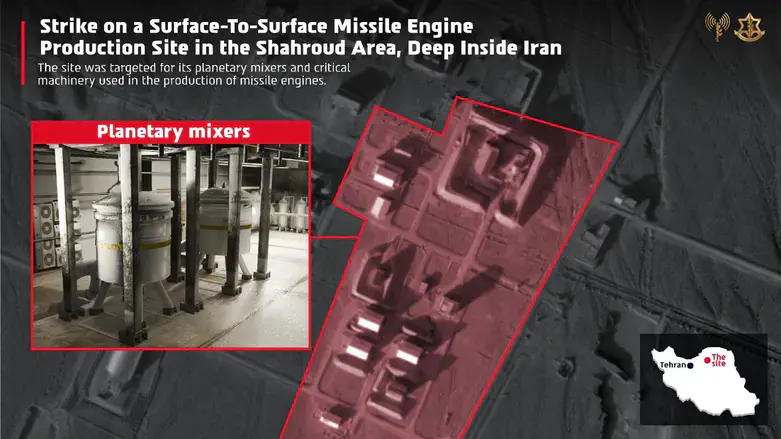
Iran’s ballistic missile program is not theoretical. It is active, expanding, and regionally consequential. Israel lies within range. So do U.S. forces in the region. So do Gulf states and critical global energy infrastructure.
But the implications extend beyond the Middle East. Sustained disruption of oil production, maritime routes, or strategic chokepoints would reverberate through global markets.
This is not Israel’s problem alone. It is a systemic global vulnerability.
The 2019 strike on Saudi Aramco facilities at Abqaiq and Khurais demonstrated how relatively inexpensive projectiles could temporarily disrupt a significant portion of global oil production. No nuclear warhead was involved. Yet the shock was immediate and international.
Missile capability alone can generate geopolitical consequences.
Modern missile defense systems, while advanced, are not impermeable. They operate within probabilistic limits. Large-scale, coordinated salvos can strain interception capacity. Quantity becomes a strategic variable. When dozens or even hundreds of ballistic missiles are launched simultaneously, the probability of penetration increases - even against capable defensive networks.
In that context, the missile force itself constitutes a major strategic instrument independent of the nuclear file.
The dual-use nature of ballistic systems intensifies the problem. The same missile that carries a conventional payload today can carry a nuclear warhead tomorrow. Limiting enrichment without constraining missile capability may delay breakout timelines, but it leaves intact the infrastructure that makes nuclear capability militarily meaningful.
Deterrence rests not merely on possession, but on credible delivery.
Since 1945, nuclear weapons have functioned primarily as instruments of deterrence rather than battlefield tools. Once multiple states acquired them, their use became constrained by the logic of mutual destruction. Classical deterrence theory assumes leaderships ultimately prioritize regime survival and state continuity.
Iran presents a more complicated case:
Its governing doctrine is rooted in a revolutionary religious ideology that frames conflict not purely in geopolitical terms but in theological and civilizational ones. When strategic objectives are intertwined with transcendent mission, cost-benefit calculations may not align neatly with classical deterrence assumptions. This does not imply inevitability of nuclear use. But it does elevate uncertainty. It explains why the United States is willing to risk serious confrontation over this issue: the concern is not merely capability, but the interaction between capability and worldview.
The margin for error is thinner when deterrence assumptions are less predictable.
There is also a structural weakness in the emerging diplomatic posture:
The United States appears eager to secure a diplomatic outcome and has signaled flexibility regarding enrichment ceilings. Rather than insisting on zero enrichment, negotiators may accept limited enrichment capped at defined percentages and quantities.
But verification logic suggests a hard truth: it is more difficult to cheat when the requirement is zero.
Zero enrichment creates a binary condition. Any enrichment activity constitutes a clear violation.
Permitting limited enrichment introduces gray zones. Incremental deviations can be concealed within permitted activity. Measurement tolerances become politically contested. Monitoring becomes more complex. The gap between allowed capacity and breakout capacity narrows.
The constraint structure itself affects the ease of concealment.
None of this diminishes the importance of enrichment limits. They remain necessary. But a framework that tolerates limited enrichment while leaving ballistic missile capability largely intact risks optimizing the wrong variable.
-If the objective is diplomatic optics - measured in negotiated percentages and signed documents - the current approach may deliver a temporary success.
-If the objective is reducing long-term strategic risk and preventing the next regional shock from cascading into a global crisis, then ballistic missile capability must move to the center of the discussion.
Diplomacy that overlooks the vector misunderstands the weapon.
And diplomacy that optimizes the wrong variable may win the agreement - while preserving the architecture of the next confrontation.