

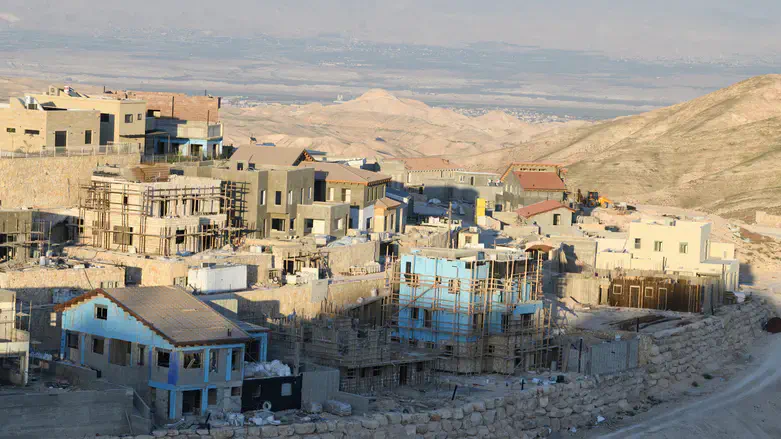
The Yesha Council published its annual population report today (Friday), indicating that as of January 2026, the Israeli population in Judea and Samaria stands at 540,327 residents in approximately 150 communities.
According to the data, in 2025, the population increased by 10,623 people. According to estimates by the Central Bureau of Statistics, by December 31, 2025, the population of Israel was estimated at around 10.028 million citizens. Therefore, residents of Judea and Samaria make up about 5.25% of Israel's total population.
In the recent war, 925 soldiers were killed since October 7, including 124 from Judea and Samaria, representing 13.4% of the total casualties.
According to the CBS, in 2025 the population growth rate in Israel was 1.1%, while in Judea and Samaria, the population growth rate was around 2.01%.
In the last decade, the population in Judea and Samaria has increased by 134,683 residents, a 33% increase.
The largest settlements in Judea and Samaria are the cities (by size): Modi'in Illit, Beitar Illit, Ma'ale Adumim, and Ariel, which together house 230,252 residents. These cities experienced a growth of 1.75% in the past year and account for 42.6% of the region's population.
In the local councils of Judea and Samaria, there are a total of 122,463 residents, which make up 22.7% of the total population in the area. The largest local council is Giv'at Ze'ev with 25,646 residents, followed by Efrat with 13,484 residents, and Karnei Shomron with 11,203 residents.
In the regional councils spread across most of the area, 187,582 residents live, making up 34.7% of the total population. The regional council with the highest number of residents is the Binyamin Regional Council, followed by Shomron, Gush Etzion, Har Hebron, the Jordan Valley, and Migilot.
The largest community that is not a local council or city is Tel Zion, with 7,442 residents. Following it are the settlements of Talmon with 6,299 residents, Shiloh with 6,214 residents, Alon Zahav with 5,747 residents, and Kfar Adumim with 5,271 residents.
The community with the most significant growth percentage is Nahaliel (Binyamin), with a growth rate of 24.6%, followed by Megdalim (Shomron) with 15.8%, Talem (Har Hebron) with 12.6%, and Kiryat Netafim in Shomron with 12.3%.
The Jordan Valley Regional Council recorded the highest growth rate this year with 4.6%, followed by the Gush Etzion Regional Council with a 3.8% growth rate.
The local council with the highest growth in percentage terms is Emmanuel, with about 10.2% growth, followed by two councils experiencing a construction boom-Ma'ale Ephraim with 6.7% and Beit Aryeh with 3.4% growth.
Israeli council leader and Yesha Council Chairman, Yisrael Ganz, responded to the data and said, "Judea and Samaria continue to grow and develop by leaps and bounds, in construction, infrastructure, and with a steadily increasing quality population. According to our forecasts, next year we will see an even greater increase, due to the extensive construction taking place now throughout Judea and Samaria."
He added, "Especially now, after a long war and in the face of those who seek to destroy us, the growth in this strategic heartland shows the victory of the people of Israel. This is a clear message to our enemies that we are here to stay and strengthen our hold on the land of our forefathers."
Ganz warned, "This victory cannot remain merely a demographic fact; it must also be reflected in the basic civil rights of the residents in the area. We are approaching 600,000 residents who still do not have the right to equality as full citizens of the State of Israel. It is time to grant the residents of Judea and Samaria the rights they deserve, apply full sovereignty across the area, and thereby strengthen the security of the entire State of Israel."