
Edited by B. Silberstein
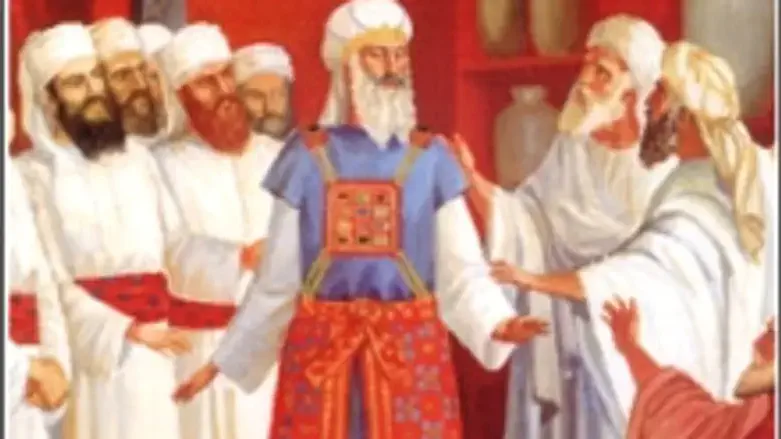
This week’s Parsha, Tetzaveh, continues with the theme of the Mishkan (Tabernacle), discussing the special garments to be worn by the Kohanim (priests) when performing the service in the Mishkan and Beit HaMikdash (Holy Temple).
Garments and Holiness
The “ordinary" Kohein donned four garments, while the Kohein Gadol (chief Kohein) wore eight. These articles of clothing were essential to the performance of the Avodat HaKodesh (sacred service). A Kohein was not permitted to enact any element of the service if he was not garbed in the priestly vestments. It can be said that his particular holiness was incomplete unless he was dressed in the specified clothing.
The question arises, why are externals such as dress so important? In general, Judaism does not seem too interested in outward appearances. This is in sharp contradistinction to the attitude of contemporary society. Fashion is a multibillion-dollar industry that is based on the premise that people buy more clothing than they need. They get rid of perfectly good garments simply because they have become outdated by the latest style.
Clothing and the Human Image
It would seem that clothing is not just a necessity; it also has profound psychological significance. Each person has a sense of uniqueness and seeks to express it by projecting a certain public image. A major component of this image is his or her “look," and clothing is essential to creating the picture each person wants to display to the world. This is why style is so important. Even though the clothing is undamaged, people are easily bored by their projected image, and they yearn for something new.
Many people love to go shopping or “just browsing." Buying a new garment, even a minor one, can lift one’s spirits. Indeed, it is often referred to as a “pick-me-up." That’s why the words “Sale" and “Clearance" elicit great excitement. The idea of getting new stuff at reduced prices is irresistible.
Since the Torah provides guidance in all areas of life, we should ask, What is the attitude toward clothing? Is there anything wrong with trying to look one’s best and constantly keeping up with the latest style?
Moderation and Tzniut
In my opinion, there is nothing wrong with dressing fashionably; however, the philosophy of moderation should apply. We should not go to the extreme of denial nor to the extreme of excess. People do have a legitimate sense of individuality and, within reason, may express it in the styles that are most appealing to them.
This moderation regarding clothing is also expressed with Tzniut (modesty) which balances the legitimate desire to express individuality and look one's best with the higher value of inner dignity and holiness. Beyond covering one’s body, true Tzniut is an expression of one’s spiritual perfection rather than a vehicle for drawing undue attention to oneself or bolstering one’s vanity.
In this way, even fashionable dress, when governed by modesty, becomes an expression of self-respect and reverence for the divine image in which all have been created, unifying one’s external appearance with one’s obligation to pursue perfection of one’s soul. The key is that a Jew should seek to live modestly and to present a beautiful inner and outer appearance.
It should be noted that, if people are concerned with how they look, they should take care of their bodies and stay in good shape, as this enhances their appearance more significantly than clothing.
The problem with extreme involvement in stylishness, as I see it, is expressed in the philosophy, ‘Clothes make the man.’ The danger is that people may identify with the external image they project, rather than focusing on their inner qualities.
For example, someone can adopt a very religious form of dress, and this may give him a false feeling of piety. An imaginary sense of righteousness can impede a person from engaging in the difficult work necessary to bring about genuine inner improvement. One should not take too seriously the superficial image one projects based on the “externals."
Honor and Glory in the Service of Hashem
We can now understand the special role that garments played in the Temple service. Before doing his work, the Kohein had to divest himself of his regular clothes, which reflect the outer, superficial dimension of the human personality. He could not derive comfort from his personal image. Rather, he had to be aware that his real nature was contained in his soul, which was fashioned in the Tzelem Elokim (“image of G-d").
Hashem commanded Moshe:
“You shall make holy garments for your Aharon, your brother; for honor and for glory." (Shemot 28:2)
The Ramban (Nachmanides) explains that these "holy garments for honor and for glory" were modeled after the royal attire worn by kings and nobles in ancient times, such as Yosef's special multicolored coat and the multicolored robes of princesses like Tamar, daughter of David HaMelech (King David).
By dressing the Kohein Gadol in such magnificent and beautiful vestments, rich in color, intricate craftsmanship, and spiritual significance, he would be visibly distinguished and revered by the people, much like a monarch in state. Yet this elevation served a deeper purpose. It does not glorify the wearer personally, but rather, elevates the awareness that Hashem’s Presence dwells among Bnei Yisrael (Children of Israel) and the sacred service performed with exactitude on behalf of the nation, reminding all that true honor stems from being aligned with Hashem’s Will rather than man-made superficial status.
The essential honor of man is that he pursues truth and molds his personality in accordance with the way of perfection revealed by Hashem.
May we always strive to cultivate and perfect this inner dimension, expressing it in all our endeavors and even in the clothing we wear.
Shabbat Shalom.