
Alex Traiman is the CEO and Jerusalem bureau chief of the Jewish News Syndicate (JNS) and host of “Jerusalem Minute." A seasoned Israeli journalist, documentary filmmaker and startup consultant, he is an expert on Israeli politics and U.S.-Israel relations. He has interviewed top political figures, including Israeli leaders, U.S. senators and national security officials with insights featured on major networks like BBC, Bloomberg, CBS, NBC, Fox and Newsmax. A former NCAA champion fencer and Yeshiva University Sports Hall of Fame member, he made aliyah in 2004, and lives in Jerusalem with his wife and five children.
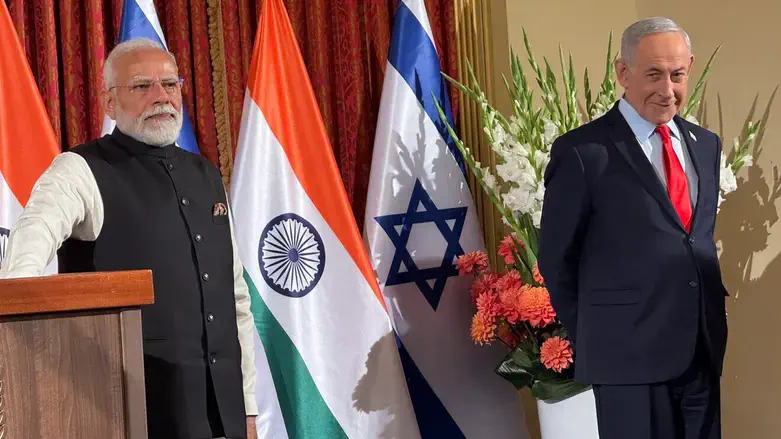
(JNS) Narendra Modi became the first prime minister of India to address Israel‘s Knesset. The strategic significance of his visit and is powerful, and the timing of it particularly noteworthy.
During his historic address on Feb. 25, the transformational leader noted that he was addressing the Israeli people “as the prime minister of India, and also as a representative of one ancient civilization addressing another. I bring with me the greetings of 1.4 billion Indians, and a message of friendship, respect and partnership."
During Modi‘s previous visit in 2017, Israeli Prime Minister Benjamin Netanyahu noted, tongue in cheek, that “together, we are 20% of the world’s population."
Israel’s entire population of nearly 10 million wouldn’t even count as a rounding error compared to India’s census. But Jerusalem’s shared values and strategic importance to the population superpower are readily apparent.
In welcoming Modi on Wednesday, Netanyahu stated that “India is a giant power of one and a half billion people. Israel is a bit smaller. But Israel is a giant, too. It is a superpower. It is a giant in spirit, a giant in deeds, capable of performing miracles. The alliance between us is a massive multiplier of the strengths of each of our countries."
“In India, there is great admiration for Israel’s resolve, courage and achievements," Modi stated in his nearly 30-minute talk. “Long before we related to each other as modern states, we were linked by ties that go back more than 2,000 years. The Book of Esther refers to India as Hodu. The Talmud records trade with India in ancient times."
The emerging India-Israel alliance comes not only at critical moments for the two nations, but amid shifts in the global balances of power.
Shifting power centers
Long-established world orders have been breaking apart in recent years. U.S. economic and foreign policy has swung like a pendulum under alternating Republican and Democratic presidents, as America’s national debt continues to skyrocket.
Europe has been suffering a demographic earthquake from mass Muslim immigration over the past decade. And in 2020, the European Union lost one of its major powers with the withdrawal of Great Britain. After years of failed liberal policies, several key European nations are beginning to experience a conservative revolution. Indeed, a major political divide has formed between staunchly nationalist Eastern European nations and globalist Western nations.
The now four-year war between Russia and Ukraine threatens European power projection, while similarly degrading Russia’s economic strength and global reputation as a world player.
In recent decades, China has emerged as a mega-superpower and perhaps the primary economic adversary of the United States. For Trump, many of his foreign-policy objectives, including in Venezuela and Greenland, relate directly to strengthening America’s position-as the leading economic, technological and military force on the global chessboard-over China.
The U.S. president is actively working to secure and divert sources of energy, rare minerals and the ability to manufacture superconductors to America and its allies-at China’s expense-as nations race to advance in the areas of artificial intelligence and quantum computing. Similarly, the president seeks to create an alternative trade route to China’s Belt and Road initiative.
World’s fastest-growing economy
Enter India. Modi stated during his address at the Knesset that “for the last few years, India has been the fastest-growing major economy in the world. Soon, we will be among the top three economies globally." This is a function of the immense size of India’s population multiplied by Modi‘s aggressive economic policies.
“At the same time," he added, “Israel is a powerhouse of innovation and technological leadership. This creates a natural foundation for a forward-looking partnership."
India has long-held policies of strategic autonomy and non-alignment. Both Trump and Netanyahu want India to remain closer to the West than to neighboring China.
An alternative trade route
The India-Middle East-European economic corridor (IMEC) portends to shift international trade dynamics. IMEC would enable goods to move from Southeast Asia via India across the Middle East, specifically via Saudi Arabia and Jordan, and on to Israel. Traveling over ground by roads and rail through the region offers possibilities to marginalize the strategic reliance on Egypt’s Suez Canal. From Israel, goods will be shipped to multiple points along the Mediterranean in Europe and on to the United States.
IMEC essentially revitalizes ancient trade routes, where Israel and India similarly served as major commerce hubs. Modi related to this history during his address at the Knesset on Wednesday.
Still, for IMEC to flourish, the Middle East needs to settle down.
Changing the Middle East
The combustible region is undergoing a complex realignment jump-started by the signing of the historic Abraham Accords normalization agreements in September 2020 with Israel and the United Arab Emirates, Bahrain and Morocco.
In the wake of the Hamas-led terrorist attacks in Israel on Oct. 7, 2023, the Jewish state has been dismantling Iran’s Shi’ite terror axis one proxy at a time: Hamas in Gaza, Hezbollah in Lebanon, and the Houthis in Yemen have all been significantly degraded.
In December 2024, the longtime regime of Syrian President Bashar Assad fell from power, and the dictator was forced into exile.
Iran, the head of the terror octopus, is in economic and domestic freefall. Its strategy of terror financing and pouring billions into nuclear weapons has backfired amid crippling global sanctions. And last June, Israel and the United States combined to strike hard at Iran’s network of air defenses, ballistic-missile capabilities and illicit nuclear facilities.
Iran stands on the brink of collapse, with internal revolt bearing a striking resemblance to the 1979 Islamic Revolution that ended in the forced exile of the pro-Western Shah Mohammed Reza Pahlavi.
Israel’s weakening of Iran and its proxies, coupled with the signing of additional normalization agreements with moderate Arab neighbors, could usher in years of regional stability and economic prosperity. Even Iran-under a more moderate government-could normalize relations with Washington and Jerusalem.
Modi’s visit comes just as America and Iran hold negotiations over the future of Iran’s nuclear program. The United States similarly seeks agreements to effectively halt the production of ballistic missiles, cease funding of regional and worldwide terror proxies, and stop murdering civilians protesting in the streets. Jerusalem believes that negotiations will soon break down and that war with Iran is inevitable.
That said, Modi’s bold expressions of support for Israel and its fight against terrorism-potentially on the eve of a regional war-serve as a tremendous counterweight to Israel’s detractors.
Common fight against Islamic radicalism
Netanyahu noted that one of the many reasons Modi receives such a warm response in the Jewish state is that “immediately after the horrific massacre on Oct. 7, immediately after that murderous attack," the Indian leader stood up “so clearly, so morally, so sharply."
“You stood by Israel," stated Netanyahu. “We will never forget that."
He added that “Israel stands, has stood and continues to stand at the forefront of civilization against radical Islam. And the home base of radical Islam is the Middle East, but the lava that has erupted from the volcano of this fanaticism is spreading rapidly to every continent, to every country. India, like Israel, has known terrorist attacks, severe terrorist attacks that claimed the lives of innocents.
“No cause can justify the murder of civilians. Nothing can justify terrorism," Modi stated. Similar to Israel, India has been forced to deal with murderous Islamic fundamentalist terrorism. Like you, we have a consistent and uncompromising policy of zero tolerance for terrorism, with no double standards," he stated.
Muslims, Western liberals and right-wing American isolationists have stood against Israel during its two-year war with Hamas, Hezbollah, the Houthis and Iran. China’s energy needs have forced the superpower into bed with Iran.
Many countries have threatened to boycott Israel over its conduct in Gaza. But not India. For Israel, having the support of India demonstrates that Israel is not alone and that America is not Israel’s only friend.
“Narendra, my friend, prime minister of India, in the face of radical Islam that threatens all of humanity and free nations, we will build together an iron alliance. An alliance of nations that advocate for moderation, progress, human dignity, and mutual respect," Netanyahu stated. “An alliance of nations that sanctify life, and are ready to fight against those who worship death and want to return us to the dark barbarism of the Middle Ages."
The energy equation
For Trump, removing Ayatollah Ali Khamenei and deposing the Islamic Republic has repercussions beyond Israel’s existential security and regional stability.
Oil extracted by a free Iran could begin to flow westward towards America and its allies, instead of directly to China. This would diminish Chinese energy supply and eliminate China’s commercial advantage of acquiring Iranian oil at below-market prices.
Energy is crucial not only to manufacturing but to AI and quantum computing, both of which require massive amounts of energy to function. These are areas where India, with its wealth of engineering expertise, and Israel seek to become leading world powers.
On the one hand, India offers Israel tremendous manufacturing capacity. Even within Israel, India has been providing increasing numbers of skilled laborers, reducing Israeli dependence on Arab labor. On the other side of the manufacturing equation, India’s population offers the world’s largest market for Israeli technology.
A technology incubator
Modi sees how Israel can serve as a technology incubator for India.
Perhaps less known, India is also an ascending space superpower. Satellites are critical for communications, intelligence-gathering and even missile defense. Collaboration offers benefits to both nations.
Israel has already demonstrated its value to India with sophisticated agriculture solutions and water conservation technology.
India is a nation with freshwater challenges. While having nearly 20% of the world’s population, the nation has access to less than 5% of the world’s freshwater resources. Several Indian provinces face acute shortages. Israeli drip irrigation, recycling and desalination technology can aid India to stretch its limited water resources now and in the future.
“Israeli expertise in precision irrigation and water management has already transformed agricultural practices in India," Modi stated.
In his address, he related to the benefits of the bilateral partnership in the years since Netanyahu has been in office, and Modi first served as the governor of Gujarat and then as the premier.
More importantly, he related to the potential for both nations and the international community in the years ahead. “Our teams are working hard to negotiate an ambitious free-trade agreement," Modi said. “It will unlock the vast untapped potential in our trade relationship."
‘Am Yisrael Chai,’ ‘Jai Hind’
Following the Knesset address on Wednesday, Netanyahu and Modi signed 16 bilateral agreements on Thursday in the areas of education, technology, agriculture and more.
The two governments announced that Israel would visit India for the next round of strategic meetings. This alliance offers the ability to be among the most transformational in the world.
In concluding his Knesset address, Modi stressed that “our shared ideals are the deep foundations that give strength to our modern partnership. We are democracies shaped by history and focused on the future. Our partnership is grounded in shared experience and shared aspirations."
The leader ended with a joint phase, the language of hope and strength: “Am Yisrael Chai. Jai Hind."
I