
There are moments when a person is not merely inspired, not merely happy, not even merely proud, but overtaken. As if something ancient inside him, something older than his own life, rises like a tide and says, Stop. Look. Listen. Remember. Feel what you have. And in those moments, I feel it with a force that almost hurts: an overflowing, trembling gratitude to Hashem for placing me inside the living inheritance of Am Yisrael.
I do not mean gratitude in the polite, conventional sense. Not gratitude as a slogan. Not gratitude as an abstract theological posture. I mean gratitude that feels like breath returning after suffocation. Gratitude that makes my eyes wet without warning. Gratitude that tightens my throat because the words cannot carry what the heart is trying to say. Gratitude that is not an “idea" but a revelation:
I am a Jew. I belong to this people. I was given a miraculous guidebook. And this is the greatest gift I have ever received in my life, greater than talent, greater than success, greater than health, greater than comfort, greater than the privileges of modernity.
This gratitude is not only about the land of Israel. Israel intensifies it. Israel concentrates it into one blazing visibility. But the miracle I am describing is found wherever Jews are found. It lives in Brooklyn and Boston, in London and Paris, in Toronto and Johannesburg, in Melbourne and Miami. It lives in Yerushalayim and in the Diaspora. It lives in a shtiebel, in a shul, in a yeshiva, and in every dedicated Jewish home. It lives wherever Torah is learned, wherever a Jew blesses before eating, wherever a child sings a pasuk from Tehillim, wherever a family builds its life around kedushah. The Jewish people are a portable sanctuary, and our covenant is not geographically bound; it is soul-bound.
Sometimes it hits me in Israel with almost unbearable intensity, not because holiness exists only there, but because there it is public and effortless, stitched into the ordinary fabric of life. I hear children speaking Hebrew as naturally as breathing. I see Jewish calendars governing Jewish time. I watch Jewish life unfolding not as a private refuge but as a national pulse. And something inside me whispers, Do you understand how impossible this is? I look around and feel the ground pull me down into humility, and all I want to say is, Ribbono Shel Olam, thank You for this vision, thank You for this privilege, thank You for letting me stand inside this living miracle.
Then I return to the Diaspora and I feel the same astonishment in a different register. There, the holiness is not carried by sovereignty. It is carried by loyalty. By sacrifice. By choosing to build a Jewish life when the world offers a much easier but less meaningful path. The Diaspora is its own miracle: the refusal of Jewish identity to dissolve into convenience, the refusal of Torah to become a relic, the refusal of Shabbat to be reduced to nostalgia. And I look at it and I think, We are still here. Still learning. Still singing. Still blessing. Still arguing with love. Still raising Jewish children who will carry the flame forward. That is not sociology. That is not luck. That is Hashem holding us up.
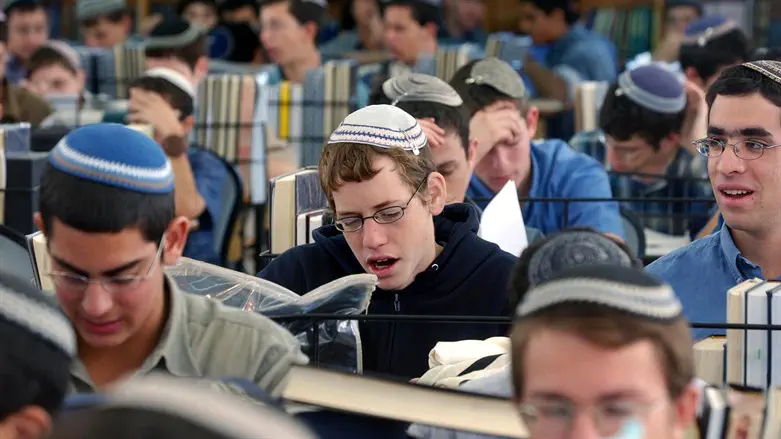
The battei midrash throughout the world undo me. There is nothing like it on earth. The beit midrash is not merely a building, not even merely a place of learning. It is a spiritual ecosystem. A factory of eternity. A chamber where time behaves differently. You walk in, and the air is thick with Torah, not as “religious content," but as living electricity. The hum of chavruta. The sharpness of minds that refuse superficiality. The intensity of voices climbing ladders into the heavens.
I can sit and enjoy it for hours. I can observe young boys hunched over a Gemara, swinging back and forth, arguing fiercely, laughing suddenly, then returning again to the text with seriousness. I can watch a rebbe, tired, underpaid, uncelebrated, pour his soul into a shiur as if the entire continuity of Sinai depends on him, because in a way it does. I can watch a beit midrash late at night, when normal human beings are asleep, and see Jews still learning as if they are keeping the world from falling apart.
But what moves me even more deeply, what forces the gratitude up from somewhere beneath speech, is the awareness that the beit midrash is not a moment; it is a chain. Not an institution but an intergenerational miracle of mind and spirit. Every page of Gemara is a map of Jewish genius. You are not merely reading words; you are standing in the presence of intellectual giants, those rare minds that reshaped how human beings reason about God, law, ethics, obligation, language, and truth.
I think of the Tannaim Rabban Gamliel, Rabbi Akiva, Rabbi Meir, Rabbi Yehudah, Rabbi Shimon bar Yochai, Rebbe-minds that could compress universes into a single line of Mishnah. I think of the Amoraim Rav and Shmuel, Abaye and Rava, Rav Ashi and Ravina-architects of the Talmud, builders of the greatest intellectual structure the Jewish people ever produced, perhaps one of the greatest structures of disciplined reasoning ever produced by mankind. I think of the Geonim, those guardians at the hinge of history, preserving Torah in the turbulent shift from Babylonian academies into dispersed Jewish life, stabilizing halakhah when the world around us was swirling and near collapsing.
And then come the Rishonim, the magnificent blaze of medieval Torah, each figure a world: Rashi, whose clarity became the Jewish people’s eyesight; Tosafot, whose daring dialectic became the Jewish people’s nerve system; the Rambam, that towering fusion of halakhic precision and philosophical grandeur; the Ramban, whose Torah contains both law and fire; Rabbeinu Yonah, the Rashba, the Ritva, the Rosh, the Ran, the Tur, and the sea of halakhic brilliance that continued to deepen and widen the covenant.
And then the Acharonim centuries of sharpening, ordering, expanding; the Beit Yosef and the Shulchan Aruch, the Rema, the Maharal, and the Gra; the Vilna Gaon, that near-supernatural mind who drank Torah like oxygen and saw the unity of all knowledge as part of the divine order. And onward: Rav Chaim Volozhin and the rebirth of the yeshiva world, Reb Chaim and the Brisker derech, the Chofetz Chaim, Rav Kook’s prophetic breadth, and Rav Soloveitchik’s majestic insistence that halakhah is not only law but also the most refined religious language of human dignity. And this is only the faint outline. Jewish learning is not one mountain; it is an entire range of peaks, generation after generation.
This is what stuns me:
Torah is not only sacred because it is commanded; it is sacred because it is brilliant. It is not a religion of slogans. It is not a religion of emotional intoxication. It is a religion of disciplined mind, of fierce moral demand, of intellectual honesty. Yiddishkeit teaches that faith is not the enemy of reason. It is the highest form of reason, aimed at the highest object: the will of God.
And then I step outside the beit midrash and see Jewish children playing, Jewish children laughing, running, teasing each other, living their innocent, ordinary lives, and something in me breaks open again. Because I know what Jewish childhood has looked like in so much of history: fear, hiding, running, humiliation, helplessness, and blood. And here, this miracle, Jewish children are just being children as a normal fact of life. In yarmulkes and sneakers. In braids and skirts. With the future in their voices. This alone is enough to bring a man to tears.
And then come the arts. There is Jewish song, Israeli melodies that sound like they contain a nation’s soul inside a tune. Songs loaded with longing, pain, victory, memory, loss, and stubborn hope. But it is bigger than music. It is the arts in general. It is the Jewish ability to take breath and turn it into beauty. To take suffering and refuse to let it have the last word. To take the human voice and make it praise.
I confess I do not have my wife’s eye for art in a museum sense. That is her gift. But I marvel at something else, something living and embodied: the Israeli dance that erupts on the beaches in Tel Aviv on Shabbat morning, young and old together, secular and religious together, bodies moving as if life itself is a form of gratitude. There is something astonishing about that scene. It is not merely recreation. It is not merely fitness. It is the Jewish soul refusing to be crushed into a single mode of existence. It is a people that prays and studies and also dances. A people that remembers tragedy and also insists on joy. A people that has learned through blood and exile that if you do not sanctify life with celebration, you will be conquered even when you survive.
And even beyond Torah and the arts, I find myself overwhelmed by something else: my gratitude for secular wisdom, for science, engineering, medicine, mathematics, and the deep wonders of the created world. Because the Rambam and the Vilna Gaon both teach, each in his own register, that all true wisdom is a gift from God. The laws of nature are not “outside" God; they are the language of His creation. To study them honestly is not heresy; it is sheer honor and awe.
When I think of the depth of science, I feel reverence. When I think of the elegance of chemistry and physics, the intricate intelligence of biology, the hidden choreography inside every cell, I feel I am peeking into Hashem’s artistry. And when I think of engineering, human beings taking raw matter and shaping it into devices, bridges, systems, solutions, I feel something almost mystical. Not mystical in the vague sense, but mystical in the sense of human beings being permitted to imitate divine creativity in miniature. To take chaos and impose order. To transform scarcity into possibility. To make the world more livable and whole.
How can a religious Jew not feel gratitude for this? How can one look at the living world-the immune system, the nervous system, the regeneration of tissue, the silent miracles unfolding in every heartbeat-and not whisper, Mah rabu ma’asecha Hashem. How great are Your works, Hashem.
Hashem gave us a guidebook that teaches us how to live inside the world without being swallowed by it; how to enjoy beauty without worshiping it; how to build greatness without becoming arrogant; how to pursue wisdom without turning wisdom itself into God. Because Yiddishkeit is not merely a “religion" in the narrow modern sense; it is an entire civilization of holiness, a total architecture of life in which even the most ordinary human acts-eating, speaking, resting, loving, teaching, working, creating-can be lifted into meaning and consecrated into purpose.
Halakhah is therefore not a cage meant to crush the human spirit; it is the blueprint of sanctification, the discipline that transforms instinct into dignity and routine into reverence. It is Hashem’s astonishing invitation to the Jewish people: not merely to believe, but to walk with the divine, to become His partner in turning the physical world into a holy dwelling place.
And now I must add something essential, because any essay about gratitude that ignores it would be incomplete to the point of dishonesty: I am grateful not only for Yiddishkeit in the abstract, but also for the Jewish home Hashem gave me to live it in. I am grateful, profoundly and constantly, for my wife, for my three sons, and for what they have taught me about love, responsibility, humility, and joy.
And what overwhelms me as I look at my sons is not only that each one is wonderful, but also that each one is different, and yet all are connected by something deeper: the ability to love, the ability to commit, and the ability to thrive and build. This is the continuity of covenant made personal. This is the Torah not only learned but also lived.
Hashem could have made me a human being floating in the modern world, raw and unclaimed, trying to invent meaning out of emptiness. He could have made me one of those people who calls himself “free" but is actually enslaved to appetite, opinion, fashion, ego, despair, and boredom. He could have made me spiritually homeless. Instead, He gave me a spectacular life. He gave me people: family, colleagues, friends, and community. He gave me smarts, vision, and passion. He gave me memory. He gave me language. He gave me law. He gave me Shabbat. He gave me the words of tefillah that Jews have whispered in hospitals, shouted in trenches, cried in pogroms, and sung in liberation. He gave me the ability to walk into a shul anywhere on earth and feel that I am not alone. He gave me the privilege of being able to say, Avraham is my father, Sarah is my mother, Sinai is my root, and Yerushalyim is my axis.
And we are here as a proud nation. Studying. Singing. Building. Blessing. Praying. Marrying. Dancing. Raising children. Writing new pages of Torah in every generation. Not because we are smart. Not because we are strong. Not because we deserve it. But because Hashem does not abandon His people. There is a line that keeps ringing in my mind: “Ki lo yitosh Hashem et amo." Hashem does not forsake His nation. And I have lived long enough to know this is not a poetic sentence. It is a fact that defies history.
There are many things in life one can be grateful for. But there is one gratitude that towers above all others, because it touches eternity: Thank You, Hashem, for making me a Jew. For giving me Yiddishkeit in Israel and in the Diaspora, wherever Jews struggle, build, learn, sing, and dance. Thank You for Torah alive in battei midrash, in the minds of giants across the generations, in the disciplined beauty of halkhah, in choirs, orchestras, and the full range of Jewish creativity, and in the secular wisdom that reveals the wonders of Your creation.
And if I have one request as I write this, it is simple: Ribbono Shel Olam, do not let me become numb. Do not let me treat Torah, Shabbat, Am Yisrael, or the privilege of being a Jew as ordinary. Let me live with memory, with discipline, with gratitude, and let me answer Your gift with loyalty, love, and joy. Because to be born a Jew is not merely to inherit a tradition. It is to inherit light, and to be responsible for joyfully keeping it burning.
Dr. Maish Yarmush is an American physician-scientist and bioengineer, known for pioneering work in biotechnology and in cellular, tissue, and organ engineering. He is Distinguished Professor of Biomedical Engineering, holder of the Paul and Mary Monroe Endowed Chair in Science and Engineering at Rutgers University, and serves as Director of the Center for Engineering in Medicine and Surgery at the Massachusetts General Hospital and Harvard Medical School. He was educated at Yeshiva University, The Rockefeller University, Yale, and MIT, and captained the BTA high school basketball team.