
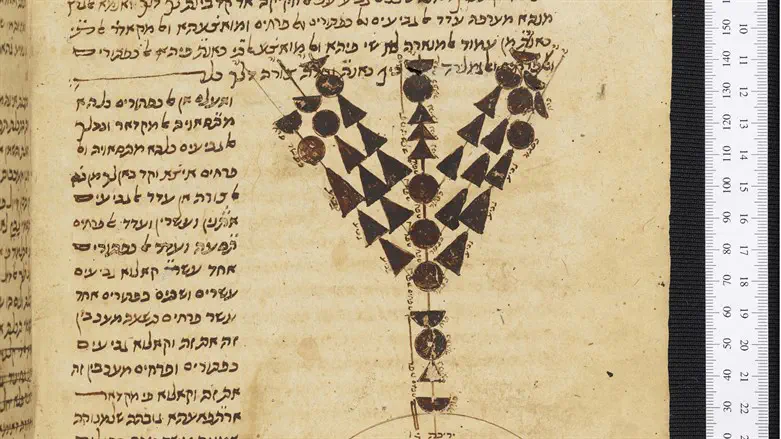
The preceding parsha - Parshat Terumah - the parsha of the command: ‘Make for Me a Sanctuary, so that I may dwell in your midst’ - concluded with the command to make the courtyard of the Sanctuary.
Our parsha - Parashat Tetzave, opens with the injunction to Moshe: ( 37:20-21 )’Now you shall command Bnei Israel that they shall take for you pure, pressed olive oil for illumination, to kindle the lamp continually, in the Tent of Assembly, outside the partition that is near the Testimonial tablets, Aaron and his sons shall arrange it from evening until morning before Hashem, an eternal decree for their generations, from Bnei Israel.’
Abarbanel queries:’Why did Hashem command here, the arrangement of the lamps - should this not have been after the construction of the Sanctuary, and the placement of the Menorah and the other utensils in their places? - further, the priesthood had not yet been given to Aaron and his sons, so why were they commanded here as to the manner of their service, and the service that they would perform in kindling the lamps, which was part of their service.
‘This whole parsha was itself repeated in Parashat Emor, with the one change - here, it began with: ’Now you shall command, whereas there it said ( 24:1-2 ): ‘ And Hashem spoke to Moshe, saying:’Command Bnei Israel, and they shall take for you pure, pressed olive oil’ - there was its proper place and time, and it was therefore unnecessarily said in our parsha.’.
The sage answers the queries he raised:’From the style of the psukim, it would appear that they did not come here to command the acts, but the intention was to command the making of the priestly garments - this is why Hashem said to Moshe:’You shall command’, meaning: you are destined to command Bnei Israel at a future time, to take for you olive oil, and for it to be placed outside the partition, and that Aaron and his sons will arrange it there, as described in our parsha - as only kohanim are permitted to perform this service.
‘This is why our parsha continues:(28:1-2) And you bring near to you Aaron your brother and his sons with him, from amidst Bnei Israel to serve Me..and make for them holy garments, for honor and glory’ as it is not proper that they should come there in ordinary clothing, to perform their holy service - therefore, it is necessary for you, to ensure the making of the proper attire.
‘The words:’Take for you’, alludes to the teaching of the Sages ( Menachot 86: ): Hashem did not need the illumination, but it was required for those who entered, to perform their holy service, to see before whom they was performing their service - as Moshe freely entered there at any time he wished, therefore it commanded that the oil be ‘pure, pressed olive oil’ - and therefore it said ‘for you’, meaning for ‘your benefit’, to enable you to see.
‘The Torah added:’to kindle the lamp continually’, which Rashi expounded as :’so that its flame would always burn’, the whole day and night, this being the meaning of ‘continually’.
‘However, our Sages expounded - in Midrash Sifra - that it referred to the western candle, which burnt at all times, and was never extinguished - and this is the view of Ramban - and it is the correct one.
‘In saying:’outside the partition’, it came to say, that it would be in the place of Assembly, where Moshe came to prophecy, or for Aaron, when he entered to kindle the incense or to kindle the lights, or to arrange the loaves on the Table or to perform his service on Yom Kippur - but not for any need of Hashem.
‘Hashem therefore commanded that it be ‘outside the partition’ - not before it, so that the kohen, when he came to kindle the candles, would not see from there the faces of the Cherubs.’
Rav Yosef Salant also comments, that:’Logically, the command to kindle the candles should have been written after the erection of the Sanctuary, and the menorah, that being its place, and not to ‘interrupt’ here, between the construction of the Sanctuary and its utensils AND the making of the holy garments - more so, as the commentators have pointed out, the proper place of this being in Parshat Emor, so why bring it here?
‘Further, in the concluding words:’An eternal decree for their generations, from Bnei Israel’ - what reason was there for the words:’from Bnei Israel’ - it would have sufficed if it merely said:’for their generations?
‘We can answer this, by looking at what was said (Menachot 102 ) as to the animal offerings:’a sweet smelling offering’ - and likewise in regard to other offerings, as long as your heart is to Hashem.
‘Should you say: He needs to eat’? did it not say ( Ps’ 50:12 )if I were hungry, I would not tell you, for the world is Mine, and the fullness thereof’., and all the beasts and cattle in it.
‘I did not tell you, to bring an animal offering, so that you would say: ‘We have done Your will, now do ours’ - you are not bringing the animal offerings to satisfy My will, but for your needs, so that, by fulfilling My mitzvah, you are obtaining atonement for your transgressions.
‘In the kindling of the Menorah and the lighting of its candles in the Sanctuary, we would not think that it is in any way for the benefit or need of Hashem, as the Gemara says:( Menachot 86: ):’And to its light, He has need? For forty years that Bnei Israel traveled in the desert, the only light was from Hashem’ - they all saw with their eyes, that He illuminated the way by His pillar of fire, every place where they camped or alighted.
‘Therefore, concludes the Gemara, it was as testimony to the world, that the Shechina resided in Israel - what was the testimony ? The western candle, which received the same amount of oil as the other candles, yet it was the first candle to be lit - and the one which concluded the lighting.
‘From thatwhich Bnei Israel saw in the desert, they knew faithfully that there was no need for them to illuminate before Hashem, and that any lighting in the Sanctuary, was in the category of חוקים: statutes the reason for which are beyond our understanding - if we ascribe to it reasons, they are only צדדיים : ‘side thoughts’, be it that it was as testimony that the Shechina resided in their midst, or to elevate their image among the nations, to say:’Israel illuminate before the One by whose lights, the whole wotld is lit’ - but on no account could it cross our mind that Hashem needs Israel to provide light for Him in the Sanctuary.
‘However, in the future, generations who will enter the Land, and will not see the clouds of glory or the pillar of fire - the world behaving in its natural manner - so that they , too, will know the truth: that Hashem has no need for their illumination, and that the mitzvah is solely for the honor and needs of Israel - as it was at the time that that the clouds of glory illuminated for them.
‘This is why it said:’for your generations’ - meaning, the generations to come, this will be a statute the reason for which is beyond our understanding.
‘This is why it concluded with the words:’from Bnei Israel’, to say: that this matter of lighting the candles , and all that comes to Hashem from Bnei Israel - be it what they give to Him, or do for Him - are all in the nature of the lighting of these candles, that we cannot, Heaven forfend, think are for Hashem’s benefit - but are all for our benefit and honor.
‘For this reason, the Torah wrote this matter here, as He wanted to command Moshe here to draw Aaron and his sons from the midst of Bnei Israel, to appoint them to serve Hashem, and to make their attire for that lofty purpose, so that they would thereby then offer the offerings and offer the incence as ‘a sweet smelling offering to Hashem’ - so that it does not cross our minds that Hashem desires our offerings because He has a need for them.
‘Hashem therefore chose Aaron and his sons, and commanded that clothes of honor and glory be made for them - in which they would perform their service - and preceded this with the mitzvah of the lighting of the candles, as from this mitzvah no-one could think that it was necessary for the benefit of Hashem, to illuminate before Him.
‘From this all would learn that all of our service of Hashem - including the offerings - are only for the benefit and honor of Bnei Israel - a message for all generations of Bnei Israel.’
The Ohr Hachaim Hakadosh proffers another reason, as to why the Torah refers in our parsha:’for you’, Moshe.
He expounds:’The midrash relates that the mockers of the generation were casting aspersions om Moshe, saying:’Could the Shechina really reside in something that Moshe constructed? there were even sceptics amongst Bnei Israel, as to this.
‘Even when the Shechina did reside in the Sanctuary on the First of Nissan, this - they contended - did not mean that it would reside there permanently.
‘However, the miracle of the western candle was testimony to the whole world, that the Shechina did reside in Israel - this is the meaning of ‘they will take for you’, meaning: this concerns you, as thereby your prophecy is vindicated , and is proven , by the Shechina dwelling ‘in your midst.’
The Kli Yakar brings our query - as well as others - and says:’To answer all these queries, Ramban provides an answer, thar what is said:’To kindle the lamp continually’ - refers to the western candle whiich was always lit, but the rest of the candles, were not - only from the evening till the morning.
‘From this, all of the queries can be answered - as after Hashem commanded Moshe to the Sanctuary and all its utensils, He divided the Sanctuary into three parts, on all of which he said:’And make for Me a Sanctuary, and I will dwell in your midst’.
‘The Parochet separated the Holy part from the Holy of Holies, and Moshe wanted that in each of the parts there should be something indicating that the Shechina dwelt in Israel - in the Holy of Holies, there were the Tablets of Testimony, which faithfully testified to the Shechina dwelling there, as they bore evidence of miracles, in the writing on them.
‘However, as the curtain separated them - and as no man was permitted to come there - lest the sceptics say: ‘One who wants to deceive, distances potential witnesses’, therefore Hashem was compelled to also provide in the Heichal the constant miracle of the western candle - so that all would look at it, and see from it, that the Shechina was there - which would not have been necessary, had the curtain not been there.
‘It therefore can be said, that this whole parsha is not intended to command as to the candles of the Menorah, as its proper place is in Parashat Emor - whereas here, the main command is as to the westtern candle, to instruct him that even though the curtain conceals the Tablets of Testimony, there is here also a sign by way of a constant miracle that Hashem dwells here - the western candle from which several other candles are lit, yet it itself is not depleted.
‘Thisis why the Torah gave a reason as to why this miracle was necessary:’because it stood outside the Parochet which covered the Tablets of Testimony - as the Parochet separated them place where the Tablets were located, and the rest of the Tent of Assembly.’
Rav Gedalia Schorr adds:’The objective of constructing the Sanctuary was to providea place for the Shechina to dwell here below, as it had departed when Adam HaRishon transgressed - therefore Hashem commanded now:’Make for Me a Sanctuary, so that I may dwell in your midst’ - as was His wish at Creation.
‘The dwelling of the Shechina in the Sanctuary, was by אתערותא דלעילה: ‘awakening from Above’, and after the Schechina rested amidst Bnei Israel, they were commanded to do their part - the part imposed on man, as had been the case with Adam before the sin, who was placed in the Garden ‘לעבדה ולשמרה: ‘to work it and to protect it’.
‘Our parsha details the service from the deeds of man - as Hashem yearns for the handiwork of man, and therefore the command as to the lighting of the Menorah by Aaron and his sons - Hashem leaving, as it were, at Creation, place for man’s deeds - proving that He yearned for them - and the midrash spells this out.
‘The parshiot of Terumah and Tetzave, respectively, are parshiot of the Written Torah - parshat Terumah - and the Oral Torah: parshat Tetzave.
‘Aaron the Kohen has a special connection to the Oral Torah, as the first occasion of the Oral Torah - in Parashat Ki Tissa - concerned an act - and exposition - of Aaron, and the first time a matter is written in the Torah, is a sign that it is the foundation and principal source of the matter - more so, as we read (Kings 2 ):’The lips of the Kohen protect knowledge, and Torah they will ask from his mouth’.
‘Asthe Menorah alludes to the Oral Torah, it was apt that it should be Aaron and his sons, who were to light it.’
The Be’er Mayim Chaim similarly writes:’Whilst Hashem, in His infinite goodness, wants to bless us with all the choicest blesssings, the awakening Above requires in all things, awakening down here, as this is the Divine’s rule in Creation - therefore, it was necessary that ‘Bnei israel’ - for their part, to receive the Divine blessings from Above - ‘take the pure olive oil’, and perform the mitzvot in the most honorable way, to give nachat ruach to the Creator - and He will then rain on them His blessings and chessed.’
A parting gem from Rav Moshe Feinstein:’The injunction that ‘Aaron and his sons shall set it up before Hashem’, before they were formally elevated to the priesthood, was becase the matter of the Menorah and what it comes to teach, applies to all who teach Torah, as the Menorah alludes to Torah, and it illuminates what is required to best educate children and to bring them to Torah and mitzvot - and the obligation of the teacher and the father in this holy work.
‘First, it is his obligation to light until it burns by itself, until the pupil able by himself to understand, and to grow.
‘Further, this requires that ‘the oil be pure’, free from any alien elements, so that he not be drawn to them.
‘Finally, the quantity of oil that to be used, is to be the same for each pupil, regardless of their ability, and not to assume that there is less need to pay attention to a seemingly more talented pupil - and, in the opposite case, of a less talented pupil.’
לרפואת נועם עליזה בת זהבה רבקה ונחום אלימלך רפאל בן זהבה רבקה, בתוך שאר חולי עמנו.