
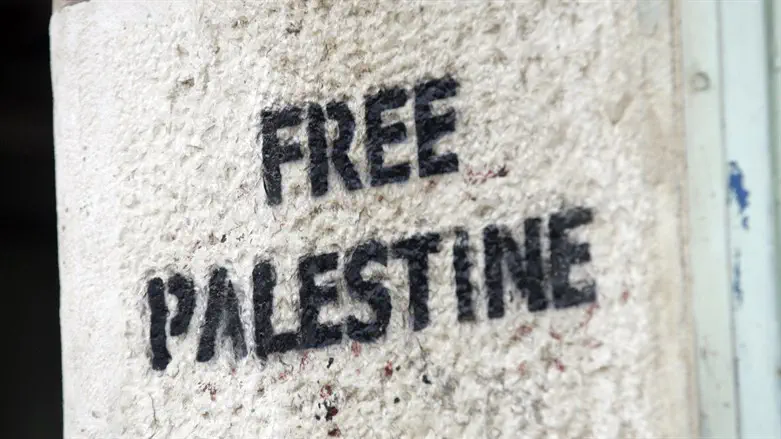
Since October 7, 2023, the Jewish people have watched an old hatred accelerate in a new costume. For millennia, Big Lies about Jews have been manufactured to justify violence against them. Pharaoh enslaved the Hebrews by branding them a fifth column. Medieval Europe spread the original Blood Libel-that Jews murdered Christian children for ritual purposes. The Nazis blamed Jews for Germany’s collapse and then “defended" themselves by exterminating six million.
The pattern is constant: invent a lie, claim fear, commit atrocities.
One of today’s versions of this ancient slander comes wrapped in the language of national liberation: the myth of an ancient “Palestinian People." According to this narrative, there once existed a distinct Palestinian Arab nation-indigenous, rooted, sovereign-cruelly dispossessed by Zionism. Repeat it often enough and it begins to sound like profound and authentic received wisdom. But history, primary documents, and the words of Arab leaders themselves tell a very different story.
Before the mid‑20th century, there is no historical record of a distinct Palestinian Arab people with its own language, history, institutions, or national identity of any form. Under the Ottomans, the area was a neglected province, administratively sliced among different districts. Local inhabitants identified by religion (Jew, Muslim, Christian) or by city (Jerusalemite, Jaffan, Nabulsi). “Palestinian" was not one of these.
Nineteenth‑century visitors such as Mark Twain and Herman Melville described the land as sparsely populated and desolate, a place of ruin rather than a supposedly thriving national Palestinian Arab state. Jewish immigration and land reclamation in the late 1800s and early 1900s brought economic revival, which in turn attracted Arab migration from neighboring areas seeking work and stability. Unfortunately for the preferred narrative, population movement rooted in basic human economics cannot retroactively invent a supposedly ancient nation.
Joan Peters, in From Time Immemorial (1984), meticulously marshaled census records and official reports to show that the overwhelming majority of the Arab population in British Mandatory Palestine were recent arrivals drawn by Jewish development, not long‑rooted “natives". Sha’i ben‑Tekoa’s Phantom Nation (2012) tracked the emergence of a “Palestinian people" as a political invention of the mid‑20th century-an identity retrofitted to serve a campaign against ancient Jewish ties to the land and modern sovereignty.
If there truly had been a continuous, self‑conscious Palestinian Arab nation, where are its kings, chronicles, or coins? Where are its archaeology, literature or liturgy? That mythical archive is thunderously silent. That damning silence is broken by the simple admissions of both early and contemporary Arab leaders explicitly rejecting a separate Palestinian identity.
-In 1919, the General Syrian Congress petitioned the King‑Crane Commission: “We ask that there should be no separation of the southern part of Syria, known as Palestine, from the Syrian country." Palestine, in their words, was simply southern Syria.
-In 1946, prominent Lebanese‑American historian Prof. Philip Hitti told the Anglo‑American Committee of Inquiry: “There is no such thing as Palestine in history; absolutely not."
-In 1977, senior PLO official Zuhair Mohsen told the Dutch newspaper Trouw: “The Palestinian people does not exist. We are all part of one people, the Arab nation… The existence of a separate Palestinian identity is only for political reasons."
-More recently, Hamas official Fathi Hammad acknowledged in a televised speech that “half of the Palestinians are Egyptians and the other half are Saudis… We are Arabs."
These are not Zionist talking points; they are candid statements from Arab leaders flatly rejecting the fantastical notion of “Palestinians".
The very term “Palestine" is not Arab in origin. After crushing the Bar Kokhba revolt in 135 CE, the enraged Roman emperor Hadrian deliberately erased “Judea" from the map and renamed it Syria Palaestina after Israel’s ancient enemies, the Philistines, in an attempt to sever troublesome Jewish ties to the Land of Israel. Over the following millennia, “Palestine" was a geographic designation used by foreign rulers, not the self‑description of a distinct and indigenous people. It is a bitter historical irony that this Roman act of Jew-erasure has been revived as supposed proof of a hithertofore non-existent nation whose much-touted existence indicts today’s Jews as "illegal occupiers" in their ancient homeland.
The Jewish people preserved an unbroken religious, cultural, and emotional attachment to the Land of Israel throughout a 2000-year exile. The Arab “Palestinian People" as a national identity only crystallized in the mid 1960’s in opposition to the Jews’ modern national renaissance-and particularly in opposition to the existence of a Jewish state in the exclusively Arab Middle East. There are those who wish to ignore the data and history-based approaches as exemplified by serious researchers like Peters and Tekoa, and claim that there has always been an Arab polity in Palestine. Notwithstanding the impressive pathos of those who make such fanciful claims on BBC and at the UN, a thin thread of geographic presence by some Arab families offers as much proof of an ancient Palestinian Arab nation as Star Wars proves the existence of aliens.
The Big Lie here is not merely that there was such a nation when there was not. It is the claim that the Jews stole another people’s homeland and now occupy it illegitimately-that Israel’s very existence is a crime. Once that lie is embraced, every act of Jewish self‑defense becomes “aggression," and every call to dismantle the world’s only Jewish state becomes a noble plea for “justice."
In Part 2, we will see how this myth of dispossessed natives was carefully woven into “international law," and how legal language itself has been perverted and then enslaved in the service of a new Blood Libel.
Daniel Winston is a therapist and writer living in Northern Samaria, Israel and can be reached at DanielWinston.com.