
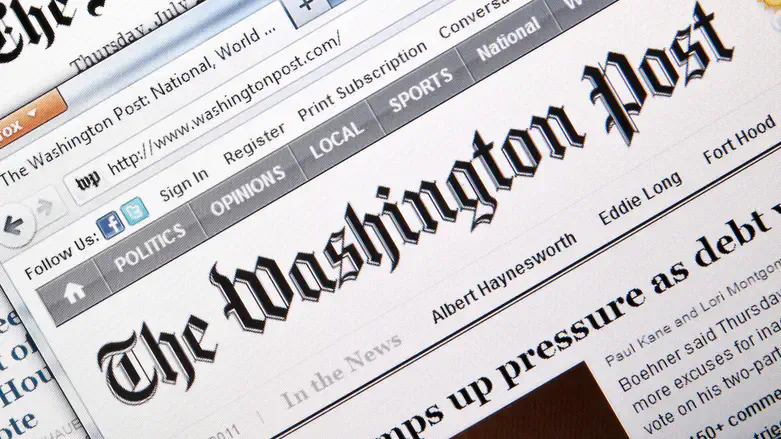
Marc Thiessen’s recent opinion piece in the Washington Post is not a serious analysis but rather a collection of inaccurate claims, superficial interpretations, and a clear lack of understanding of both the realities inside Iran and the decision-making structure of the United States government. By recycling misleading narratives, the author attempts to cover the failures of the outdated and unsuccessful policies of his own camp with a political attack on Kari Lake.
The first major distortion is his analysis of the restructuring and downsizing of the Voice of America. In reality, the changes there were not rooted in personal initiatives but the direct implementation of an executive order by President Donald Trump aimed at downsizing the federal government and preventing wasteful spending of taxpayer money.
For years, large budgets at Voice of America’s (VOA) Persian Service were spent on programs that not only failed to advance American interests, but in some cases turned into platforms supporting specific opposition groups or individuals in Iran.
As the head of The United States Agency for Global Media (USAGM), Kari Lake was tasked with carrying out efficient operations and conveying the United States’ policies, and she did precisely what the president had directed her to do.
Second, contrary to Thiessen's claims, VOA Persian is neither shut down nor handicapped. The outlet currently produces three hours of live television programming every day and maintains 24-hour digital coverage. Concrete plans are also underway to expand the programming up to 24-hour television broadcasting in the near future, which will include reports on US civic society.
More important than the number of broadcast hours is their quality and direction. For the first time, VOA Persian is representing American policies, values, and interests rather than serving as a megaphone for select factions within the Iranian opposition.
This shift has been received positively by many viewers and has repositioned VOA as a platform that actively counters disinformation, fake news and anti-American narratives - precisely the kind of change that appears to trouble the op-ed’s author.
Third, the claim that Radio Farda’s broadcasts from Kuwait were cut off is inaccurate. Based on reliable research and reporting from Iran, Radio Farda’s transmissions from Kuwait have continued. The author’s narrative is either careless or deliberately constructed to manufacture a fake crisis. Repeating such allegations without evidence amounts to political messaging rather than investigative journalism.
The most significant flaw in the article - revealing the author’s deep misunderstanding of internal Iranian conditions - is his point on the Open Technology Fund and VPN (Virtual Private Network) services. The article presents VPN funding as the key to maintaining Iranians’ access to the world, which would be true if it could not be shut down. Yet during the Iranian uprising in late December and January, the regime imposed a near-total internet blackout. When the internet itself is completely shut down, VPNs are functionally useless.
In such conditions, only satellite-based solutions like Starlink terminals can restore connectivity. Allocating large sums of money to VPN services amid digital blackout has no practical effect and primarily benefits middlemen - the companies providing those services. Ignoring this reality fundamentally weakens the author’s argument.
Ultimately, the attack on Kari Lake is an indirect attack on President Trump’s policies. Lake is faithfully executing the president’s agenda. Figures like Marc Thiessen as a member of Radio Free Europe/Radio Liberty’s board of directors - who during the presidency of George W. Bush supported prolonged, costly, and ultimately unsuccessful wars in the Middle East - have now reemerged with the same outdated mindset.
Their opposition to Kari Lake is not rooted in concern for the Iranian people, but in dissatisfaction with the dismantling of projects that consumed billions of taxpayer dollars while producing little beyond instability.
Mr. Thiessen’s opinion piece is less of an exposé and more of an attempt to revive failed policies of the past, and undermine an approach that - whether the author likes it or not - prioritizes efficiency, transparency, and the genuine interests of the United States.
That is the way to encourage the people of Iran to support a change in their homeland.
Dr. Reza Parchizadeh is a political theorist and security analyst specializing in Iran, U.S. foreign policy, and strategic communications. He has provided policy advice and analysis to the U.S. government and members of Congress on Iran-related security and regional issues. Since 2018, he has been a regular expert analyst for Voice of America Persian, offering commentary on Iranian politics, regional dynamics, and U.S. policy toward Tehran.