
Rabbi Moshe D. Lichtman, who made aliya iin 1991, has made many Torah works such as Eim HaBanim Semeichah and An Angel Among Men available to the Engliish speaking public, teaches in post-high school programs and lectures widely in Israel.
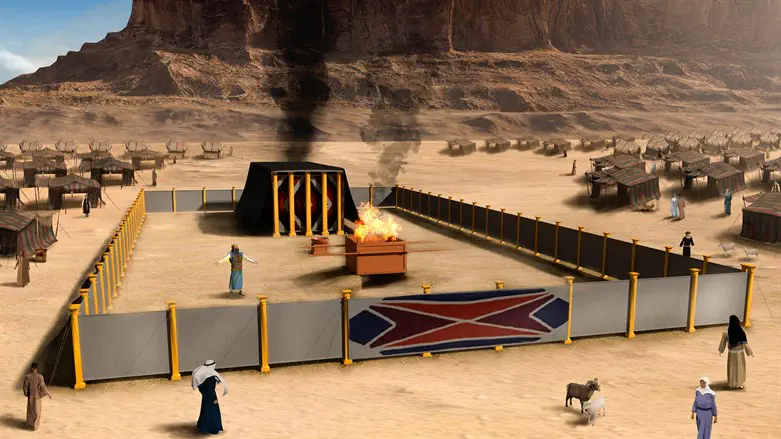
In Parashat Mishpatim we encounter the mitzvah of Shemittah whose fulfillment depends on a majority of Jews living in Eretz Yisrael. Similarly, Parshiiyot Teruma and Tetzave also contain such a mitzvah. The Torah states, “They shall make for Me a Sanctuary (מקדש), that I may dwell among them" (25:8). Sefer HaChinuch (Mitzvah 95) writes that this is the source for the positive commandment “to build a house for the sake of Hashem... where we can offer our sacrifices to Him..."
After a lengthy discussion on the purpose of the Beit HaMikdash and sacrifices, the author writes, “This mitzvah applies when the majority of Jews [dwell] in their Land, and it is one of those mitzvot which are not incumbent upon the individual, but on the community."
R. Yehoshua of Kutno, author of “Responsa Yeshu’ot Malko," points out a formidable contradiction to this determination. It is well known that relatively few Jews returned to Zion at the end of the seventy-year Babylonian exile. The book of Ezra (2:64-65) states that only 42,360 Jews returned; the rest chose to remain in exile. Even at the peak of Jewish settlement, it is estimated that only about two million Jews lived in Eretz Yisrael, while seven million lived in Asia Minor (R. Shalom Gold, “Man, Woman or Child;" Viewpoint; Summer 1998). In fact, Chazal state in many places that this is why the Second Temple did not last. For example, the Talmud (Yoma 9b) relates this story:
Reish Lakish was swimming in the Jordan River. Rabba bar Bar-Chanah came along and gave him his hand [to help him out of the river]. [Reish Lakish] said, “By God, I hate you , as it is written, If she be a wall, we will build upon her a battlement of silver; and if she be a door, we will enclose her with a cedar board (Shir HaShirim 8:9): Had you made yourselves like a wall and ascended all together at the time of Ezra, you would have been compared to silver, which does not decay. Now that you went up like doors, you were compared to cedar wood, which decays .
How, then, did Ezra and Nechemyah build the Second Beit HaMikdash? According to Sefer HaChinuch, a majority of world Jewry must live in the Land in order to do so!
R. Yehoshua Kutner answers his question based on a Gemara in Chagigah (15a):
[God] created righteous and wicked people, and He created Gan Eden (the Garden of Eden) and Gehenom (purgatory). Everyone has two portions: one in Gan Eden and one in Gehenom. If a righteous person merits it, he receives his and his friend’s portion in Gan Eden. If a wicked person so deserves, he receives his and his friend’s portion in Gehenom.
The same applies here. At the time of Ezra, all Jews had the ability and opportunity to make aliyah. The majority, however, willingly chose not to, mainly because they became too complacent in exile. Therefore, the few Jews who withstood the temptations of the Diaspora and ascended to Eretz Yisrael - in compliance with the call of the Gadol Ha’Dor (Ezra) - received not only their own “portion" in the Holy Land, but also their friends’ portions. Although quantitatively only a minority of Jews lived in the Land, qualitatively it was as if the majority dwelt there. Thus, they were able to rebuild the Holy Temple. (R. Yehoshua’s idea is found in “Itturei Torah," vol. 3, p. 210.)
(We find a similar idea elsewhere in the Torah. After describing the death of the evil spies, the Torah says, But Yehoshua son of Nun and Calev son of Yefuneh lived from the men who went to spy out the Land (BeMidbar 14:38). Rashi comments: “What does it mean, They lived from the men? It teaches that they received the spies’ portion in the Land and lived in their stead.")
There are many similarities between the return to Zion at the time of Ezra and today’s return to Zion. Both were initiated by the Gentiles (Cyrus and the Balfour Declaration); both were carried out - to a large extent - by irreligious Jews (at the time of Ezra, many of the returnees desecrated the Sabbath and married Gentiles, as the book of Ezra states explicitly); and in both cases many religious Jews refused to take part, largely because of the first two issues.
What we learn from Chazal and R. Yehoshua Kutner is that when God gives us the opportunity to return to our Homeland, we must seize it. For if we don’t, we run the risk of ruining the Redemption for all of Klal Yisrael or forfeiting our personal share in God’s special Land.
A well-known adage says, “Those who fail to learn from history are doomed to repeat it." Let us hope that we never fall into this category.