
It happened almost four months ago.
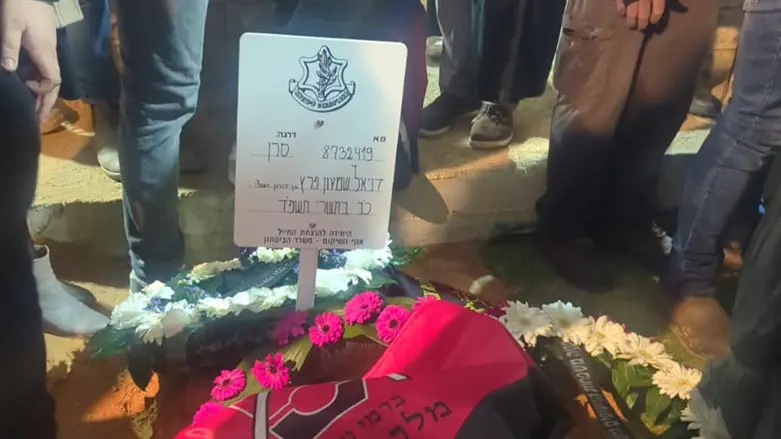
I found myself standing at the second funeral of Captain Daniel Peretz, may his memory be a blessing, a young South African-Israeli tank commander who fell while fighting Hamas terrorists and defending Kibbutz Nahal Oz. By now, many people already know Daniel’s story.
Two days earlier, his body had been returned from Gaza, after more than two years in Hamas captivity. This funeral followed the first one held a year earlier, after Daniel’s bloodied uniform was found in a tunnel, allowing the military rabbinate to declare his death according to Jewish law. I was at both funerals.
This time, like the first funeral, thousands came to Mount Herzl to pay their respects: family, friends, soldiers, youth movement members, and strangers. I stood among soldiers from Brigade 7, Daniel’s comrades, many of them fresh out of Gaza after nearly two years of fighting. Nearby were senior commanders, the former chief of staff, and the president of Israel. At the first funeral, this section of the cemetery was almost empty. Now, sadly, it is full.
And then something unexpected happened.
Matan Angrest, Daniel’s tank driver, the soldier Daniel had commanded, walked into the funeral. He had been released alive from Hamas captivity just two days earlier, after 738 days.
For a moment, everything stopped.
People froze. Some cried openly. Others laughed through tears. Soldiers embraced. It felt as though two years of tension, fear, loss, and waiting collided in a single moment. Looking around, I realized something simple but profound: we are not the same people we were before.
Looking back, the moment carries even more weight knowing what we now understand about Matan’s captivity.
During nearly two years underground, his captors beat him relentlessly. They covered his face with black sacks and left him unconscious. They told him Israel had abandoned him, that Hamas would conquer the land, and that his grandparents were dead. Every lie was meant to break him. They pressured him to convert to Islam, promising food, relief, and safety if he would abandon his faith. He refused. He later described how he clung to prayer as his last anchor, putting on a set of tephillin that he somehow demanded from his captors and prayed three times daily.
And now he was standing there, alive, unbowed, in front of the grave of the commander he had followed into battle.
Standing there, I felt an immense sense of pride. Pride to be part of this nation, part of this story unfolding before our eyes. It felt historic. Like something we’ll be talking about for generations.
In the weeks that followed, I kept seeing that same instinct play out across Israel.
I watched families return to the south, to communities that had been burned, broken, and evacuated. In places like Re’im and Nirim, people reopened schools. Farmers replanted fields that had only recently been battle zones. Teachers gathered children in temporary classrooms.
I’ve found myself increasingly aware that Jewish history is not something we study from a distance. It is unfolding around us, in real time. The stories of Abraham, Moses, King David, Judah the Maccabee, Queen Esther, they are not just ancient narratives. They are patterns. And those patterns keep repeating.
And these moments are not defined to Israel alone.
On the first night of Hanukkah, Jews gathered on Bondi Beach for a public candle lighting, a familiar and joyful scene in the heart of the local Jewish community. As the candles were being lit, a father and son affiliated with Islamic Jihad arrived with the intention of murdering Jews. More than thirty people were wounded in the attack, fifteen killed.
As the news broke, I was teaching students in Jerusalem. Many of them were Australian. One former student had been shot. Relatives of mine were meant to attend the event and changed plans at the last moment. Over the days that followed, the names of the wounded became familiar, fathers of friends, classmates, people my wife had grown up with.
What struck me most was not only the violence, but the symbolism.
Jews were attacked while lighting Hanukkah candles, a ritual about defiance, continuity, and light pushing back against darkness. It was impossible not to hear the echo of history. Different era. Same hatred. Same attempt to erase Jewish presence.
And the following night, Jews returned to the same beach and lit the candles again.
That moment felt inseparable from what I had witnessed at Mount Herzl. The same instinct. The same refusal to disappear quietly. Whether in southern Israel or on a beach in Sydney, the response was identical: we are still here.
Standing at Daniel Peretz’s funeral, watching a soldier return from captivity after refusing to surrender his identity, and later watching Jews abroad insist on public Jewish life even after an attack, I understood something clearly.
Jewish history doesn’t end where others expect it to.
That realization became the heart of History’s Greatest Comeback, a new book I have just published- an attempt to place this moment, with all its pain and complexity, into the long arc of Jewish history. Not to offer easy answers, not to minimize any suffering, but to remind ourselves that we’ve walked difficult paths before, and we didn’t walk them alone.
We are living inside the story now.
Link to the book on Amazon: https://a.co/d/05zpRg8j
David Kramer is the founder of NU, www.nucampaign.org, a social venture connecting people worldwide to the non-profit sector in Israel. He is also the author of State Of The Heart, www.state-of-the-heart.com, a book that explores the humanitarian and benevolent side of Israel (Urim Publications 2020.) He lectures extensively on Israel and lives in Jerusalem with his wife and children.