
Recently, President Donald Trump told Iran to do a deal as he hints at US strikes. Reportedly, Saudi Arabia, Qatar and Oman convinced him to “give Iran a chance."
It is disturbing that America’s so-called Arab allies intervened on behalf of Iran to avoid decisive military action by President Trump. The ayatollah regime has American blood on its hands. Moreover, the ayatollah regime has reportedly been slaughtering thousands of innocent people in the streets of Iran.
President Trump should not strike a deal with the ayatollahs. He should strike the ayatollah regime.
Saudi Arabia, the United Arab Emirates and the rest of the Gulf states, don't want the ayatollahs in Iran to fall. They don't want chaos. They prioritize stability above all else.
The Iranian Revolution was in 1979. So the ayatollahs have been running Iran for as long as the House of Saud had been running Saudi Arabia back in 1979. Furthermore, Britain ended the protectorate over the Trucial States in the Gulf in the early 1970s, and they became the United Arab Emirates. So to the monarchs of the United Arab Emirates, the ayatollahs have been essentially around as long as they have been running the Emirates. So if US strikes could enable a revolution to destroy the ayatollah regime, it risks giving people in the Emirates and Saudi Arabia the notion that maybe the same thing might be doable in their own countries.
It is possible to have an accommodation even with certain types of odious regimes. The problem for the world with the ayatollah regime is that it claims global jurisdiction. Thus the ayatollah regime in its early stages went to blow up a Jewish Community Center in Argentina, which is a long way from the Middle East. When the Putin regime came to power, no one worried its operatives would seize people in the US Embassy in Moscow.
During the recent Iranian protests, the son of the late Shah, Crown Prince Reza Pahlavi, was able to call out a lot of people onto the streets, and there seem to be in the protests many people who appear keen to see a restoration of the Iranian monarchy. There are different ethnic factions in Persia, and a monarchy can sometimes do a good job of presiding over various factions like that. If that were to be the case, then that could be the solution. All that is required to pull this off is to have regime abandonment by important elements of the existing regime; however, that is yet to happen in Iran.
The Iranian uprising is so far not comparable with the period of violent civil unrest in Romania during December 1989 in which over one thousand people died and thousands more were injured. The uprising started in Timișoara Romania, and soon spread throughout the country with riots, street violence and murders over the course of roughly a week leading to the execution of the Romanian dictator, Nicolae Ceaușescu, and his wife, and ending 42 years of Communist rule in Romania. Everything quickly unraveled, because generals and apparatchiks decided that Ceaușescu was a loser and they weren't going down with him.
It is not clear yet how many powerful Iranians have figured that the Supreme Leader Ayatollah Ali Khamenei is in a similar situation.
Moreover, the Islamic Revolutionary Guard Corps (the IRGC) may decide to shift Khamenei aside, and put a weakling sock puppet, some Joe Biden type in as the not-so-supreme Supreme Leader.
President Trump said recently the ayatollah regime promised him that the executions of protesters would stop. Trump isn't stupid. He knows he is dealing with liars. Remember, Trump bombed Iran’s nuclear facilities for a reason. Military action against Iran is NOT off the table. No matter how much the Emiratis, the Qataris and the Saudis cry about it.
Iran bestrides the Strait of Hormuz, the narrow reach of sea that is one of the most important places on earth for the energy that keeps the world lit, heated and moving. Each year, around 20% of the world's oil and a vast share of its liquefied gas are forced through its channel; 96 miles long and barely 21 miles wide at its narrowest. Were it to close, even briefly, the shock could send prices spiking and governments panicking.
This is yet one more paradox of the ayatollah regime: Externally, Iran sits astride one of the world's great strategic arteries, capable of shaking the global economy; internally, Iran is imploding. The ayatollah regime’s legitimacy has bled out. Its authority now rests not on belief but on killings, rape, truncheons and prison cells. Its death may not be imminent, but it will come, and it is incumbent on the US to help orchestrate it.
In January 2026, Pahlavi declared he was confident the ayatollah regime is finished. He told a news conference in Washington: 'The Islamic Republic will fall - not if, but when,' For decades, he has been campaigning for intervention to oust the ayatollahs and he has offered to lead a transition to democracy. He pledged: 'I will return to Iran.'
Moreover, before the end of the ayatollah regime, there will be more blood and more chaos. Dying regimes are often at their most dangerous in the period between loss of public consent and actual collapse. They still have the guns - and they still command the men willing to fire them.
Even by the regime's own estimates, 3,117 protesters have been killed as of January 25, 2026, making it one of the greatest massacres in the Islamic Republic's history. The Guardian, a UK periodical, on January 27, 2026 reported disappeared bodies, mass burials and 30,000 dead, and that testimony from medics, morgue and graveyard staff revealed huge efforts to conceal systematic killing of protesters.
In America, Trump watched the protests with rising fury. First, he urged Iranians to keep protesting, stating that 'help is on its way' before then warning the ayatollahs that executions - particularly of 26-year-old protester Erfan Soltani, whom the regime had scheduled for hanging after a sham judicial process - would bring 'very strong action'.
President Trump’s statements were not platitudes of vague support, they were unambiguous promises. Iranians heard him. Those inside felt emboldened, they rose up harder. Those outside the country looked on expectantly, waiting for him to act.
Now, it appears Trump has offered the ayatollahs an off-ramp via a negotiated deal and they have taken it; however, his comments could be a feint designed to lull the ayatollah regime into a false sense of security, while he put resources in place for a strike.
Remember, he did the same in June 2025, when he said that 'maybe US intervention isn't necessary' in Iran (as Israel attacked the ayatollah regime) and that he was 'considering a ceasefire'. Days later he rained destruction down on Iran's nuclear facilities.
Either way, one thing remains clear: the ayatollah regime has entered a security-state phase. The regime has essentially imposed martial law; terrorizing protesters off the streets. Nevertheless, every execution, every blood-soaked street widens the gulf between ruler and ruled. Consent has been replaced by coercion; legitimacy by fear.
In many countries in the West, the temptation is to treat Iran's internal crisis as tragic but contained, and its external menace as a separate, manageable problem; however, this division is an illusion. A state that survives by terror at home will project that terror abroad. A regime that governs through fear at home will use fear as a weapon abroad. This is why backing the Iranian people against the ayatollahs is not just a moral duty but a strategic one. And it is a fight that can be won.
If the ayatollahs were truly powerful, they would close the Strait of Hormuz. They have never dared. The tankers still move. The vital artery remains open. They have blustered they have ranted, they have threatened; that is it. They know what would follow: the blowback they would get. Their restraint is so telling. This is a regime that exults in killing at home, and through its proxies like Hamas, Hezbollah and the Houthis, exults in killing abroad; however, those proxies have been dismantled by Israel and the US, and the ayatollah regime is too cowardly to strike out on its own. When it vowed 'severe revenge' on America after Trump had IRGC leader Qasem Soleimani killed in January 2020, it dared only to carry out some symbolic strikes on a US base without any fatalities.
President Trump could hit the ayatollah regime hard. He can hunt the men who run the killing machine: name more of the judges, the prison chiefs, the IRGC commanders; freeze more of their money, bar the travel of any who have escaped sanctions so far, turn them into fugitives in the world's financial system.
President Trump could also choke the IRGC's business empire: its ships, its ports, its front firms, its insurers. He can make every dollar harder to move and easier to seize. He could preempt any future internet blackout the regime might impose: push satellite links, smash jamming, flood the country with digital infrastructure. Furthermore, he could make deterrence plain through naval and air power in the Gulf: escort tankers, protect Hormuz, and preempt any mine laid, ship seized or any future massacres.
The Iranian uprising threatens both Islamist narratives and globalist control. That is why the globalist left looks away.
In February 2026, UN Secretary-General Antonio Guterres sent a congratulatory letter extending his “warmest greetings" to the ayatollahs as they shoot protesters and execute dissidents. Instead of standing with the Iranian people who are being brutalized in the streets, Guterres chose to legitimize a regime built on fear, oppression, and terror.
The failure of the ayatollah regime exposes the failure of political Islam. Supporting the Iranian people would mean admitting decades of engagement with “Islamic movements" empowered a brutal regime. That is a political and moral failure the globalist elites don’t want to own.
Iranian protesters aren’t waving leftwing slogans. They are demanding sovereignty, culture, and secularism. That makes them inconvenient to Western leftists. Speaking out would reopen questions about the Barack Obama-orchestrated nuclear deal (the treaty of catastrophe), appeasement, and legitimizing a regime that massacres its own people.
Recently, US Ambassador to Israel Mike Huckabee warned that the ayatollah regime has spent over four decades calling for the destruction of both the United States and Israel, and said those threats must be taken seriously.
In February 2026, US Ambassador to Israel Mike Huckabee, at the Conference of Presidents of Major American Jewish Organizations, said the US-Iran talks may or may not succeed, but warned that if diplomacy fails, President Trump will use military action against Iran. Peace is preferable; however, the Iranian threat will not be ignored.
In the end, the answer to how long a dying system can sustain itself through fear alone is to be found not just in the behavior of the ayatollahs but of the world. Iranians have been fighting not only for their own freedom, but for a world that rejects Islamist barbarism, that looks to the future rather than the past, and that believes in a system in which their immense talents can serve not just their own country, but humanity at large.
The rot in Iran is terminal. The ayatollah regime will fall.
President Trump, don’t strike a deal with the ayatollahs, strike the ayatollah regime.
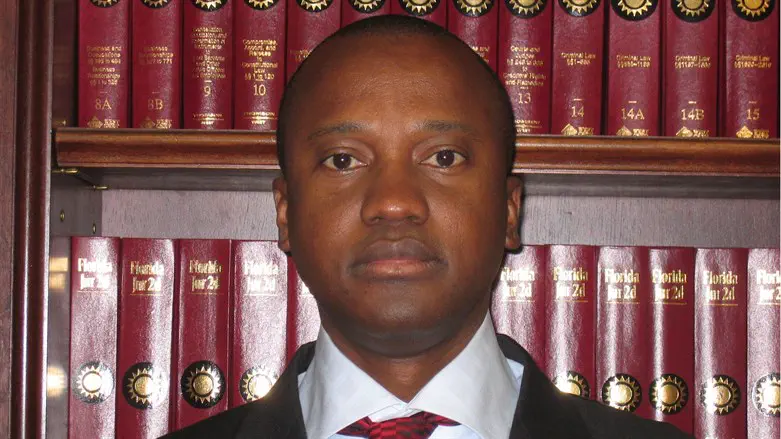
Dr. Sheyin-Stevens is a Registered Patent Attorney based in Florida, USA. He earned his Doctorate in Law from the University of Miami., Jur.D, CPA