


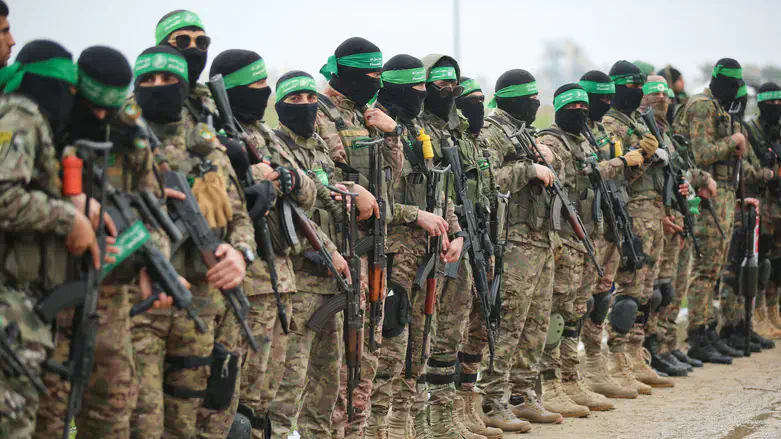
In a push to hold on to power, Hamas has appointed district governors with ties to its armed wing, replaced senior officials in key ministries, and continued collecting taxes and paying salaries in Gaza.
Two Palestinian sources with direct knowledge of the group’s operations told Reuters that five district governors were named, all linked to Hamas’ armed wing, and that senior figures in the economy and interior ministries were replaced. A new deputy health minister was also shown touring hospitals in a ministry video released this month.
Sources cited by Reuters said Hamas continues to pay public servants and fighters salaries averaging about 1,500 shekels per month, while collecting taxes from private-sector merchants, including on goods such as cigarettes and mobile phones brought into Gaza through smuggling channels.
Ismail al-Thawabta, head of the Hamas-controlled government media office, denied that the moves reflect an effort to consolidate power, saying temporary replacements were made for posts left vacant during the war in order to prevent disruption of essential services.
An Israeli military assessment, presented to Prime Minister Benjamin Netanyahu in late January and first reported by Israel's Channel 13, states that Hamas is working to preserve its influence in Gaza "from the bottom up" by embedding supporters in government offices, security bodies, and local authorities.
According to the assessment, absent Hamas disarmament, the group is likely to maintain significant influence even under a technocratic framework.
The developments have added to doubts surrounding US President Donald Trump’s peace initiative, which calls for Hamas to relinquish its weapons in exchange for an Israeli military withdrawal from Gaza. Trump’s international Board of Peace is scheduled to hold its first meeting in Washington on Thursday and is expected to review progress related to the enclave’s transitional governance.
Hamas has stated that it is prepared to transfer administrative authority to a US-backed committee of Palestinian technocrats led by Ali Shaath, a former Palestinian Authority official in Judea and Samaria. The group claims, however, that Israel has not permitted committee members to enter Gaza to begin their work.
An Israeli government official, speaking anonymously, rejected the possibility of any future Hamas role in governing Gaza, describing such a scenario as unrealistic. The Israeli military declined to comment on Hamas’ public statements.
The US State Department and Shaath’s National Committee for the Administration of Gaza did not immediately respond to requests for comment. A source close to the 15-member committee said it was aware of Hamas’ actions and dissatisfied with them.
On Saturday, the committee called on international mediators to intensify efforts to resolve outstanding issues, stating it would be unable to fulfill its mandate without full administrative and security authority.
Israeli officials say Hamas has used the October ceasefire to reassert authority in areas vacated by Israeli forces. While Israel retains control over more than half of Gaza, the majority of the enclave’s roughly 2 million residents are located in areas under Hamas control.
The military document indicates that most of Gaza’s ministries and municipalities have resumed operations compared to the height of the fighting. Hamas, which took control of Gaza in 2007, has historically overseen appointments to ministries and municipal bodies and established its own civil service structure.
Palestinian political analyst Reham Owda told Reuters that delays in allowing the technocratic committee to enter Gaza risk entrenching Hamas’ administrative and security control on the ground.