

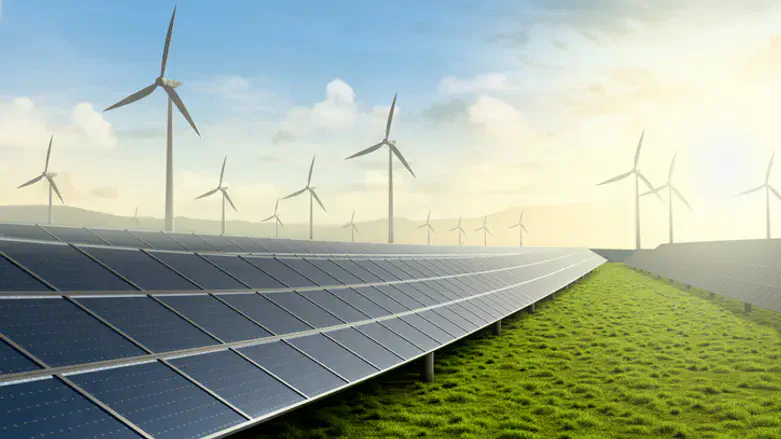
Distributed energy is rapidly becoming one of Israel’s most important strategic assets, turning small towns and regional solar‑and‑storage clusters into a security shield that backs up the economy and daily civilian life. In an isolated “electricity island" that cannot import power from neighbors, spreading generation across the country is no longer just smart engineering - it is critical defense policy.
Israel’s power system is highly concentrated, heavily reliant on a limited number of natural gas fields, central power plants, and long transmission lines running through small, exposed territory. Damage to gas infrastructure or key high‑voltage lines can trigger wide, prolonged outages that paralyze hospitals, bases, industry and digital services.
Unlike Europe, Israel is not synchronized to surrounding grids and cannot lean on cross‑border imports in an emergency, which magnifies every local disruption into a national risk. At the same time, fast‑growing electricity demand, electrification of transport, and digital dependency mean that any significant blackout today carries much higher economic and security costs than a decade ago.
Why distributed energy is a sound security policy
Distributed energy - solar on landfills, local storage, and community‑scale generation connected to the distribution grid - fundamentally changes the risk profile of the power system. It reduces “single points of failure": thousands of small renewable sites are far harder to disrupt than a handful of large power plants and gas platforms. Also, keeping power close to critical loads like hospitals, water utilities and data centers can pair on‑site solar with storage to ride through grid disturbances or intentional attacks. Furthermore, it supports islanded operations - emerging microgrids can disconnect from the national system in crises and continue operating locally, preserving civilian and operational continuity.
For Israel’s security, that means less vulnerability to targeted strikes on energy infrastructure and more flexibility to maintain functioning civilian infrastructure and command‑and‑control capacity in prolonged conflict scenarios. For communities, it translates into fewer and shorter outages, more predictable costs, and the ability to generate income from clean power even in routine times.
The role of renewables and storage
Solar and storage are at the heart of this new distributed architecture. Solar is local and modular - panels can be deployed on water reservoirs, agricultural structures, and brownfields across the country, turning unused surfaces into strategic energy assets.
Storage turns intermittent sun into firm capacity. Batteries provide fast response, frequency support, and backup during evening peaks or grid disturbances, making renewables reliable in both routine and emergency conditions.
Recent large solar‑plus‑storage clusters in Israel already demonstrate how distributed assets can support both security and economic resilience, supplying a significant share of clean power in new segments of the market while strengthening agricultural communities in the periphery. As storage costs continue to fall and control systems mature, these clusters can be orchestrated as a virtual power plant that stabilizes the grid during stress and backs up critical loads when the unexpected happens.
How distributed energy aligns with national policy
Government targets to expand renewable generation and modernize the grid explicitly link renewable energy with energy security and resilience. Expert analyses from Israel’s central bank, research and energy institutes emphasize that decentralization, microgrids, and advanced grid management are now core pillars of a resilient electricity strategy.
In this context, companies like Enlight, with a global renewable portfolio spanning solar, wind, and storage along with significant footprint across Israel’s regions, are positioned as key implementation partners in the transition from a centralized, fuel‑dependent system to a distributed, climate‑aligned, security‑grade grid. By accelerating greenfield development, deploying storage at scale, and working with local communities and businesses, such platforms help transform every new project from a pure energy asset into a piece of national infrastructure that fortifies Israel’s resilience.
From energy project to strategic infrastructure
The strategic question facing Israel is no longer whether to expand distributed renewables, but how quickly they can be integrated with modern grid infrastructure, regulation, and market design. Every additional megawatt of local solar power and each battery installed in outlying areas creates a microgrid capable of standing on its own in a crisis. These form another layer in Israel’s security shield by protecting citizens, strengthening the economy, and ensuring consistent power availability when it's most needed.