
Edited by B. Silberstein
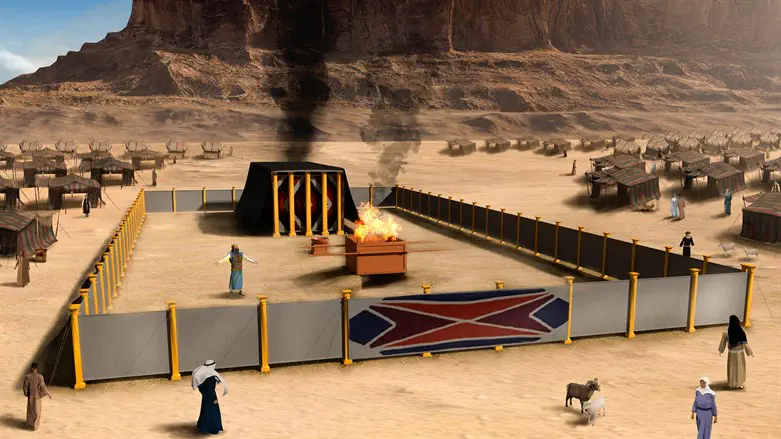
This week’s Parsha, Teruma, deals with the construction of the Mishkan (Tabernacle) in the Wilderness. Precise details were transmitted regarding the materials that were to be used, the dimensions of the structure, as well as the vessels that would be needed. The purpose of the edifice is stated at the outset:
“And they shall make for Me a Sanctuary; and I will dwell among them." (Shemot 25:8)
The Theological Problem of a “Dwelling Place"
Some questions arise. First of all, what is the meaning of the idea that G-d “dwells among us?" In addition, the manner of securing the materials for the Mishkan was unusual. Our relationship to the Creator is based on the idea of Mitzvot (commandments). The Torah, to those who believe in it, is not a book of advice and suggestions. G-d’s Will is incorporated into the six hundred and thirteen Mitzvot which we are obligated to perform.
Commandment Versus Voluntary Devotion
The concept of commandments runs counter to the mentality of modern man, including many accommodationist “rabbis." Contemporary man believes in himself, and feels that his sense of right and wrong is supreme. He dislikes the idea of an objective Truth and an absolute Ruler to Whose Will we must conform.
The Torah, however, recognizes the shallowness of this attitude, and affirms that man can elevate his nature only by submission to the Divine Will. If that is the case, we would have expected Bnei Yisrael (Children of Israel) to have been commanded to provide the objects needed for the Mishkan.
Yet, that is not the way it happened. Hashem instructed Moses to accept donations from anyone:
“Whose heart motivates him to give." (Shemot 25:2)
No one was obligated to contribute, as the giving had to come from the heart. Thus, our second question is why, in contradistinction to Tzedaka (charity), which we are mandated to give, G-d saw fit to have the Mishkan established on a purely voluntary basis.
Divine Incorporeality and the Meaning of “Dwelling"
In addressing our questions, it is important to realize that the very notion of a Mishkan is problematic. The most fundamental idea of Judaism is that G-d is absolutely incorporeal. We cannot attribute to Him any physical qualities. He Exists, Eternally, Outside of time and space.
Therefore, in a strict sense, it is idolatrous to maintain that G-d “resides" in a particular location. Yet, on a superficial level, our Parasha seems to be making the point that Hashem “dwells" in the Mishkan. How are we to reconcile this with our doctrine of Divine incorporeality?
To resolve this problem, we must pay careful attention to the exact wording of the verse. It says:
“And they shall make for Me a Sanctuary; and I will dwell among them." (Shemot 25:8)
Scripture does not state that Hashem resides in the Sanctuary, as such a notion would be blasphemous.
Rather, the verse contains two ideas: that Bnei Yisrael should make a sanctuary which is dedicated to G-d’s Name, and that if they do, He will “dwell among them." To “dwell among them" means that He will manifest His providential concern in their midst. When the people He has chosen adhere to His Torah and reflect its infinite wisdom in every area of individual and communal life, they will be worthy of His protection.
When Bnei Yisrael act in a Godly manner and all their endeavors are crowned with success, people take notice. This was the case with Yosef, whose success in the house of Potiphar was so great, that his master was convinced:
“That Hashem was with him; and that whatever he did Hashem caused to succeed in his hand." (Bereishit 39:3)
The National Mission to Sanctify G-d’s Name
The national mission of the Jewish People is to sanctify the Name of G-d in the world. When the Jews rise to this level, all mankind will seek to become holy by renouncing idolatry and hedonism and embracing worship of the True G-d, as elucidated in His Torah.
We can now understand why Bnei Yisrael were not commanded to make contributions for the building of the Mishkan. Had it been done this way, the people would have viewed the Mishkan as just another ordinary religious obligation.
The Mishkan is much more than a structure in which the sacrificial service is performed. It is, in addition, a place which serves to remind humanity of the Creator of the Universe and the moral order which He established for mankind.
In his introduction to Parashat Teruma, the great commentator Ramban (Nachmanides) explains that the Mishkan was designed to be an eternal reminder of the Revelation on Mount Sinai. There, G-d “spoke" to an entire nation which had gathered to witness the Revelation. In this encounter, the People reached an exalted level of prophecy. The experience transformed them into a “Kingdom of Priests and a Holy Nation." (Shemot 19:6)
A people of this character experiences such a love of G-d that they have an all-consuming passion to publicize His Name in the world. Only that spirit and desire could be the motivation for constructing the Mishkan. G-d, therefore, instructed Moshe to take donations only from those whose hearts elevated them to participate.
May Hashem enlighten us to elevate our souls to serve Him with love and inspire mankind to do the same.
Shabbat Shalom.