
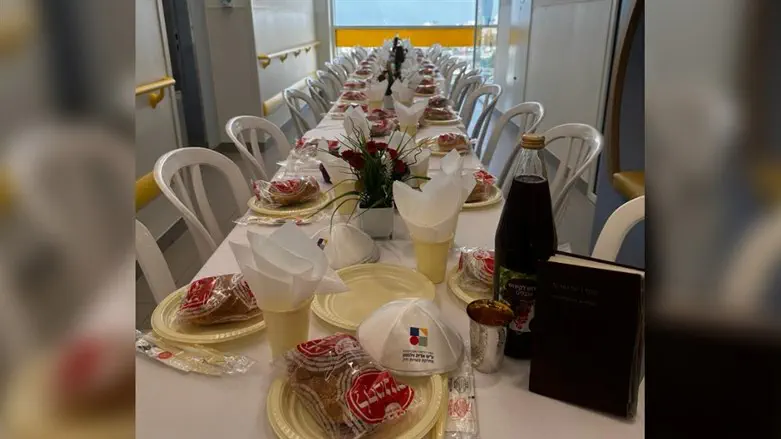
In our Parasha, Moshe is commanded:( 23:23-30)’ You shall make a Table of acacia wood, two cubits its length, a cubit its width, and a cubit and a half its heigth. You shall cover it with pure gold and you shall make for it a crown all around. You shall make for it a molding..all around and you shall make a gold crown on the molding all around. You shall make for it four rings of gold. upon the corners of its four legs.opposite the moldings, as housings for the staves..and cover them with pure gold, and the Table shall be carried through them.
‘You shall make its dishes, its spoons, its shelving-tubes, and its pillars, with which it shall be covered, of pure gold you shall make them.
‘On the Table shall you place show bread before Me always.’
Rabbeinu Bachya wonders:’We have already learned that the Ark was to fulfill a great need - to house the tablets of the law in it - and the Kaporet to cover it; the Cherubim which were from this cover, allude to the existence of angels - but the Table, what purpose did it serve and what need was there for it, in the Sanctuary and in the Temple, that required that there be a Table?
‘On a practical level, there was a need for the Table in the House of G-d, because of the bread which was placed on it, to be the root of blessing arising from it.
‘This bread, which was placed on it, was fed to the Kohanim, who served in the Sanctuary, and a little of it satiated the many, who ate of it.
‘It was therefore called שלחן: Table, because Hashem שלח: sent His blessing on thd bread that was on it, and this blessing spread from there, to the food in the whole world, and sustained all.
‘The midrash offers a different understanding: The Table was made of עצי שטים: acacia wood : the initials of ש’לום ט'ובה י’שועה מ’חילה: peace, good, salvation and forgiveness.
‘We find that in the Ark and in the Altar, all of these could be found, and - in their merit - they all come to be.
‘Likewise, they also all come by reason of the Table, as it operates as a מזבח כפרה : an altar of atonement - the bread on the Table reckoned as an offering, when a good-hearted benevolent person feeds the poor on it - and then it is referred to, in the words of the prophet (Yechezkel 41 ):’And He spoke to me: this is the Table which is before Hashem’ - first said: ‘altar’ but concluded with ‘table’ - as, when the Bet Hamikdash existed, atonement was by the offerings on the altar, but now - that we do not merit to have the Temple, a person’s atonement is ‘by his table’.
‘The custom of the French chassidim was to make their burial coffins out of their tables, as man takes nothing from all his toil, in this world, but the charity that he does here, and the goodness that he bestows around his table.’
The Midrash Aggadah offers the following insight, to our question:’You shall make a Table’: ‘Not that it was needed for eating and drinking, but rather, because the deeds of men are revealed before Him - as there are men whose only desire in this world is eating and drinking - therefore He said:’And make a Table’, and have in mind that the Table’s place is בצפון: in the north, and man’s evil inclination, yetser ha’ra, is located בצפונו : in his north, which is his left - as we read ( Kohelet 10:2): ‘the heart of the fool is in his left side’.
‘This is an allusion to those who are drawn after their yetser ha’ra, which is in his left side - which is why Hashem commanded that we lay our tefillin on our left side, to break the attraction of the yetser ha’ra.
‘This is why Hashem promises - by His prophet, Yoel - ‘I shall dostance from you הצפוני’ - the yetser ha’ra which is בצפון: in the north of a person.’
Sforno adds:’After the Torah describes the making of the Ark - which is likened to making a throne for the Shechina - as it says:’And I shall gather with you, there’ (verse 32), it commanded the making of the Table and the menorah, as was the custom, for ministers, as we read regarding the Shunamit (Melachim 2, 4:10 ):’We will place there for him a bed, a chair and a menorah’.
‘Our Sages comment, that the Table alludes to the crown of kingship, the affairs of the conduct of the nation having two aspects: The one being sitting in judgement on the subjects, and the second being to defend the country against its enemies - as it says: ( Samuel 1, 5:20:)’And our king will judge us, and go before us, to fight our battles’ - two crowns were placed on the Table: one for the Table itself, alluding to the welfare of its people, and the conduct of its affairs - and the second, as a frame, as if guarding those within it, from any external harm.’
Rav Shimshon Raphael Hirsch comments:’The fresh acacia tree - from which the Table was made - symbolizes activity which leads to welfare - but this requires that it be founded on a basis of purity, so that the resulting welfare is in the likeness of gold which has been purified.
‘The זר (zer): the crown, linguistically alludes to distancing from anything זר (zar) alien, and not sanctified.
‘The Table - as the Torah states - was itself made of only wood, except fo the gold crown adornment , to signify its distancing from anything impure, in regard to the objectives it represented.
‘This is to teach that all our material activities - those which result in welfare and profit - should be based on purity , always being alert to the lurking risk of impropriety in these activities.
‘This motif of purity - as signified by the pure gold crown - is not found in regard to any of the other items in the Sanctuary.
‘This concern on purity, is encapsulated by the Table being called השולחן הטהור: ‘the pure Table’ on which the bread was placed, ‘before Hashem’.
Abarbanel comments:’As the Sanctuary was created in the likeness of a King’s palace, therefore it had - as it were - an inner sanctum reserved exclusively for the use of the King, where his treasure and most sanctified object was kept, and where no-one else was permitted, as there was to be found the seat of the King, in which were found his throne, his Table and His menorah.
‘That is where His servants would enter to render Him service, the Table being in the likeness of the table of kings in all its opulence and glory - and where the altar on which incense was offered in the evening and in the morning, in the manner that was usual for kings, at their two mealtimes.
‘The Table was made of acacia wood, so that it was light, and easy to carry , and its length was two amot, as if for one person only to eat, as the width of a man is one ama, leaving a half ama on either side, for the two series of bread, one at each end, still leaving room for the person, to eat.
‘Each of the two sets of bread were of six loaves, as against the six days on which manna was provided for Bnei Israel in the desert, one in the morning for each person, and the second in the evening.
‘As no manna fell on Shabbat, the Kohen arranged it before Hashem.
‘The Table was one ama wide, so that the remaining place before the eater, was one ama by one ama - and its height was one-and-a half, so that the table was as the height of a person’s abdomen - as the height of a person is three amot, and from the legs to the abdomen, is one half of that.
‘The height of the Table from the ground - one and a half amot from the ground - signifies : That Hashem chose that His Table, was not ‘on the ground’ - as was the custom of some peoples, such as the Ishmaelites, but rather higher off the ground, in the manner of nobles - and more so, kings - as befits their honor.
‘The entire Table was to be covered in gold, and surrounded by a frame, and then crowned by two crowns- one around the frame, and the second one as described in the passage.
‘If we are seeking allusions in the measurements of the Table - and of the other items in the Sanctuary - the Kli Yakar has graced us with his beautiful insights.
Expounds the sage:’Let us note, that the three main items which merited to have a gold crown, being: the Ark, the Table and the Altar, regarding which our Sages say ( Yom 72: ), that they are against three crowns: the crown of Torah, the crown of the Kehuna and the crown of kingship.
‘Look around, and you will find that they are different in their measurements, in amot - the Ark, all its measurements are broken (meaning whole numbers, ed.) , the altar’s measurements are all complete, whereas some of the Table’s measurements are broken, and some are complete.
‘It appears to me, on this, that, as our Sages say: in the matter of spiritual ascent, look at that which is above you, as you will then realize that you have not reached completeness, and are less complete than your fellow man, and this will lead you be envious of him, spurring you to grow in completeness.
‘In matters of this world - physical and material matters, and matters of wealth and honor - look down, at those who have less than you, and thereby rejoice in your lot.
‘The measurements of the Ark were all broken - in length, in width and in height - to signify that three barriers affect the acquisition of wisdom: the limitations of our intellect, the depth of wisdom, and the great amount to be acquired.
‘The Table, on the other hand, alludes to kingship, and to all the material blessings that we receive from the Divine Table - here, some of the measurements are complete, to teach that we should be happy in our lot, and have been blessed by Hashem with all that we need - and, in our hearts, feel that we lack nothing , as Yaakov Avinu said:’I have everything’.
‘However, some of the measurements are broken, to teach that a person will never fill all his material desires in this world.’
‘The altar’s measurements are all complete, to signify that atonement makes the offerer complete again.
The chassidic master, the Be’er Mayim Chaim, adds:’ The Table and its allusions, all come to teach us, as to the table of a man whilst he is eating on it, that it merit to be ‘as a table before Hashem’, so that it will be an atonement for him before Hashem, like an offering on the altar - as our Sages teach:’Now that we do not merit to have a Bet Mikdash where we can bring offerings as atonement, a person’s table, atones for him’.
‘We have on several occasions brought the teaching that the main objective of a person when eating, is to be elevated from his food, from all the sparks of holiness in it - this by eating in a manner that subjugates all his material desires, as these are the marks of animals, and not fittiing to man who is created with intellect and understanding of the service of Hashem - it is not proper that he and animals should ‘eat from the same trough’, in their manner of eating.
‘If he does so, then man’s eating resembles the offerings on the altar, whose purpose is also to elevate- and to unite those things which through man’s transgressions, have separated the offender from his Source.
‘To achieve this, man must first take some assistance from Above - which is the deeper meaning of the opening words of our parsha:’’Take for Me an offering’: the word תרומה alludes to taking something elevated (ram), which, in turn, will enable our offering to ascend.
‘The thirteen items from which offerings are to be brought, allude to the Thirteen Attributes of Mercy - praying that we merit that these attributes come to our aid, so that our atonement is accepted Above’ - may we merit this grace.
A parting gem from the Chatam Sofer:’The measurements of the objects in the Sanctuary, allude to lofty matters - the broken measures of the Ark, to the תלמיד חכם: the torah scholar, whose heart should always be ‘broken’’ within him, in his service of his Creator; the measurements of the Table are complete, alluding to the supporters of Torah doing so in a wholehearted manner - whilst, in their own eyes, they should always regard themselves as incomplete in their holy endeavors - therefore, the height of the Table is a broken measure.’
לרפואת חיילי צה"ל ולרפואת נועם עליזה בת זהבה רבקה ונחום אלימלך רפאל בן זהבה רבקה, בתוך שאר חולי עמנו.