

The United Nations Development Programme (UNDP) on Wednesday launched operations to remove a large wartime garbage mound that has overtaken one of Gaza City’s oldest commercial hubs, posing significant environmental and health concerns.
Alessandro Mrakic, head of the UNDP office in Gaza, announced that crews have begun clearing the solid waste that has engulfed the historic Fras Market area. The accumulation is estimated at more than 300,000 cubic meters and rises to a height of approximately 13 meters.
The site developed after municipal workers were unable to access Gaza’s primary landfill in the Juhr al-Dik area near the border with Israel following the outbreak of war in October 2023. The Juhr al-Dik area is currently under full Israeli control.
According to UNDP, the waste will be relocated over a six-month period to a newly established temporary facility in the Abu Jarad area, south of Gaza City. The location spans roughly 75,000 square meters and has been prepared in accordance with environmental standards. It is also intended to handle routine daily waste collection. The initiative is financed by the Humanitarian Fund and the European Union’s Civil Protection and Humanitarian Aid Operations.
Gaza Municipality confirmed that the transfer process is being carried out in coordination with UNDP, describing the move as an urgent measure to address a deepening waste crisis after approximately 350,000 cubic meters of refuse accumulated in the city center.
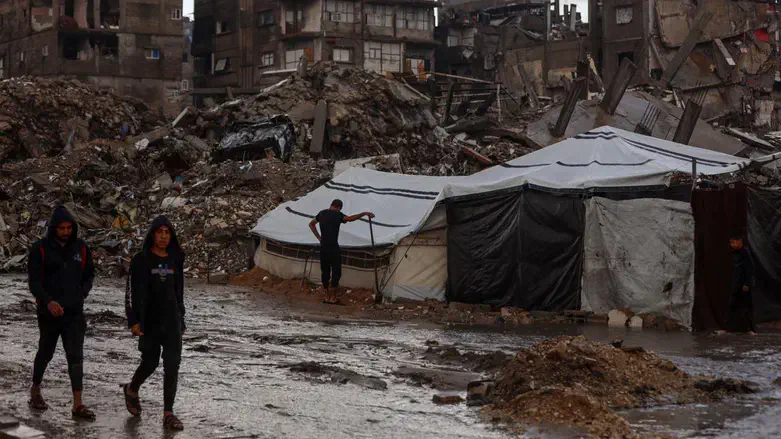
Residents were seen searching through the piles of garbage for usable items, though some expressed relief that the area would eventually be cleared. An elderly resident, Abu Issa, said the waste must be relocated far from populated areas, warning of the dangers posed by gases, disease, and germs.
Fras Market, which before the war served hundreds of thousands of residents with food, clothing, and household goods, has remained buried under refuse for more than a year.
Amjad al-Shawa, head of the Palestinian NGOs Network and a liaison with international agencies, stated that the dump contributed to serious environmental and health hazards, including the spread of insects and illness. He described the site as a symbol of the war and said its removal could provide residents with a sense of progress following the ceasefire reached last October.
Shawa added that the waste is expected to be transported to a transitional location near the former Netzarim area in central Gaza until Israeli forces withdraw from eastern sections and access to permanent landfill sites is restored.
UNDP reported that since the start of the war it has removed more than 570,000 tons of solid waste across Gaza as part of emergency efforts to prevent further public health deterioration. The number of temporary dumping locations has been reduced from 141 to 56, according to a report issued last December.
However, only a limited number of those sites remain accessible and operational, while Gaza’s two main sanitary landfills are still out of reach. UNDP warned that environmental and public health risks remain severe.