
Israel Kasnett offers expert analysis on Israeli politics, society and regional developments at JNS.org. With a deep understanding of the region, he delivers insightful commentary that challenges media bias and provides a clear perspective on Israel.
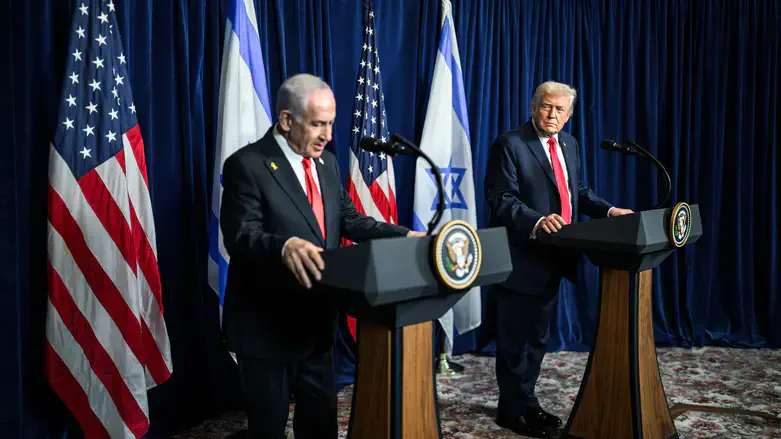
(JNS) Israeli Prime Minister Benjamin Netanyahu’s trip to Washington today for an urgent meeting with U.S. President Donald Trump underscores Israel’s deep concern that a renewed diplomatic process with Iran, moving quickly and under intense political pressure, could lead to a narrow and strategically insufficient agreement. The urgency of the moment is heightened by Trump’s decision to position a massive U.S. armada near Iran, including carrier strike groups, advanced aircraft and naval escorts in the Gulf and Arabian Sea, intended to signal resolve and back diplomacy with force.
Yet as Eytan Gilboa, an expert on U.S.-Israel relations at Bar Ilan and Reichman universities, and former Israeli National Security Adviser Meir Ben-Shabbat warn, military pressure without clear political red lines risks becoming set dressing for a deal that is expedient but dangerous. They caution that military pressure without strategic clarity risks enabling precisely the outcome Israel fears most: a narrow nuclear deal that restores Iran’s legitimacy and resources while leaving its core threats intact.
Gilboa, also a senior researcher at the BESA Center for Strategic Studies. said that Iran interprets the U.S. buildup through the prism of Trump’s overriding preference to avoid war. Tehran does not underestimate American power, but appears convinced that Trump views the threat of military force primarily as leverage.
“At the moment, Trump and Iran share a short-term interest in avoiding war," Gilboa explained. “That convergence does not necessarily include Israel."
Iran’s strategy, he added, is shaped by its belief that “Trump does not want war," a calculation that encourages Tehran to test limits while avoiding outright confrontation.
Ben-Shabbat, now the president of the Misgav Institute for Zionist Strategy and National Security, added that from Iran’s perspective, the very existence of negotiations already constitutes a strategic gain.
“From the standpoint of the Iranian regime, the very fact that talks are taking place already provides it with a series of benefits," he said.
Talks blunt international pressure, weaken the morale of regime opponents, and gradually erode the credibility of military action, he said. Time, Ben-Shabbat stressed, is Tehran’s most valuable asset. By dragging out negotiations, Iran seeks to turn diplomacy into what he described as “a containing and wearing mechanism" that exhausts its adversaries while preserving its own freedom of action.
Despite the visible military pressure, both experts caution against the assumption that a nuclear agreement is close. Iran has shown limited openness to discussing constraints on its highly enriched uranium stockpile, but it has firmly rejected the principle of zero enrichment, a central Israeli demand. “When people talk about a nuclear deal, they assume it’s close," Gilboa noted. “But there is a substantial gap between the two sides," even on the nuclear issue.
This gap places Trump in a political bind. Having famously condemned the 2015 Obama-era nuclear deal as disastrous, he now needs any new agreement to appear tougher while still avoiding war. Iran understands this dilemma and is pushing for a narrowly defined deal that confines negotiations to the nuclear file and excludes missiles, regional aggression and proxy warfare. For Israel, the danger is that such an agreement, reached under the shadow of overwhelming U.S. military power, would provide Tehran with economic relief and renewed legitimacy while preserving its most destabilizing capabilities.
Ben-Shabbat stressed that from Israel’s perspective, the worst outcome is not war but a bad agreement, because it would “give the regime oxygen to breathe at its most difficult moment."
A narrow deal would enable continued military buildup, strengthen Iran’s regional posture, and institutionalize future crises. By contrast, Ben-Shabbat argued, “a situation in which there is no agreement at all is preferable to a bad agreement," since sanctions would remain in place and continue to undermine the regime’s survivability.
Both experts emphasized that Israel’s concerns extend far beyond the nuclear file.
Ballistic missiles and proxy forces pose immediate threats that nuclear deterrence alone cannot neutralize.
Gilboa warned that “missiles are not theoretical weapons," noting that they can be employed below the nuclear threshold to devastate cities and infrastructure. A deal that ignores these dimensions risks entrenching instability rather than preventing it, he said.
Despite their personal rapport, Netanyahu and Trump do not share identical priorities. Netanyahu seeks to preserve credible military pressure and prevent diplomatic outcomes that strengthen Iran over time. Trump seeks to avoid war and secure a legacy-defining achievement.
“Netanyahu wants the United States to operate militarily," Gilboa said. “Trump wants to avoid war." This divergence makes direct, high-level coordination essential, particularly as Washington navigates negotiations under the cover of massive military deployments.
Israel is not opposed to diplomacy. Both Gilboa and Ben-Shabbat emphasized that Israel would accept a diplomatic solution if it is comprehensive, enforceable and strategically meaningful. To assist Trump in further understanding the Middle East, Israel must frame its arguments in terms he values, the said: American credibility, deterrence and historical legacy. Any agreement reached under the shadow of U.S. carrier groups must be demonstrably tougher than its predecessor and backed by real enforcement mechanisms, they added.
The challenge for the United States and Israel alike is ensuring that the display of American power near Iran does not become a substitute for strategic rigor. As Ben-Shabbat explained, lasting security will not come from managing Iran’s ambitions, but from ending them. Until then, even the largest armada offshore cannot compensate for a deal that trades long-term stability for short-term convenience.