
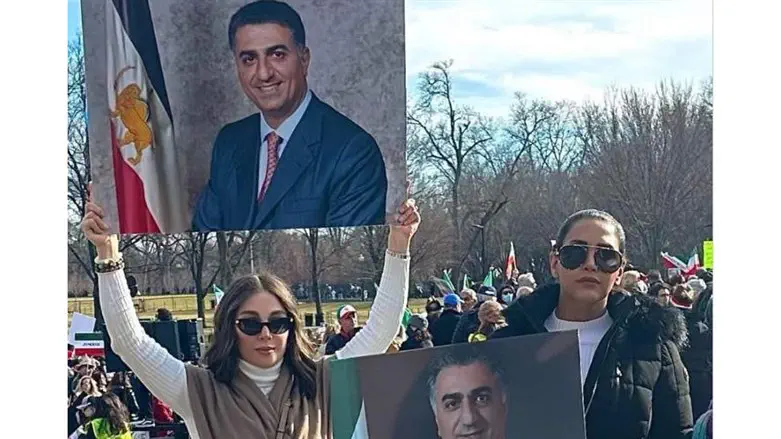
For Iranians, February 14 this year arrives with urgency. As families inside Iran buried their loved ones in silence and others searched for sons and daughters who never came home, a different kind of gathering is taking shape beyond the country’s borders, one driven not by symbolism, but by necessity. When speech is criminalized and mourning is punished, resistance finds new geography.
Iran is enduring a campaign of state violence that leaves little room for ambiguity. Executions carried out behind closed doors. Young women and men seized from the streets, many of them never returned. Torture revealed through fragments of video and whispered testimony. Streets marked by blood, walls bearing messages written with wounded hands “Long live the Shah" declarations not of nostalgia, but of identity and refusal.
The Islamic Republic has responded to dissent with overwhelming force. Tens of thousands killed, tens of thousands detained, and entire cities thrown into digital darkness to prevent documentation. Hospitals are monitored, families threatened, grief turned into a punishable act. Yet despite this, the Iranian people have not retreated. They have adapted, turning names into symbols and memory into resistance.
Crown Prince Reza Pahlavi has called for a coordinated global mobilization on February 14, urging Iranians to gather in Los Angeles, Toronto, and Munich. The message is simple: when Iran is denied a voice at home, that voice must be carried abroad. These protests are not spontaneous expressions of outrage; they are deliberate acts of political presence.
Much of this mobilization has been organized by the Constitutional Party of Iran, which has played a central role in coordinating demonstrations across the diaspora. In Los Angeles home to one of the largest Iranian communities in exile Mr. Arash Razi has emerged as one of the principal organizers and coordinators, working to ensure that the gatherings are not only large, but disciplined, unified, and strategically aligned with the broader national movement.
Los Angeles remains a focal point, but it is only one node in a far wider network. Large demonstrations are expected across North America and Europe, as Iranians of different generations and political backgrounds come together under a shared demand for visibility, unity, and legitimacy. What distinguishes this moment is not merely turnout, but coherence a collective refusal to fragment.
For many Iranians, Crown Prince Reza Pahlavi has emerged as a unifying national figure, not as an imposed leader, but as a representative capable of articulating what the people inside Iran are risking their lives to say. When his name is chanted in the streets of Iran and echoed across the diaspora, it reflects a call for alignment rather than division, and for a collective path forward rather than competing claims to leadership.
These demonstrations are intended to do more than express anger. They aim to break the isolation that sustains the regime and to communicate, unmistakably, to the international community that the Islamic Republic has lost all legitimacy. February 14 is about presence refusing disappearance, refusing fatigue, refusing silence.
The regime has survived by waiting for attention to fade. This moment challenges that strategy. A dispersed nation is learning how to act as one.
February 14 will stand as a measure of that resolve, the day Iranians, wherever they could stand safely, chose unity over fear and visibility over erasure.