
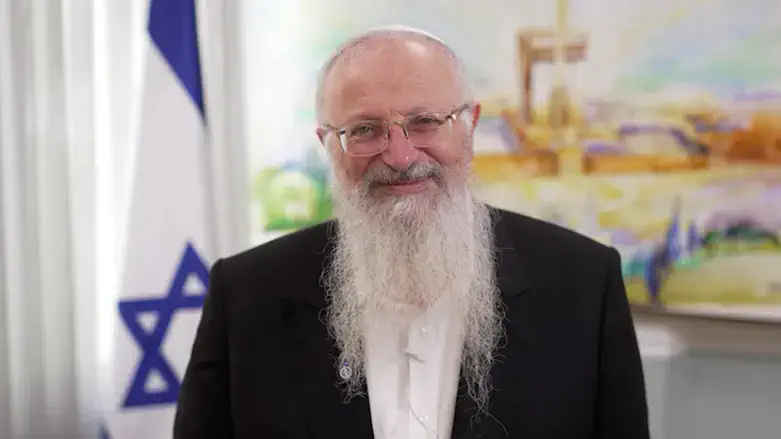
HaRav Shmuel Eliahu is Chief Rabbi of Tzfat
The Giving of the Torah is not only a healing from the impurity of Egypt; the Giving of the Torah is the true objective of the People of Israel. All of the bondage in Egypt prepared Israel to receive the Torah. The descent to Egypt was intended to refine Israel so that it would be worthy of fulfilling its role - the role for which the Covenant was established: “I, behold, My Covenant is with you, and you shall be a father of a multitude of nations" (Bereshit 17:15).
We are to sanctify the Name of Hashem throughout the world: “This people I have formed for Myself; they shall declare My praise" (Yishiyahu 43:21).
In order to implement its mission, Israel must always be a nation with God: “And I will establish My Covenant between Me and you and between your seed after you throughout their generations for an everlasting Covenant, to be God to you and to your seed after you" (Bereshit 17:7).
For the sake of Israel’s great mission, it is given the Torah. Through it, the Divine Presence rests upon us. Through it, we are freed from Egyptian culture We also teach the world how to free itself from impurities and other forms of bondage. Through it, the Covenant of the Forefathers is fulfilled within us.
Therefore, Rabbi Tzadok HaKohen of Lublin wrote in the name of the Arizal that: “The days of Shovavim are a time for the ‘rectification of the Covenant,’ which is Torah. Increasing the attribute of ‘Fear,’ however, is only ‘guarding the Covenant,’ but not its rectification. This occurs when all of one’s desire be solely for a matter of truth. Only the beginning of this process must be through subjugation."
Two Actions During the Days of Shovavim
In these brief words, Rabbi Tzadok explains in the name of the holy Arizal that during the days of Shovavim there are two primary actions. The more important of them is connecting to the Covenant of the Forefathers - connecting to the mission of Israel described above. The second action is guarding the Covenant from disturbances such as the impurity of Egypt and the many impurities of our time. For it is impossible to connect to holiness while standing at the gates of impurity. Therefore, during these days we sanctify and purify ourselves from everything associated with the impurity of Egypt (especially from transgressions to the Brit, Covenant) of physical holiness).
Therefore, the two Luchot HaBrit are called the “Tablets of the Covenant" (Devarim 9). The Torah is called the “Book of the Covenant" (Shemot 24);the Ark is called the “Ark of the Covenant" (Devarim 10); and the Ten Commandments are called the “Words of the Covenant" (Shemot 34).
Through the Torah and its commandments, we are able to fulfill our holy mission - the purpose for which the People of Israel were created. Through the Torah and its commandments, we can cleave to God, and it is fulfilled within us: “After Hashem your God shall you walk, and Him shall you fear; His commandments shall you keep, His voice shall you obey, Him shall you serve, and to Him shall you cleave" (Devarim 13:5).
Through the Covenant We Left Egypt
At this time, we remind ourselves that the entire Exodus from Egypt and the Giving of the Torah occurred through the merit of the Covenant. Through it, the Red Sea was split: “And He made a Covenant with him to give the land of the Canaanite, the Hittite, the Amorite, the Perizzite, the Jebusite, and the Girgashite, to give it to his seed, and You fulfilled Your words, for You are righteous. And You saw the affliction of our fathers in Egypt, and their cry You heard at the Sea of Reeds" (Nechemia 9:9).
Through the Covenant, Hashem struck Egypt with the Ten Plagues: “And You performed signs and wonders against Pharaoh and all his servants and all the people of his land, for You knew that they acted arrogantly against them, and You made for Yourself a Name as it is this day." (Ibid).
Through the merit of the Covenant, the future Redemption will also occur: “And I will remember My Covenant with Jacob, and also My Covenant with Isaac, and also My Covenant with Abraham I will remember, and I will remember the Land" (Vayikra 26:42).
Through Torah Study One Rectifies the Blemish of the Covenant
Based on this, it is written in the book Ohev Yisrael (Parashat Vayechi):
“The essence of repentance is through Torah, prayer, and charity - each according to his ability - and especially through the study of the Oral Torah and clarifying Halachah with thorough and refined analysis. Through this, one gathers the good portions and the holy sparks and refines them from within the husks, extracting what they (negative spiritual forces) have swallowed, as in the secret of ‘He swallowed wealth and vomited it’ (Iyov 20:15). And this is the main rectification of the blemish of the Covenant, the study of the Oral Torah with intention of the heart and with fear of His blessed, honored, and awesome Name."
Torah Studied for Its Own Sake Brings Redemption
And it concludes there that: “All the more so, one who merits to study Torah for its own sake (merits to rectify the Brit.")
For Torah studied for its own sake is the Torah that brings Redemption to the world, as we pray in the blessing of Ahavat Olam - “for the sake of Your great Name" - to study Torah that will bring Redemption:
“Break the yoke of the nations from upon our neck and lead us upright speedily to our Land. For You are a God Who performs salvations, and You have chosen us from among every people and tongue, and You have drawn us near, our King, to Your great Name with love, to give thanks to You and to unify You in awe and in love of Your Name."
Torah that emerges from closeness to the great Name of Hashem. Torah that brings love of the Name of Hashem. Torah for its own sake - Torah of Redemption.
Torah Study Is Preferable to Fasting and Self-Affliction
Therefore, it is written in Shem MiShmuel (Vayechi 5681):
“From what has been said, the days of Shovavim are a time for rectifying the well-known sin. There are those who fast and perform afflictions. It is better that each person say to himself that it is preferable to subjugate himself within the house of Torah and to limit all his deeds and conduct so that they follow the path of Torah, rather than to subjugate himself to fasts and afflictions. As my holy grandfather, the great Admor of Kotzk, of blessed memory, said: ‘Walking in the path of Torah is the greatest affliction for the body.’"
And it is understood that a person who subjugates himself to Torah - both in the toil of study and in restricting his conduct according to the ways of Torah - benefits more than all bodily afflictions.
The holy Shelah writes that together with study, one must also give charity.
The Way of My Father and Teacher, Rabbi Mordechai Eliyahu of Blessed Memory During Shovavim.
Because of this matter, my father, the great Gaon Rabbi Mordechai Eliyahu, of righteous and holy memory, instructed all his students during the days of Shovavim to observe a fast of speech, together with Torah study and the recitation of Psalms, which are considered as significant as Torah study. He did not instruct fasting, even though in Maggid Meisharim it is written that the Torah giant, Maran Rabbi Yosef Karo, of blessed memory, fasted during the days of Shovavim, and this is brought in many other books as well.
In my Father’s opinion, today, strengthening must be primarily through proper speech and guarding against other speech that may bring great stumbling, especially during our time of Redemption.
During the days of Shovavim, we must adopt speech that is clean from any concern of prohibition - falsehood and flattery, evil speech and gossip, vows and false oaths, curses, and shaming others publicly.
Especially, one must beware of weakening speech, such as the weakening words of the Spies, who contradicted the words of Moshe Rabbeinu and said that there was no possibility of conquering the Land because of the giants (BaMidbar 13:31).
Rectification of Speech in the Days of Mashiach
Mashiach will lead the world through speech alone:
“And a shoot shall emerge from the stump of Yishai, and a branch from his roots shall bear fruit. The spirit of Hashem shall rest upon him - a spirit of wisdom and understanding, a spirit of counsel and might, a spirit of knowledge and fear of Hashem. He shall be imbued with the fear of Hashem; he shall not judge by the sight of his eyes nor decide by the hearing of his ears. He shall judge the poor with righteousness and decide with fairness for the humble of the earth. He shall strike the earth with the rod of his mouth, and with the breath of his lips he shall slay the wicked" (Yishayahu 11).
Leaving the Immoral Culture of Egypt
The Torah reminds us to distance ourselves from the conduct of the land of Egypt regarding forbidden relations:
“Like the practice of the land of Egypt in which you dwelled you shall not do, and like the practice of the land of Canaan to which I am bringing you, you shall not do, and in their statutes you shall not walk. My ordinances you shall perform and My statutes you shall observe, to walk in them. I am Hashem your God" (Vayikra 18).
Our Sages learned from this passage to be cautious of all aspects of Egyptian culture. On the words, “and in their statutes you shall not walk,Rashi explains: “What did Scripture leave unsaid? Rather, this refers to their social customs and institutions established among them, such as theaters and stadiums."
Similarly, it is written in the Shulchan Aruch (Yoreh De’ah 178):
“One should not follow the customs of idol worshippers nor imitate them. One should not wear clothing designated for them, nor grow the hair of his head like their hairstyle. One should not shave the sides and leave hair in the middle, nor shave the hair across the front of the face from ear to ear while leaving a forelock. One should not construct gathering places resembling the temples of idol worshippers for large public assemblies, as they do." The gloss adds that a Jew should remain distinct from them in dress and in all other behavior.
Sanctifying Oneself by Guarding the Eyes
In the portion of Tzitzit we learn to guard what our eyes see:
“And you shall not stray after your hearts and after your eyes, after which you go astray."
“After your hearts" refers to thoughts of forbidden relations.
“And after your eyes" refers to seeing forbidden relations.
The Torah teaches that we sanctify ourselves through this holiness because this is the purpose of the Exodus from Egypt:
“I am Hashem your God Who took you out of the land of Egypt to be your God; I am Hashem your God (BaMidbar 15:39).
There is no more fitting time to rectify the sin of forbidden relations than during the period of Shovavim. My revered teacher and father, of blessed memory, told me this several times when I asked how people who had stumbled in such sins could rectify them. He answered that while a fast from speaking (ta’anit debor) was more appropriate to our times, for people who wanted to rectify specific forbidden relations they should fast each year throughout their lives one or two days during the period of Shovavim.
Indeed, the rectification differs from person to person. There are those who stumbled in thought and those who stumbled in action. Some sinned once, while others sinned many times. Some sinned alone, while others caused others to sin as well. Therefore, the rectification differs for each individual, according to his spiritual level and the severity of his transgression.
Feeling the Presence of Hashem
The spiritual work during the period of Shovavim is first to fulfill the verse, “I place Hashem before me always" - to be conscious of the Divine Presence at every moment, to recognize that the entire earth is filled with His glory, and to thank Him for the daily miracles and the constant wonders. After acknowledging this, one comes to know that “Hashem alone shall be exalted on that day"-there is none besides Him. This is our spiritual task in the present time, during the period of Shovavim. When Hashem is present, there is joy, as it is stated:
“Splendor and majesty are before Him; strength and joy are in His place." (I Dvrei HaYamin 16:27)
Rectifying Sadness
One of the most important rectifications during the period of Shovavim is the rectification of sadness and grumbling that was not corrected at the time of the Exodus from Egypt. The Torah describes the beginning of the spiritual decline in the words:
“And the people were as complainers, speaking evil in the ears of Hashem; Hashem heard, and His anger burned, and the fire of Hashem burned among them and consumed the edge of the camp" (BaMidbar 11).
These complaints accompanied the Children of Israel for forty years, reaching their peak in the sin of the Spies, when they cried a baseless cry in their unwillingness to journey on into the Land of Israel. Sadness darkens the soul. When this occurs it is impossible to serve Hashem. The Torah teaches that exile comes because of a lack of joy:
“Because you did not serve Hashem your God with joy and with gladness of heart, despite the abundance of everything" (Devarim 28:47).
This sin stands in the way of Redemption and must be rectified in our generation.
Sadness in Egypt Egypt
The Arizal explains that the Egyptians sought to increase sadness among the people of Israel:
“They appointed taskmasters over them in order to afflict them with their burdens" (Shemot 1:11).
This is the intent of the Sages who taught that the building of Pithom and Raamses was not meant for construction, but rather to enslave Israel and cause them to be downtrodden. (Midrash Rabbah, Shemot 1:10). From here we can understand why Pharaoh commanded the killing of the children - cruelty intended to increase sadness in the world.
The People of Israel Refuse to Submit to the Shell of Sadness
The People of Israel refused to surrender to Egypt, and therefore they triumphed. The Egyptians attempted to bring despair upon Israel so that they would separate from their wives and cease having children. However, the daughters of Israel continued to bear children and bring life into the world:
“For they are vigorous" (Shemot 1:19).
Miriam encouraged her father to continue living. Moses was born and the entire house was filled with light. His face was destined to shine like the sun. The daughters of Israel prepared tambourines for joy, and the Children of Israel left Egypt with uplifted hands and sang happily at the Red Sea.
Sadness Is the Hardest Spiritual Barrier of All
Therefore one must be extremely cautious of sadness, especially during the days of Shovavim. Sadness is the most difficult spiritual barrier. Sadness has no connection to God, as it is stated: “Splendor and majesty are before Him; strength and joy are in His place" (I Divrei HaYamim 16:27).
The Divine Presence rests only in an atmosphere of joy, as taught in the Talmud (Shabbat 30b).
Sadness During Prayer Causes Great Spiritual Harm
Therefore, the Arizal writes:
It is forbidden for a person to pray in sadness, for if he does so, his soul cannot receive the supernal light that descends upon him during prayer. However, at the time of confession, when one enumerates his sins, it is proper to feel sadness. During the rest of the prayer, however, great spiritual harm is caused by sadness.
Rather, one must present oneself before God with great humility, awe, and reverence, yet simultaneously with profound joy, like a servant who serves his master with joy. If he serves with sadness, his service becomes repulsive. Almost the entire level of spiritual perfection and the attainment of Divine inspiration depend upon this, whether during prayer or while performing any commandment. Therefore, one must not belittle this matter, for its reward is exceedingly great (Beginning of Sha’ar HaKavanot).
Joy Brings Divine Inspiration
The Arizal further wrote in Sha’ar Ruach HaKodesh:
A person must be joyful and of glad heart when fulfilling any commandment, when studying Torah, or when praying - more joyful than if he had gained thousands upon thousands of golden coins. This is the meaning of the verse:
“Because you did not serve the Lord your God with joy and gladness of heart, despite the abundance of everything" (Devarim 28).
One must rejoice in the service of Hashem more than one would from acquiring all the wealth in the world.
Sadness itself is a very reprehensible trait, especially for one who seeks wisdom and Divine Inspiration. Nothing prevents spiritual attainment, even if a person is otherwise worthy, like sadness. Proof of this is the verse:
“Now bring me a musician. And when the musician played, the hand of the Lord came upon him." (II Kings 3).
“The Redeemed of Hashem Shall Return and Come to Zion with Joy."
The removal of sadness will occur at the time of Redemption. Thus prophesied Zechariah:
“On that day, says the Lord of Hosts, I will cut off the names of the idols from the Land, and they shall no longer be remembered; and I will also remove the prophets and the spirit of impurity from the Land" (Zechariah 13:2).
The rectification of the damage caused by sadness will occur through the rebuilding of Jerusalem and the ingathering of the exiles:
“The Lord builds Jerusalem; He gathers the dispersed of Israel. He heals the brokenhearted and binds up their sorrows" (Tehillim 147).
The great rectification of joy will be fulfilled with the return of Israel to its Land:
“And the redeemed of the Lord shall return and come to Zion with singing, with everlasting joy upon their heads; they shall attain gladness and joy, and sorrow and sighing shall flee away" (Yishayahu 35:10).
May it be soon.