
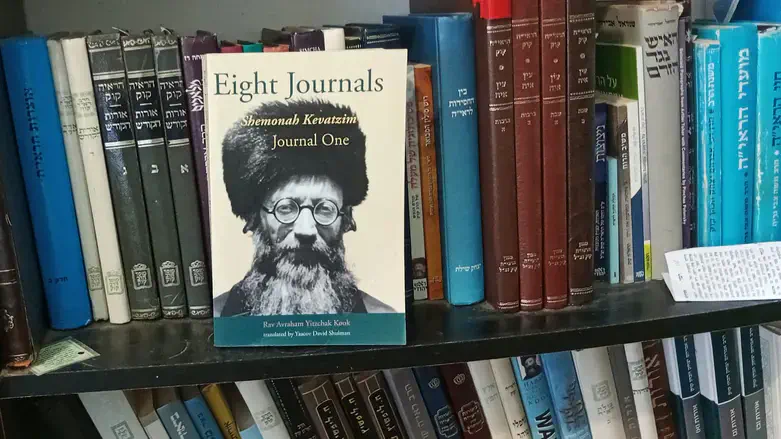
Lovers of Rabbi Kook will be delighted with the English translation of Volume One of the book “Shemonah Kevatzim" - “Eight Journals." The translator, Yaacov David Shulman, lives in Efrat. From his many previous translations of Rabbi Kook's writings, including the book “Lights of Teshuva," he is known for his ability to capture both the meaning and poetic imagery of the rich and flowing Hebrew. In addition, he has written some forty books on a variety of Jewish themes including short biographies of the Vilna Gaon, the Rambam, the Ramban, Rashi, The Maharal of Prague, Reb Yisrael Salanter, the Chasam Sofer, and the Rema.
After World War II, Shulman’s parents moved to Melbourne, then to Paris, where he was born, and from there to Brooklyn. Although he was raised in a nonobservant home, he says that his wandering Jewish soul brought him to the synagogues and yeshivas in the area. After graduating from SUNY College, he learned for three years in the Ohr Sameach Yeshiva in Monsey, New York, where the learning was strictly non-Zionist, with not a mention of Rabbi Kook.
“Returning to Brooklyn after I left Ohr Sameach, I found that certain non-Zionistic elements in what I had been learning in Torah rubbed me the wrong way, so I turned to Rabbi Kook for a healthy and healing spiritual infusion. In Monsey there exists Beit Medrash Elyon. In contrast, I learned Rabbi Kook’s “Orot Hakodesh" in the subway to work, and called it “Beit Medrash Tachton (underground Bei Medrash) ." In 2007 he made Aliyah.
In the book’s introduction, Shulman describes Rabbi Kook as follows:
Rabbi Avraham Yitzchak Kook (1865-1935), first Chief Rabbi of the Holy Land, was a Talmudic genius, a communal leader, a saintly personality, an impassioned visionary, a fighter for social justice, a poet and mystic. He was also a deeply original thinker, the inclusive spirit and transcendent ecstasy of whose teachings embrace the entirety of creation. Rabbi Kook’s teachings are exalted, piercing and universal.
"He was a poet of the soul and a spokesperson for a complete human spirit that embraces contradiction, that reconciles the poles of this-worldly and other-worldly experience. His writings celebrate the union of legalism and poetry, particularism and universalism, faith hidden in atheism and atheism hidden in faith, the spirit revealed from the flesh, and beauty revealed through ugliness. Rabbi Kook’s writings are the gifts of a universal teacher.
"Although he is principally known to the English-speaking world for his teachings on repentance and Zionism, he was a polymath who addressed every possible topic, and always brilliantly: poetry and war, Divine Immanence and evolution, social justice and aesthetics. All of these caught his attention and were refracted through his ever-searching mind and soaring soul. Rabbi Kook sang of universal creativity, of an unceasing fecundity that is the natural song of all being. And he championed the poetic and creative spirit within each individual.
“Every time our heart beats with a true expression of spirituality," he wrote, “every time a new and exalted thought is born, we hear the likeness of a Godly angel’s voice at the doors of our soul asking that we allow him entry so that he may appear to us in the totality of his beauty." Ultimately, Rabbi Kook’s robust message is one of life and growth, hope and optimism. “Death is a false phenomenon," he taught, and “to the degree that the quantity of movement toward wholeness grows, evil decreases and goodness is revealed."
Rabbi Kook’s major works - Orot, Orot HaKodesh, Orot HaTeshuvah, and others - were compiled from his journals, which he wrote over a period of fifteen years. When eight of these were published in Hebrew in 1999, they provided an unprecedented look into the progress of his thought, revealing many hitherto unpublished teachings. Students familiar with Rabbi Kook’s massive written output (with hundreds of pages still to be published) feel that the “Eight Journals" are an overview of the Rabbi Kook’s thoughts and beliefs.
During the course of our discussion about his new book, I asked: “While Rabbi Kook's teachings have had a profound influence on almost every sphere of life in Israel, his books are still not to be found in most Haredi yeshivot. Considering that Rabbi Kook was a universally recognized master of Halakhah and as stringent as can be, what do you think led to such harsh resistance to his teachings throughout the Haredi world?"
“Originally," Shulman answered: “Rabbi Kook was greatly respected throughout the Torah world. He was only opposed by the old haredi Jerusalem leadership because of his Zionistic views. Unfortunately, this polarizing outlook was zealously spread. I hope that as people in the haredi community search for an expansive, creative, and illuminating vision of Torah they will overcome any negative preconceptions they may have about Rabbi Kook and allow themselves to discovers the wonder of his teachings."
“Did you consider including a running commentary to help guide readers through the expanses of Rabbi Kook's thought and exalted imagery?" I asked.
“I actually did originally write a brief outline summary per teaching, thinking that it would give readers a pathway to enhance better understanding, but after writing about a hundred I felt that they flattened out the teachings, not expressing their depth, so I removed them. Instead, I rely on the title that I added to each piece to provide a broad overview, and I rely on the teaching to present itself."
In general, Rabbi Kook’s writings are not easy reading. The ideas presented in the book demand study and rereading in order to draw out the profundity of Rabbi Kook’s thought and to correctly decipher his Divinely-inspired flights into the Torah’s most exalted realms of universalism and unity. In the book “Eight Journals" Yaacov David Shulman has succeeded in remaining faithful to the Hebrew text while capturing the poetic style of Rabbi Kook’s often intricate prose.
Here are some samples from the book:
pp.101 People with great souls cannot be separated from the most encompassing totality. Their constant, entire desire and aspiration is the good of the entire whole: the whole in its full breadth, height, and depth.
pp. 102, Clinging to Hashem is humanity’s most natural yearning. It is developed in an intellectual and emotional form, whereas in all other existence it is in a mute and deaf form, in a potential form. The character of the nation of Israel took this yearning for itself as the foundation of its national life, in keeping with its historical destiny.
pp.181, If you desire, human being, look at the light of God’s Presence in everything. Look at the Eden of spiritual life, at how it blazes into each corner and crevice of life, spiritual and this-worldly, right before your eyes of flesh and your eyes of soul.
Gaze at the wonders of creation, at their Divine Life-not like some dim phenomenon that is placed before your eyes from afar. But know the reality in which you live.
Know yourself and your world. Know the thoughts of your heart, and of all who speak and think.
Find the source of life inside you, higher than you, around you. Find the beautiful ones alive in this generation in whose midst you are immersed.
The love within you: lift it up to its mighty root, to its beauty of Eden. Send it spreading out to the entire flood of the soul of the Life of worlds, Whose light is reduced only by incapable human expression.
Gaze at the lights, at what they contain. Do not let the Names, phrases and letters swallow up your soul. They have been given over to you. You have not been given over to them.
Rise up. Rise up, for you have the power. You have wings of the spirit, wings of powerful eagles. Do not deny them, or they will deny you. Seek them, and you will find them instantly.
pp. 528 The worldview unique to Israel makes that nation a singular entity in the world (Berachot 6a). That view is embedded in the Torah’s teaching of creation ex-nihilo: “In the beginning, God created the heavens and the earth" (Genesis 1:1).
This unique view leads to all of the practical commandments and the outstanding separateness of this nation. And it leads to the nation’s dependence on the Land of Israel as a land unique for it, where it may expand its spirit without interference, in parallel with receiving the help of all the characteristics ingrained in the atmosphere of the Land and its climate overall.
pp. 821, I cannot move away from clinging to the Divine, and so I have an obligation to strive to see the Divine Light and its pleasantness in all mundane matters, in all speech and in every deed and movement, whether my own or of others, and certainly to feel the revelation of the supernal light as it comes through the conduits of truth and righteousness within the entire Torah, including its simple meaning, halachic discourse and Talmudic disputation.
“Eight Journals" is available at Amazon Books. Readers will also find English translations of many other writings by Rabbi Kook on the translator’s website: ravkook.net.