
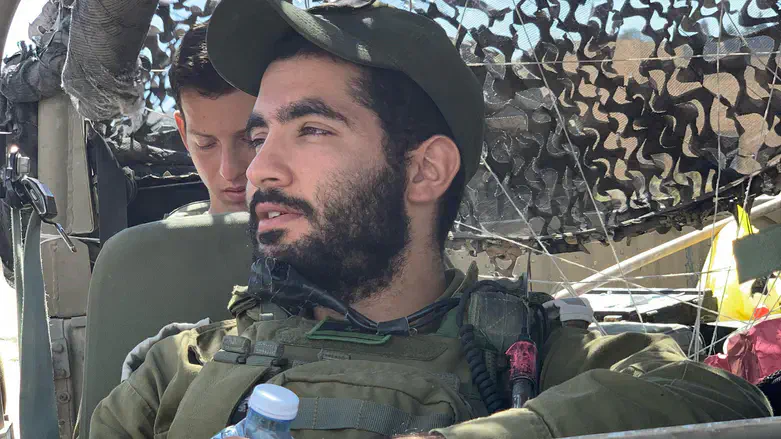
Sayeret Matkal Commander, Major Tal Cohen HY"D, or TalCo as he was affectionately called by his men, liked to say that there are four Independence Days, not just one, that take place during the spring months of Nissan and Iyar: Passover, Holocaust Remembrance Day, IDF Memorial Day and Yom Ha’atzmaut.
He saw IDF Memorial Day as a day of soul-searching and introspection alongside the sadness and pain, and as a day of holiness, despite the mourning for those who are no longer with us. He wanted that day to be part of a learning process in which we stress, in his words, “incorporating part of their character traits into ourselves, continuing on their path."
Several years ago, he sent a Memorial Day message to the commanders in his elite reconnaissance unit, writing:
“There are days during the year when one must pause, pause and think about where we come from and where we are headed. It is easier not to ask those questions, not to ask “why"? Because we have good soldiers and excellent commanders full of energy and the desire to excel - and that’s how it should be in Sayeret MatKal.
But, and perhaps for that very reason, we must ask ourselves that question. Because we always want to live to the age of 95-100, no less, and if possible, to an even older age.
Memorial Day is mainly a day for introspection. For my own self-searching as a person, as a fighter, as a commanding officer.
How well do I live up to my obligations, my responsibility, and how strongly am I dedicated to my mission and to our people? Do I intend for them to reach the age of 95-100?
Anyone who has fought, has lost friends in battle, has led his soldiers and endangered their lives - understands that a commander’s duty is to bring his fighters home safely, and that this comes from constant introspection and soul-searching about where he himself comes from and where he is headed.
The foundations we lay will give rise to success on the day our fighters are called to act upon them.
Memorial Day is that kind of day for me, especially when I think of those who are not with us anymore.
And the question that burns in my mind is - could we have done things differently?"
How heartbreakingly prescient that message and its last sentence turned out to be…how burning his questions became after October 7th.
Heartbreaking and prescient, because Major Tal Cohen was the proudest of fathers to his three young sons, Tzur, Ivri and Dror, but did not live to see his fourth child, a joyously anticipated daughter whose name the happy couple had chosen before October 7, 2023, the day Tal, aged 31, fell battling terrorists in Kfar Aza. Five months later, Tal’s wife Natalie gave the newborn infant that name, but without her beloved husband at her side. Little Re’em will never know her father.
TalCo’s parents, Rivka and Benzion Cohen, raised a closeknit family of 8 children, 6 sons and two daughters, in Berekhya, a religiously observant moshav near Ashkelon. The moshav was established in 1950 by immigrants from Djerba, an island off Tunisia whose Jewish population was almost entirely Cohanim. Tal was the family's 7th child, and spent his early years studying in the moshav school, secure in the warmth of his family and the friendly community numbering about 1000 residents, reveling in the open spaces of the rural village.
“He was a mischievous, sweet and curious boy who knew how to stand up for what he felt were his rights, was not very interested in schoolwork," says his older brother Eliraz, a CPA, “but he showed precocious initiative from early on."
“In our house everyone took it for granted that they would work and be self-supporting at a fairly young age and Tal did so as well. Our mother was a housewife and our father, who taught us all to love reading, including Tal, worked at various jobs until he became CEO of a charity organization. During his student years, Tal opened his own successful business selling cut-up frozen fruits that expanded to the point where he made deliveries over most of the country, until he eventually sold it. Tal was persevering, if he did something he did it thoroughly from start to finish, but he also knew how to enjoy life."
“He had an 80-year-old friend Yigal Shadmi from Kibbutz Nir David (on the site of Kibbutz Tel Amal, founded in 1936) from the paratrooper reconnaissance unit. They met when Tal was 7 as Yigal is married to our cousin, and developed a strong relationship, in which Yigal influenced the building of Tal’s strong character and solid values. After Tal was killed, Yigal was unable to bring himself to enter our parents’ home.
“Tal liked to hike all over the country on an all-terrain vehicle, but his real love was horses. He wanted a stable of his own, was saving for one, but didn’t live to fulfill that wish. I built one next to my home in his memory," says Eliraz, surreptitiously wiping away a tear.
After spending his high school years at Tsvia Yeshiva H. S. in Ashkelon, Tal went on to the pre-army Torah program at the Ateret Cohanim Mechina, but would go to hear high level shiurim (Torah lectures) at its adjacent yeshiva (now renamed Ateret Yerushalayim). He became attached to Torah at the yeshiva, and to some of the rabbinic figures who taught there, would go to hear shiurim by Rabbi Yosef Kellner whose recent book was dedicated to Tal’s memory. He also went to hear Rav Eliezer Kastiel at Bnei David Yeshiva in Eli and Rabbi Eliyaahu Elkaslasi, who became his halakhic advisor, at the Bnei Rochel Yeshiva near Rachel’s Tomb.
Because he felt it was important, he paid an Arab to speak to him in Arabic for an hour a day and really knew how to speak the language. He, who had been an indifferent student as a youngster, now saw his future in education. The IDF felt the same.
IDF Service
During Tal’s IDF basic training, he had difficulties living up to his commander’s expectations until it was discovered that he had multiple stress fractures. After he recovered, his army years became a meteoric success story, starting with the Givati Reconnaissance Orev Special Force which specializes in operating anti-tank missiles, intelligence gathering, and other high-risk missions, passing its grueling entrance exam and soon going on to officers training to become an Orev squad commander, where he served with Hadar Goldin, HY"D.
In a Ynet article about the the Givati Reconnaissance Force’s training to be the first line of attack (to see a film of the training including Major TalCo speaking, click here), Tal is quoted on how to handle a mass casualty event, telling his men: “Units can fail in this kind of situation because of the smell of blood, people screaming, soldiers shouting that they are wounded, but everyone has to remember the task he was assigned for just this kind of incident, keeping calm and being exact and focused."
The article emphasized the wisdom of Tal’s closing statement, a prophecy that came true: “If everything seems to be going exactly according to plan, then something has probably gone wrong. Don’t give in to euphoria."
Tal was appointed head of the training course for Orev reconnaisance squad commanders (Ma"kim in Hebrew, short for Mefaked Kita) and commander of the force’s Sappers unit. He met and married Natalie, who hailed from Ashkelon and was a distant relative, in 2015.
In 2018, the IDF sent him back to school to get a B.A. and M.A. (he completed most of his M.A. degree) in the Jerusalem College of Education. In his farewell to the unit under his command until then (summarized in English below each clip) the tough officer shows his sensitivity and humility - and also why the IDF singled him out as a born educator:
Tal:We have travelled a long journey together (lists their missions and operations) and kept our standards high. When I came to command Company Bet, you had been ranked lowest in the Brigade, but the very next day you achieved the highest score of the entire Brigade. Not me, you. And our standards remained the highest. Thank you for having me as your commander. (Tal's voice breaks). I will be with you, but not as your commander. You are the best and if I sometimes lost my temper, I apologize, but it was for your own good.
Tal:I bought each of you a gift because every one of you matters. In another 48 hours, we will hold the ceremony in which you welcome your new commander. I rely on you to continue on as you have been and I thank you for everything - and most of all, I give special thanks to Natalie who made it all possible.
Tal: Remember that it is the indiividual soldier, not the commander, who sets the standard.
When TalCo returned to active service, it was as a career officer in Sayeret Matkal, the IDF’s most elite reconnassance force.
At the age of 28, Tal was appointed head of all Sayeret Matkal training courses and also assumed his last and most prestigious position, that of a matzbi - the officer responsible for field operations at the highest level.
IDF career officer rules of thumb:
Career officers in elite units know that they must make the most of precious family time whenever it occurs and their wives know that there will be many Shabbat days and holidays without their presence.
Religiously observant high-ranking career officers are faced with problems civilians never have to solve. On Rosh Hashanah 2023, his last, TalCo was on clandestine operational duty in an enemy country. He had asked Rabbi Elkaslasi what to do about hearing the shofar, an obvious impossibility for him, but was told that there is no way to perform that mitzvah after the holiday and that protecting the Jewish people from its enemies takes precedence. He returned for Yom Kippur and Sukkot to Ganei Tal, a moshav built in memory of the village of that name in Gush Katif and where he and Natalie had made their home.
October 7:
On Simchat Torah morning, TalCo heard the sirens and rushed to his unit to find out the situation, arriving there at 8:30 a.m. Finding them without ready-for-action operational plans, he simply took a few fighters and rushed south.
The group reached Kfar Aza, only 3 km from Gaza, where 250 terrorists, mostly from the Nukhba force, had invaded, taken over the Kibbutz, and were going house to house in the neighborhood with families of young children, massacring civilians of all ages in unspeakable ways, looting and burning homes. He called his sister Efrat, who resides in nearby Zikim, and asked her to lock herself in the safe room and not to go out. She told him there were terrorists on the kibbutz fence.
On the way, Tal made contact with an officer named Zandani who was on a roof in the young families’ neighborhood, and when he arrived, was joined by several Duvdevan Unit officers at the entrance gate. Impossibly outnumbered, though killing as many terrorists as they could, Tal and three others, Cpt. Hadar Kama, Maj. Ilay Zisser and Cpt. Amir Zur fell in a massive firefight with the terrorists. Five other soldiers were wounded.
The youth organization “Five Fingers´ whose goal is educating for leadership, produced a podcast titled “They commanded us to live" about what characterizes those who serve in the elite Sayeret Matkal, their mission, and the price they paid in the Swords of Iron War. Their message is that this generation of young Israeli adults now has to carry on that mission, choosing to do things that will build a better Israeli society, choices that will create a reality that makes those heroes' sacrifice worthwhile, and doing so in their memory. Featuring an officer who was severely wounded but survived the battle in Kfar Aza, it focuses on the four Sayeret Matkal officers who fell on that horrific day - a day of death, bloodshed, Hamas barbarity and IDF heroism, the day in which Tal’s sterling character and love of his country and its people meant more to him than his own life.
The officer, who has his back to viewers so he remains unidentifiable, says: “Sayeret Matkal soldiers are expected to think out of the box and do more than they are expected to do in every situation. War is the Kingdom of Uncertainty and that is what they prepare for. On that day, we understood why we had that training. We gotready in minutes, 9 fighters including TalCo the matzbi, throwing equipment and gear into an armored vehicle, and rushing southward, getting organized on the way. We drove on route 232 and began to see the bodies and burned cars, realized this is an invasion against civilians, not a terror attack. Skirting army vehicles that tried to stop us, we reached Kfar Aza, decided to try to reach the dining hall, managed to enter the kibbutz gate, and heard shooting."
"TalCo began running towards the shots and we followed, TalCo leading the most courageous effort to make contact with the enemy I have ever seen. Talco and another soldier went inside, saw the terrorists and began shooting. TalCo rushed forward and and we all followed to form a second line of fire. Four soldiers circled the terrorists, the rest provided cover, soldiers were wounded, evacuated and treated, but the terrorists had the high ground and the advantage, and TalCo, Ziser, Hadar and Tzur were soon out of sight". The four went down fighting, delaying the terrorists’ advance.
(note: from minute 16, he describes the battle in Kfar Aza and TalCo's role).
On the Moshav:
Eliraz recalls the day it all happened: “I was on the farm with my parents for Simchat Torah, joining my father for davening at sunrise as we do every morning, and heard sirens. Half an hour later we were told to lock the shul because there are terrorists nearby. Then the phone rang and a fellow member of the moshav secretariat told me to lock the gates to the moshav. We were not close enough to Gaza to have an emergency response squad, so we locked the gates and everyone who had a firearm took up positions."
Eliraz is the Hof Ashkelon Regional Authority internal auditor, and the head of the authority called and asked him to check with every community under its aegis to find out if they had an emergency response squad and to tell them to form one asap if they did not.. The communities began to organize defense squads and tried to obtain long firearms from the Home Command, but to no avail, getting hold of only one M-16 rifle. During those fateful hours, his best childhood friend, Aviad Cohen, who lived farther south in Moshav Shlomit, fell defending Moshav Pri Gan whose three security squad members had called for help from the security squad in nearby Shlomit. Aviad was one of the two members of the force who were killed in Pri Gan (two others had been away for the holiday and were killed trying to reach the moshav), but, due to their bravery, no civilians were harmed in either of the Moshavim.
Eliraz received another call from someone he knew who had information, which turned out to be inaccurate, that his brother, whose unit had rushed to Kibbutz Be’eri and fought there on Shabbat, had been killed. No one imagined that TalCo was in the area, so the error was understandable. He said nothing to his parents, just calmly suggested they come home with him, hoping he could have a doctor near his mother when the news came, but an officer arrived and told them about Tal when she was still outside.
Tal was buried on October 10 at the Mount Herzl military cemetery in Jerusalem. Eliraz eulogized his younger brother:
“How the mighty have fallen. I don’t believe that we are eulogizing you. Every one of us had his own role to fill in our home, that’s how it is growing up in a house with eight siblings. Your role was to be the glue - to decide when we meet at our parents’ home, when we have a family barbecue, when we go on holiday together. You knew better than all of us when to stay silent as we talked, how to calm things down when there was tension, laugh at who knows what, keep Yoni, Gili and Efrat in the loop. In fact, I think you still owe Yoni at least three chargers. Just two weeks ago we decided on a cross country hike together, and I had already begun to plan it…
"Our catastrophe is just one point in the horrific tragedy that is happening to our people. We, ordinary citizens, call on our people to put their differences aside and understand that what we have in common is greater than what divides us, what unifies us is greater than what separates us. We are one nation after all. We promise you, dearest brother, that we will do everything we can to care for Natalie, Tsur, Ivri, Dror and the whole family. They will never be alone. ‘I grieve for you, my brother; you were very dear to me (from David’s elegy for Jonathan, R.S.)'. Farewell."
May his memory be blessed.