
“At every available opportunity," Rabbi Ze'ev Gold would say, “I tell the story of the remarkable lesson I was privileged to learn from our great teacher, the gaon and saintly Rav Kook, may the memory of the righteous be a blessing."
Rabbi Gold (1889-1956), a prominent figure in the Religious-Zionist Mizrahi movement, once accompanied Rav Kook, then Chief Rabbi, to the fledgling settlement of Magdiel in the Sharon. The occasion was ceremonial: an official visit, speeches, and the planting of saplings to mark the birth of a new forest.
The air was bright. The soil was coarse and stubborn, freshly turned, clinging to boots and hems. A row of young trees waited patiently beside neatly stacked tools.
When Rav Kook was handed a sapling, Rabbi Gold expected a dignified gesture, a symbolic scoop of earth with the hoe provided. Instead, he froze in astonishment.
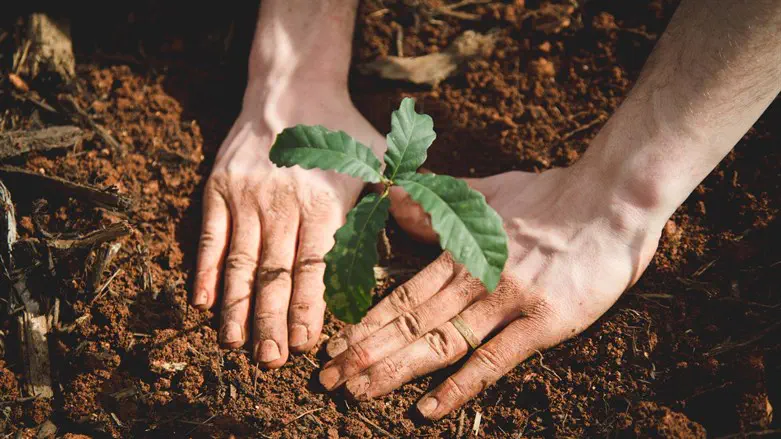
Rav Kook’s face suddenly blazed, as if lit from within. His body trembled with intensity. He set the hoe aside. Slowly, he knelt down onto the ground. With his bare hands he broke into the soil, fingers digging into the resistant earth. Dirt clung beneath his nails. His hands shook.
Gently cradling the sapling, he lowered it into the hollow he had made. As he covered the roots with earth, he whispered words of gratitude, thanking God for the privilege of planting a tree in the Land of Israel.
Rabbi Gold watched, shaken. This was not a ceremony. This was a profound spiritual encounter.
On the return journey to Jerusalem, silence hung between them. Finally, Rabbi Gold could not contain himself.
“Rabbi," he asked, “why were you so deeply moved by the planting of a single tree? Nowadays, thank God, hundreds of trees are planted every day in the Land of Israel."
Rav Kook turned to him, his voice calm but charged.
“As I held that young sapling in my hands," he said, “I recalled the words of our Sages on the verse, ‘Follow the Eternal your God... and cling to Him’ (Deut. 13:5).
“They ask: Is it possible for flesh and blood to ascend to the heavens and cling to the Shechinah, of Whom it is written, ‘For the Eternal your God is a consuming fire’ (Deut. 4:24)?
“Rather," Rav Kook continued, “they teach us this: At the beginning of creation, the Holy One engaged in planting, as it says, ‘God planted a garden in Eden’ (Gen. 2:8). And so too, when Israel enters the Land, their first act is planting: ‘When you come into the Land, you shall plant all kinds of fruit trees’ (Lev. 19:23)."
Rav Kook paused.
“When I stood there, my hands holding that tender sapling and lowering it into the holy earth, these words were no longer ideas. They were reality. In that moment, I felt as though I was clinging to the Shechinah itself. I was overwhelmed with feelings of awe and reverence."
(Stories from the Land of Israel. Adapted from Zehav HaAretz by Rabbi Ze'ev Gold (1982); Mo'adei HaRe’iyah, pp. 222-223.)