
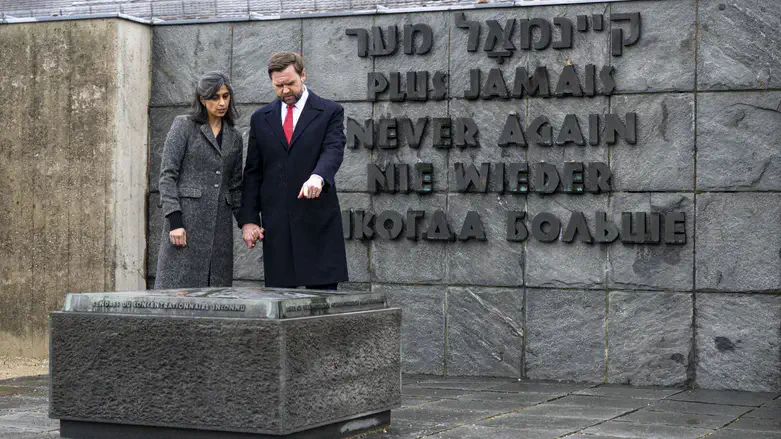
Commemorating the Shoah remains a challenge for many. Some deny that six million Jews were murdered or reject the historical reality of the systematic attempt to annihilate European Jewry. Others, like VP Vance and the BBC avoid mentioning Jews altogether or find it uncomfortable to acknowledge that Jews-and Jews alone-were Nazi Germany’s primary victims. As Elie Wiesel observed, “Not all victims were Jews, but all Jews were victims."
Still others invoke the Holocaust to underscore the urgency of combating antisemitism and Islamophobia as if they were interchangeable phenomena. They are not. Universalizing the Holocaust-however well-intentioned-distorts, diminishes, and ultimately trivializes its meaning.
Until the destruction of European Jewry is recognized as an unprecedented historical event that occurred within Western civilization, we will remain unable to confront antisemitism as a uniquely persistent and corrosive force-and to grasp the danger it poses to American and Western societies.
As historian Yehuda Bauer has argued, the Holocaust occupies a singular place in both Jewish and world history, with antisemitism having become “one of the basic elements" of Western culture. At this stage, it has little to do with who Jews actually are. Antisemitism has endured for centuries, generating stereotypes that resurface whenever social or political conditions allow.
The Shoah: An Unprecedented Occurrence
The Holocaust marked the first instance in which murder was not an end in itself, but a means to an ideological end. Historian Lucy S. Dawidowicz explained that" in the destruction of European Jewry, the ends and the means became indistinguishable. The Germans claimed the right to determine who deserved to live and who did not.
In doing so, the Holocaust defined the outer limits of human cruelty and arrogance, while also setting the measure of human endurance and courage. Other genocides were confined to specific territories-even if vast ones. The murder of the Jews, by contrast, became a universal objective, unconstrained by geography."
The Risk of Superficial Comparisons
There is a tendency, historian Richard J. Evans notes, to view the Holocaust as merely one genocide among many. While such comparisons can illuminate certain aspects of the Nazi period, they also risk erasing crucial distinctions by homogenizing acts of mass murder until they become morally indistinguishable.
“For Hitler, Jews were not simply a population to be eliminated in pursuit of racial purity. They were conceived as a global enemy-endowed with almost supernatural power-who had to be hunted down, humiliated, and eradicated without exception. This obsessive worldview explains why modern neo-Nazis deny Auschwitz and why Nazism continues to exert such a powerful grip on collective memory."
The Germans depicted Jews as a cancer-a virus that, if left unchecked, would allow them to dominate the world.
This fixation is evident in Hitler’s Political Testament. In his final message to the German people, written on April 29, 1945, shortly before his suicide, Hitler called for the continued enforcement of racial laws and “merciless resistance against the universal poisoners of all peoples, international Jewry."
Why the Holocaust Resonates Beyond the Jewish World
What accounts for the sustained fascination with the Holocaust among non-Jews? It is not simply the scale of the murder or the fact that it occurred in one of the most educated and technologically advanced societies in the West-though these factors matter.
Rabbi Richard Rubenstein suggested that the Holocaust resonates especially with Christians who view Jewish history as a theological signpost. In this framework, events affecting the Jewish people are interpreted as manifestations of divine providence, carrying implications for the Church. The Holocaust, therefore, raises unsettling questions about God’s presence-or absence-in history for both Jews and Christians.
No other genocide or episode of mass murder-whether in Cambodia, Rwanda, the former Yugoslavia, or elsewhere-evokes this same biblical and theological resonance.
Confronting the Dark Side
Any religious tradition that seeks to play a constructive role in contemporary society must also confront its own history, including how it has justified or enabled violence. Father John Pawlikowski has argued that moral credibility requires an honest reckoning with this legacy.
Cleansing a tradition of violence demands more than acknowledgment; it requires reconciliation with those who were harmed by it. While reconciliation with long-dead victims is impossible, meaningful efforts can and must be made with their descendants. It was in this spirit that he advocated reconciliation with the Jewish community.
A Final Note
Historian Yaacov Talmon warned that humanity’s continued fixation on the Nazi period should serve as a warning. It is entirely possible, he argued, that the fate of European Jewry represents not an aberration but a precursor. Auschwitz may stand either as an eternal warning-or as the first station on a road toward the destruction of nations and the self-destruction of humanity.
Dr. Alex Grobman is Senior Resident Scholar at the John C. Danforth Society, a member of the Council of Scholars for Peace in the Middle East, and serves on the advisory board of the National Christian Leadership Conference of Israel.
Snippet: Paraphrased from Yonah E.'s article: The GOP Made Jews Optional. I’m Gone.