
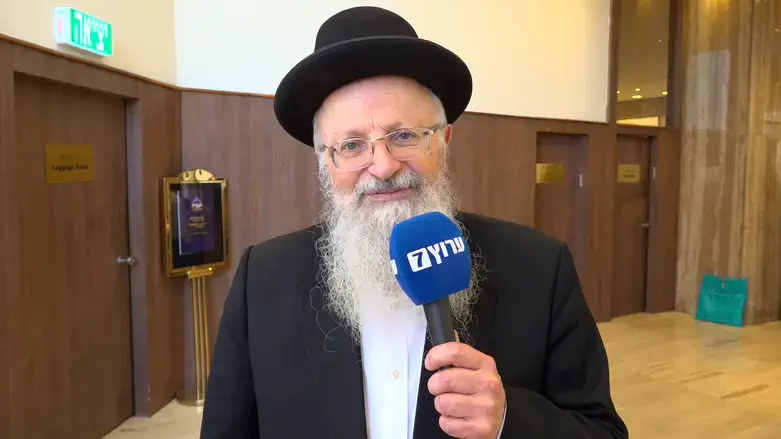
HaRav Shmuel Eliahu is Chief Rabbi of Tzfat
It is written in the Shulchan Aruch (O.C. 131:6): “The custom is not to fall on one’s face (during the nefilat apayim in the Viduy prayer) on Tu B’Av, nor on Tu B’Shvat, nor on Rosh Chodesh, nor at Minchah beforehand." The Gaon alluded to the fact that in the Mishnah, Tu B’Shvat is bound together with the other “New Years." Just as all the other New Years are a special day for man, so too is the New Year for trees.
The source of this is in the Mordechai (siman 351), who writes that “they once sought to decree a fast on the day of Tu B’Shvat, and they told them that one must be concerned for the New Year of the trees and postpone those fasts." He adds: since the fast is postponed until after Shabbat, the Mishnah teaches them together: “There are four New Years: on the first of Nisan is the New Year for kings and festivals; on the first of Elul is the New Year for the tithe of animals. Rabbi Elazar and Rabbi Shimon say: on the first of Tishrei. On the first of Tishrei is the New Year for years, sabbatical years, and jubilees; for planting and for vegetables. On the first of Shevat is the New Year for the tree, according to Beit Shammai; Beit Hillel say: on the fifteenth of it." In other words: since the Tanna bound them together, their laws are alike with respect to Viduy.
And not at Minchah beforehand
The sanctity of the day spreads outward. Just as on Rosh Chodesh one does not fast even at the Minchah before it, so too on Tu B’Shvat one does not fast at the Minchah before it.
The Olat Tamid (ad loc.) wrote that it appears from the words of the author that only on Rosh Chodesh do we not say Tachanun at the preceding Minchah, but on Tu B’Shvat and Tu B’Av there is nefilat apayim at the preceding Minchah-however, the custom is not so. So too wrote the Pri Chadash (ot 7), that it applies to all of them: any day on which there is no nefilat apayim, we do not practice it at the preceding Minchah (see Mishnah Berurah s.k. 32; Kaf HaChayim s.k. 101).
Man’s Connection to the Fruit of the Soil
The reason is that in the Shema we see a connection between man and the fruit of the earth. If the People of Israel love God and fulfill His commandments, God gives the rain of our Land in its time-“early rain and late rain"-and “you shall gather your grain, your wine, and your oil… and you shall eat and be satisfied." But if, God forbid, not-“He will restrain the heavens so that there will be no rain, and the Land will not give its produce, and you will perish swiftly from the good Land that the Lord gives you" (Deuteronomy 11).
“And you shall know that I am the Lord"
So too in Ezekiel: in exile, God says to “the mountains and the hills… the desolate ruins and the abandoned cities" not to give their fruit. And when the time of Redemption arrives, God commands them to give their fruit:
“But you, mountains of Israel, you shall give forth your branches and bear your fruit for My people Israel, for they are soon to come… for behold, I am for you; I will turn to you, and you shall be tilled and sown."
Through this, there will be blessing among the People of Israel. Cities will be settled and ruins rebuilt. From this we understand that it is God who does this: “And you shall know that I am the Lord… and I will bring upon you man, My people Israel, and they shall possess you (the Land) and you shall be their inheritance, and you shall no longer bereave them" (Ezekiel 36).
“Let the heavens rejoice and the earth exult."
The Land does not do this as though coerced, but with great joy, as it is written: “Let the heavens rejoice and the earth exult… let the sea roar and all it contains." The heavens bring down rain with joy, and the earth produces its fruit with gladness: “Let the field exult and all that is in it; then shall all the trees of the forest sing out-before the Lord, for He comes… to judge the earth" (Psalms 96).
Therefore, the Sages said that the Land’s yielding of fruit is the “revealed end" of Redemption: “Rabbi Abba said: you have no clearer sign of the End than this, as it is said: ‘But you, mountains of Israel, you shall give forth your branches and bear your fruit for My people Israel…’" (Sanhedrin 98a).
Eating Fruits on Tu B’Shvat
Therefore, the Magen Avraham (s.k. 16) wrote: “Ashkenazim have the custom to increase the eating of various fruits of trees." This is to thank God for them, to recite blessings over them with intention, and to draw their abundance into the world. Specifically the fruits of trees on Tu B’Shvat, for this day is the New Year for the fruits of the tree.
Some take fruits from the Seven Species, such as fig and date, and the Kabbalists added that one should take thirty-six different kinds of tree fruits.
The meticulous take fruits where the edible part is inside and the peel outside (like pomegranates and almonds), and those where the edible part is outside and the pit is inedible (like plums and apricots), and those that are entirely edible (like figs), and those like grapes where even the seed is edible. Concerning all of these it is said: “From my flesh I behold God"-that contemplation of physical reality teaches us about the flow of abundance from the higher worlds.
Study about the fruit before the blessing and eating.
The Kaf HaChayim (O.C. 131) writes that some have a special order of study on the night of Tu B’Shvat-“a Mishnah or Zohar dealing with that fruit, and afterwards they bless over it." There is even a book arranged for this called Sefer Pri Etz Hadar. So too today in many places: they try to understand in depth the unique quality of each fruit, to rejoice in it and to thank God with a full mouth of gratitude: “Let my mouth be filled with Your praise, all the day with Your glory" (Psalms 71:8).
In the Diaspora, where fruits from the Land of Israel were not available, they would make an effort to bless over the fruits by which the Land of Israel was praised, even if those fruits had not grown there. As the verses state: “For the Lord your God is bringing you to a good Land… a Land of wheat and barley, vine and fig and pomegranate; a Land of olive oil and honey…" (Deuteronomy 8). Why mention the Land of Israel in the Diaspora over foreign fruits? Because all abundance in the world comes through the blessing of the Land: “For there the Lord commanded the blessing - life forever" (Psalms 133), as explained in the prophecy of Zechariah (at the end of chapter 14).
Taking great care to eat fruits of the Land of Israel
Today, people are especially meticulous to eat fruits grown in the Land of Israel and to bless over them first. The reason is that through these fruits, God shows His love for us. Thus the Bach (on O.C. 208) writes that in the Me’ein Shalosh blessing one should say: “and we shall eat of its fruit and be satisfied with its goodness," for the abundance revealed in the fruits of the Land of Israel is from the holy Shechinah: “The sanctity of the Land, which flows from the sanctity of the Supernal Land, also flows into its fruits, which draw nourishment from the sanctity of the Shechinah that dwells within the Land."
For the Holy One “dwells within the Land - within the very body of the Land," and with the Destruction the Shechinah departed in exile, and therefore the fruits of the Land did not flourish throughout the some two thousand years of exile. And it also dwelt within Israel themselves, as it is written: “They are the sanctuary of the Lord" (Jeremiah 7)-“for the Shechinah would dwell literally in their midst." Therefore we say in that blessing, “and we shall eat of its fruit and be satisfied with its goodness," for by eating its fruits we are nourished from the holiness and purity of the Shechinah and are satisfied with its goodness.
The Tree of Life and the Tree of Knowledge
When we speak about fruits of the tree, we cannot avoid speaking of Adam’s sin, for through eating with Eve from the Tree of Knowledge, death was decreed upon the world. Yet the Tree of Knowledge is not entirely evil; it contains “good and evil." One can use the Tree of Knowledge to bring good into the world, but without caution it can bring evil and death into the world. What is the way by which one can “eat" from the Tree of Knowledge in goodness?
In Tiferet Shlomo on the Torah (Parashat Beshalach), he brings the verses about Joseph’s bones in the Book of Joshua: “And the bones of Joseph, which the children of Israel brought up from Egypt, they buried in Shechem…" (Joshua 24:32). The expression “the bones of Joseph" is said of Joseph even during his lifetime: “God will surely remember you, and you shall bring up my bones from here" (Genesis 50). And in Beshalach: “And Moses took the bones of Joseph with him…"
Why is Joseph called “bones"? Tiferet Shlomo explains: “For Joseph the righteous was the repair of Adam’s sin. ‘Atzamot’ (bones) is the same letters as ‘etz mot’ (tree of death). And through his merit the splitting of the Sea occurred, as is known." For it is written: “The sea saw and fled"-what did it see? It saw the coffin of Joseph the righteous, who overcame his impulse and fled outside. By this he repaired the sin of Adam, who together with his wife followed their eyes and sinned.
Another great repair in Joseph was that he did not bear a grudge against the brothers who sold him thus repairing the sin of division between the sons of Rachel (Joseph’s path) and the sons of Leah (Yehuda’s path).
On this joining, the holy Ari writes in Sefer HaLikutim (Ezekiel ch. 37) that the joining of Yehuda and Joseph is a joining of the Tree of Life and the Tree of Knowledge, such that when they unite, the good side of the Tree of Knowledge is activated.
He writes (in substance): Messiah son of David is from the Tree of Life; Messiah son of Ephraim is from the Tree of Knowledge… and in the future “the Lord will be One and His Name One," and the Tree of Life and the Tree of Knowledge will be united: “and they shall become one in your hand."
Unity Brings Redemption
These words of the Ari relate to Ezekiel’s prophecy of Redemption (ch. 37), which takes place through the joining of “one stick… for Yehuda… together with one stick… for Joseph… and bring them near one to another to become one stick, and they shall be one in your hand."
For when Jeroboam son of Ephraim separated from Rehoboam son of Solomon, destruction was decreed upon the Temple. But when these two “sticks" are joined, Israel will again become one people: “I will make them one nation in the Land… and one king shall be king over them… and they shall no longer be two nations, nor divided into two kingdoms any longer."
Through this, the sin of Adam will be repaired: “They shall no longer defile themselves… and I will save them… and purify them; and they shall be My people and I will be their God." The Temple will be rebuilt and there will be a great sanctification of God’s Name in the world… and through this the entire world will be rectified: “And the nations shall know that I am the Lord who sanctifies Israel, when My sanctuary is in their midst forever" (Ezekiel 37).
The Ingathering of Exiles
The ingathering which we have witnessed in our times is the story of the dry bones returning to life: “The hand of the Lord was upon me… and He set me down in the midst of the valley… full of bones… and behold, they were very dry" (Ibid.)
The Midrash says on these verses: “Do not read ‘bones’ (atzamot) but ‘tree of death’ (etz mot) - from the tree concerning which the Holy One told Adam not to eat, and he ate, and death was decreed upon him and upon his offspring after him to the end of all generations" (Tanna DeVei Eliyahu Rabbah, ch. 5).
The repair of this “tree of death" is the ingathering of exiles: “I prophesied as I was commanded, and the spirit came into them, and they lived… a very, very great host," and they ascend to the Land of Israel: “And I shall bring you to the Land of Israel." Then they come to know God: “And you shall know that I am the Lord… when I open your graves and bring you up… and I shall place My spirit within you and you shall live… and I shall set you upon your Land… and you shall know that I am the Lord; I have spoken and I have done, declares the Lord" (Ezekiel 37). And this comes through the joining of the Tree of Knowledge to the Tree of Life.
This connection is the opposite of the serpent, who said to man, “You shall be like God, knowing good and evil," and brought death into the world. The Torah brings man to life: “It is a tree of life to those who hold fast to it, and those who support it are happy" (Proverbs 3).
Thus the Torah instructs the king regarding the Torah scroll: “And it shall be with him, and he shall read from it all the days of his life, so that he may learn to fear the Lord his God, to keep all the words of this Torah and these statutes, to perform them; so that his heart not be lifted above his brethren, and so that he not turn aside from the commandment, neither to the right nor to the left, so that he may prolong days upon his kingdom, he and his sons, in the midst of Israel" (Deuteronomy 17).
Had Israel held fast to the Torah they received at Sinai, no nation or language could have stood against them. They would also have been free from the Angel of Death. With the sin of the Golden Calf, the impurity of the serpent returned to us; through cleaving to the Torah, we are saved from it.
A Story about my late father, the Chief Rabbi of Israel, the Rishon LeTzion HaRav Mordechai Eliyahu zts"l, told by Raanan Cohen, the Rabbi’s assistant:
Love for the Fruits of the Land of Israel
This occurred during the period when Israel’s Chief Rabbi, of blessed memory, was hospitalized at Shaare Zedek Hospital in Jerusalem. As the Rabbi’s assistant, I joined the members of the family who attended on him in a daily rotation. One of our roles was to encourage him to eat so that he would regain strength. One day I asked him what he wanted to eat, and he said: “Hamutzim" - spicy pickles and olives.
At that time, I owned a shop featuring hamutzim. I called an employee who hurried to prepare containers with a selection of all the types of pickles olives we had in the shop. He hurried to bring them to the hospital. The Rabbi looked at the assortment, pointed to dried black olives, and asked: “What kosher certification do these olives have?"
I told him that the entire shop was under a well-known “Badatz" certification, including these olives. The Rabbi did not respond. He proceeded to eat some of the items set before him but he did not eat the dried black olives.
Immediately afterward we went to the shop to check the various kosher certifications, and I saw that everything we had brought the Rabbi had proper Kashrut, including the dried black olives. However, the dried black olives were imported, while all the other pickles were produce of the Land of Israel. (Told by Raanan Cohen, the Rabbi’s assistant.)
The Gemara says that the Holy One, blessed be He, does not cause the righteous to stumble by eating something forbidden: “Now, if with regard to the animals of the righteous, the Holy One, blessed be He, does not bring mishap through them, how much more so with the righteous themselves!" (Ketubot 28).
One who knew Rabbi Eliahu’s love for the Land of Israel and its fruits would have no difficulty understanding this “Divine Inspiration." For our Sages already said: “Rabbi Huna said in the name of Rabbi Elazar: From the Torah, from the Prophets, and from the Writings-in the way a person wishes to go, he is led" (Makkot 10).
Happy Tu B’Shvat!