

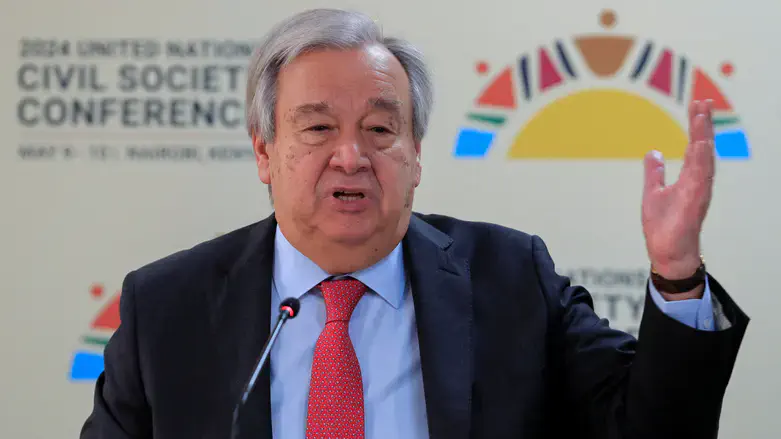
The UN chief has told member states the organization is at risk of "imminent financial collapse," citing unpaid fees and a budget rule that forces the global body to return unspent money, a letter seen by Reuters on Friday showed.
UN Secretary-General Antonio Guterres has repeatedly spoken about the organization's worsening liquidity crisis but this is his starkest warning yet, and it comes as its main contributor, the US, is retreating from multilateralism on numerous fronts.
"The crisis is deepening, threatening programme delivery and risking financial collapse. And the situation will deteriorate further in the near future," Guterres wrote in a letter to ambassadors dated January 28, according to Reuters.
The US has slashed voluntary funding to UN agencies and refused to make mandatory payments to its regular and peacekeeping budgets.
In his letter, Guterres said "decisions not to honour assessed contributions that finance a significant share of the approved regular budget have now been formally announced."
He did not say which state or states he was referring to, and a UN spokesperson was not immediately available for comment.
Under UN rules, contributions depend on the size of the economy of each member state. The US accounts for 22% of the core budget followed by China with 20%.
But by the end of 2025 there was a record $1.57 billion in outstanding dues, Guterres said, without naming the nations that owed them.
"Either all Member States honour their obligations to pay in full and on time - or Member States must fundamentally overhaul our financial rules to prevent an imminent financial collapse," he said.
The US State Department did not immediately respond to a request for comment on the Guterres letter.
President Donald Trump has described the UN as having "great potential" but said it is not fulfilling that. Some have speculated that Trump’s recently launched “Board of Peace" could undermine the UN.
European Union (EU) foreign policy chief Kaja Kallas recently indicated that European leaders would be willing to work with the Board of Peace, if its focus is narrowed down to Gaza.
German Chancellor Friedrich Merz later made similar comments, saying he would be prepared to join the Board of Peace initiative for the sake of Gaza, but made clear that Germany cannot accept the plan in its current form.