
Ruthie Blum, a former adviser at the office of Israeli Prime Minister Benjamin Netanyahu, is an award-winning columnist and a senior contributing editor at JNS. Co-host with Ambassador Mark Regev of the JNS-TV podcast “Israel Undiplomatic," she writes on Israeli politics and U.S.-Israel relations. Originally from New York, she moved to Israel in 1977. She is a regular guest on national and international media outlets, including Fox, Sky News, i24News, Scripps, ILTV, WION and Newsmax.
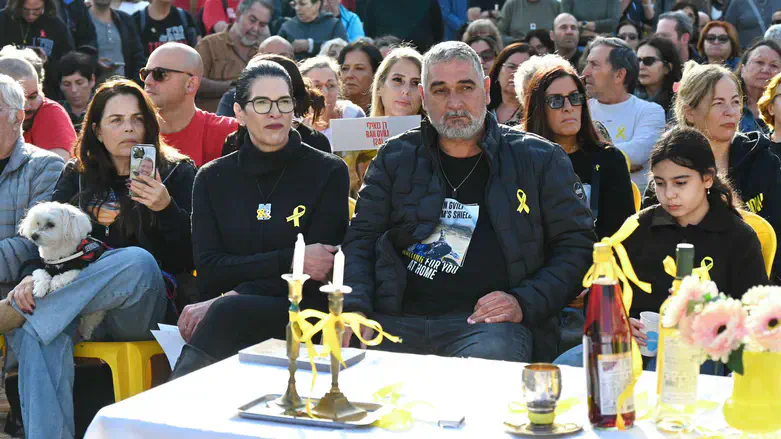
(JJNS) “Ran, thanks to you, all of Israel was reminded that we are one great and strong nation," Talik Gvili said while eulogizing her son at his funeral. “Take care up there to unite everyone."
She uttered these words on Jan. 28, two days after Ran Gvili’s body was located in and retrieved from Gaza-two years and nearly four months after his murder and abduction at the hands of Hamas. The 24-year-old master sergeant in the elite Yasam unit of the Israel Police wasn’t on duty when southern Israel was invaded by thousands of terrorists; he was at home awaiting surgery for a broken shoulder.
Nevertheless, he donned his uniform, grabbed his weapon and rushed to battle the killers on the loose. Despite his injury, he fought bravely, taking out more than a dozen terrorists by himself. It was only when he ran out of ammunition that he was gunned down and his body dragged into the Strip, where he was held for the next 843 days.
He is now referred to as the “first in and last out." Indeed, there are no more captives left in Gaza, against all odds and widespread skepticism.
This is among the points that Israeli Prime Minister Benjamin Netanyahu stressed during his press conference on Jan. 27, during which he announced the completion of the “sacred mission" of returning all the hostages.
“I have heard not one or two people saying with endless emotion, ‘It’s unbelievable that we brought Ran Gvili home,’" Netanyahu said.
“[But] it is indeed believable. I believed. I believed we would return them all. I believed it even when, at the start of the war, a very senior official in the security establishment said, ‘We must get used to the fact that we might not see even one hostage return to Israel.’ I believed it even when they told me, ‘Prime Minister, you must stop the war. You must leave Gaza. Yes, you must comply with Hamas’s demands, because otherwise, we simply won’t see the hostages here.’ But I believed otherwise."
He went on, “I believed that through the combination of military and diplomatic pressure, we could, and would, bring all of our hostages back home. Because what is important in war, more than anything else, is to ignore the background noise, to stand with composure against pressures from home and abroad, to understand what needs to be done and to strive with all our might to … achieve the goal."
He also described dozens of meetings with hostage families whose loved ones he vowed to retrieve from Gaza, crediting Israel’s soldiers and commanders, the wounded and the fallen for their part in defending the country.
“Many generations will draw inspiration from Ran Gvili, a hero of Israel, and from all our other heroes, whose courage was revealed in all its glory in the War of Redemption," he said. “This is the generation of heroism. This is the generation of victory."
But within minutes, the “anybody but Bibi" knives came out.
Naftali Bennett, former (and future wannabe) prime minister, accused Netanyahu of “dividing and polarizing," insisting that “a good leader glorifies his people, not just himself"-as though honoring fallen soldiers and defending strategic resolve were acts of ego.
Opposition leader Yair Lapid declared that “whoever wants to take credit for the hostages who returned must also take responsibility for the victims, the murdered and the greatest disaster to befall the Jewish people since the Holocaust." Without skipping a beat, he made it sound as though Netanyahu, not Hamas, was the culpable party.
Yisrael Beyteinu Party head Avigdor Liberman offered the familiar bromide that “it’s time for leadership that leads, not just reacts."
Gadi Eizenkot, former chief of the Israel Defense Forces and a former War Cabinet member, and political hopeful, accused Netanyahu of staging press conferences to “conceal the depth of the failure," claiming that only American coercion forced Israel’s hand, while supposedly compromising Israel’s security superiority.
Interesting how these paragons of ingratitude felt at the funeral when Talik requested of her fallen boy that he unite a fractured nation from his perch in heaven. One thing they all know is that healing societal wounds requires a suspension of animus-at least temporarily.
But that would mean acknowledging that certain occasions shouldn’t be poisoned in the pursuit of toppling Netanyahu. Ran Gvili’s Jewish burial in Israel is but one example. Others, unfortunately, abound.
Still, most Israelis are not politicians or pundits. They’re not professional protesters or full-time activists. They’re people with sons and daughters, brothers and sisters, spouses and close friends who fought-and continue to do so-in Gaza.
Many are now bereaved. And they don’t appreciate being told that the fallen died in vain for a lost cause or due to the political recklessness of a prime minister whose only aim is to keep his seat.
These are the Israelis who wept watching footage of IDF soldiers singing “Ani Ma’amin" (“I Believe") upon learning that Gvili had been found. These are the citizens, like the Gvili family, who cherish reminders of the heart and soul-and Zionism-that bind us as a people.
Herein lies the irony that the haters don’t seem to grasp: The more they claim that Netanyahu was actually the obstacle to freeing the hostages-going as far as to claim he wanted them dead-the less success they will have at replacing him on election day.