
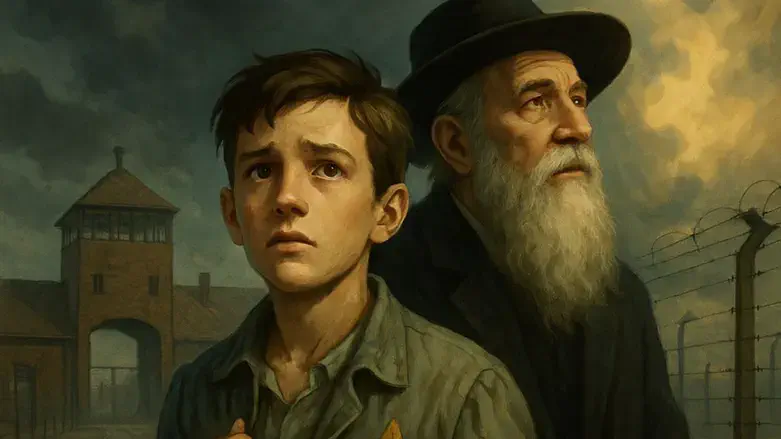
Yesterday, on the eve of International Holocaust Day, I received a letter from a publisher in France saying that he would like to publish my new novel which I based on my father-in-law’s incarceration in Auschwitz and the subsequent Death March. Here is an excerpt:
The One-Eyed Rabbi
Days passed. One by one. Each day felt like an everlasting eternity. Whenever we were marched outside, when a guard glanced away from us, my gaze quickly spanned the surroundings - the fences the height of two men, the iron gates, the endless barbed wiring, the white signs with black skulls warning of danger and death, the guard towers and giant searchlights. Clearly there was no chance of escape from within. If the opportunity arose, only when we were outside the camp on some work assignment was the thought of freedom possible. That’s what a camp sign said: ARBEIT MACHT FREI - work makes you free.
A month passed. Maybe two. Without any explanation I was chosen with three other youngsters to clean one of the barracks every day for one week. That’s how I met the old Rabbi. The barracks housed new arrivals in their twenties and thirties who were selected for hard labor. Early in the morning, after the inmates had been marched off for work, we would arrive and set to work cleaning. A rather elderly Jewish kapo was left there to watch us, but he usually didn’t pay much attention. He looked ill to me. His complexion was yellowish and a foul order emanated from his mouth. Often he dozed off and slept for a half hour or more. He would wake up with a shudder and gaze nervously around to make sure that an S.S officer hadn’t arrived on a tour of inspection.
One of our tasks was to warn him if we saw someone coming. Other than that, he left us alone to clean the barracks, the large shower room and defecation buckets. They supplied us with a strong smelling disinfectant. The liquid burned our hands. But at least while we mopped and scrubbed we were spared the stomach-churning smell of burnt flesh that wafted over Auschwitz day and night from the smoke of the crematorium chimneys.
Looking like a prophet from the days of the Bible, the tall one-eyed figure of the Rabbi sat slumped over on a bunk moving his lips in prayer and gazing into space. His stooping posture gave him a broken appearance. He stared forward like a blind man, his expression blank, his one good eye darkened like a tunnel. His arms and body were very thin from not eating, and his face was gaunt with protruding cheekbones. Now that his full beard had been completely shaven and his rabbinic attire discarded, he looked very different from the tall, strikingly distinguished appearance he possessed on the day when Mengele had decided to put on a show for visiting Nazi officials. Now, without his beard, he looked somehow naked, like a plucked chicken.
Immediately I felt ashamed for the thought. I felt very sad for him. I felt sad and angry with everything that had happened to us, to Shimshon, to my parents, to my siblings, to so many Jews. Curious to learn his name, I summoned up courage to ask the Jewish kapo. He responded, “No one has a name here, only a number." After a day-and-a-half on the job, during one of the guard’s naps, I could no longer refrain myself from approaching the skeleton-like apparition.
As I approached, his head turned toward me and he nodded as if to say it was all right to come near. Nervously I glanced around to make sure that only the sleeping kapo was present.
“Excuse me, HaRav," I said quietly in Yiddish.
Once again his head nodded slightly.
“Where are your students?" I asked.
The hollow of his empty eye socket was difficult to look at. I recalled how a Nazi guard had viciously driven the butt of his rifle into the Rabbi’s face. He spoke in a low and somber voice. “The day we arrived they took me away from them. I have not seen them since, may Hashem have mercy on them and on all of His People."
“I am from Transylvania," I told him. “The day we arrived here, I was taken away from my parents and siblings."
He nodded his head. Then without any of the distance that a teacher keeps between himself and a student, he spoke to me freely.
“I was told that some well-meaning Jews are trying to free me. They are negotiating with the Nazis in Vienna. Apparently they have offered to pay a very large sum of ransom money. For my part, I am not interested lest these cursed Germans come to kidnap Jews and demand extraordinary ransoms in order to carry out their evil machinations."
“Can I ask a question?" I ventured.
“It is good to ask questions," he replied. “Though we don’t always have the answer."
He spoke softly in Yiddish with a Hungarian accent. “It is important to speak Hebrew," he said. “Yiddish is the language of the ghetto. Now the time is coming to speak our true mother tongue - Hebrew."
“My father spoke to us at home in Yiddish. Outside on the street, he spoke in Yiddish with the Jews, and he spoke Rumanian with the goyim."
The Rabbi nodded and sighed. Day to day in the death camp I didn’t have time to think about theological questions. The important thing was to find enough to eat and drink and to keep as far away from an S.S. officer as possible. With the constant screaming of the guards and their spontaneous beatings, who had the mental clarity needed to think about philosophical matters? The unending exhaustion made the mind as dull and murky as the soup we were fed. But now was my chance to clarify questions which had been weighing heavily on my heart ever since the expulsion from our village.
“My father said that we mustn’t ask questions about the workings of Hashem," I confided.
“No doubt, that was what he learned from his father and his teachers," he replied in a soft and knowledgeable voice. “Many people feel that way. Though they are partly right, they are also wrong. How are they right?" he asked as if reading the confusion in my mind. “They are right in that at a certain point, after all the questions have been answered and we still don’t understand, at that point is it proper not to ask more questions. Human intellect is finite, whereas Hashem is infinite. The Creator of Heaven and Earth is not confined to the boundaries of our human reasoning and logic. In that sense He is beyond definition and thus His workings belong to a different realm far beyond our grasp. Only a prophet can tell us the things we cannot see or understand. Hashem briefly allows the prophet or Tzaddik (saintly individual) to glimpse things that are hidden from man. Nonetheless, until that point where human intellect ends, it is proper to ask. We must strive to increase wisdom, understanding, and knowledge in order to know the Creator and to understand His ways so that we may cling to Him and carry out His will."
When the Rabbi smiled, I realized that I hadn’t seen a smile for what seemed like ages. Not that smiling was outlawed by the Germans but who could smile in the hell around us? Yet the lips of the Rabbi unexpectedly twitched. The eye that looked like a cavernous hole came to life with a flicker of light.
I let his words sink in. I didn’t grasp everything. Like I said, in the harsh reality of camp survival, it was hard to meditate on theological abstractions. Perhaps sensing my perplexity, the elderly Rabbi continued.
“Just as the young Avraham had questions in his search for Hashem, we too must question."
‘Why is this happening?" I asked. “Why is Hashem doing this to us?"
His eye scanned the barracks. The kapo was asleep. “We have brought tragedy this upon ourselves," he replied.
His answer puzzled me. I didn’t understand what he meant.
‘’Our Sages have cautioned us, saying: ‘Da mah l’mala mimcha - דע מה למעלה ממך which can be understood as 'Know what is above you’ meaning ‘an eye that sees; an ear that listens; and a hand that records your deeds.’ But it can also be understood as ‘Know that which comes from Above comes from you.’ It is our deeds here in this world which draw down the decrees from Above."
“Yes, I think I understand that. My father taught me that. But whenever I questioned him about what is happening today with the Germans, he said that we aren’t to question the ways of Hashem."
“It is true that we are not to criticize the doings of Hashem, chas v’shalom. But we are required to inquire and to learn about His interactions with the world in order to correct our ways. Some 150 years ago the gates of Zion started to open. The Baal Shem Tov and the Gaon of Vilna sent students to Eretz Yisrael, our mother, to resettle the Land, teaching that the Redemption from the Exile in foreign lands depended upon our initiative from below through the actual labor of our hands. Then other holy Rabbis and their students journeyed to the Holy Land to further the work of drying the swamps, planting fields and building homes.
"Nonetheless, the majority of the God-fearing communities of Europe adamantly refused to become partners in the Zionist enterprise, fearing that the secularists would corrupt their youth with their hedonist lifestyles and heretical beliefs. For almost two-thousand years we fervently yearned and prayed to return to our own Jewish Homeland but when the opportunity arose we chose to remain in the spiritually impure lands of the nations ignoring the calls of our Father in Heaven to return, ignoring the permission which the nations granted to us in the Balfour Proclamation, ignoring the calls of righteous Tzaddikim like the great Rabbi Kook who wrote long heartfelt letters praising the Holy Land and urging the entire Congregation of Israel to ascend to Zion with a scythe in one hand and a Chumash in the other.
"Recognizing the hour, Ze’ev Jabotinsky traveled about Eastern Europe warning of the dangers of our clinging to alien places where the Jews have always been a hated minority at the mercy of the heathen. Ignored and ridiculed by my colleagues and by myself, the Ultra-Orthodox world shunned his public speeches. I myself was present when he was chased out of a synagogue. To my shame I did not protest. And now because we didn’t listen, because our ears remained deaf to the call of Hashem beckoning us to return to our Inheritance, to the Promised Land, to the Land of our Forefathers, to the Land of our life, now Hashem is compelling us to listen and forcing us to learn on our battered and bleeding flesh that we do not belong amongst the Gentiles in their places of abode, may the Almighty have mercy.
"I too did not listen. I too chose to oppose the Zionists, who like Herzl, seemed to be a loudmouthed swaggering secular bunch. Engrossed in my learning of Talmud and Halakhah, busy with my writing, with my obligations as Rosh Yeshiva and with my duties as Av Beit Din, the head of a prestigious Jewish court in a God-fearing community filled with flourishing yeshivot, I did not take the time to analyze the matter on my own. Rather I accepted the opposition to the Zionist movement which was rampant amongst my colleagues until the persecutions against the Jews steadily mounted and the deportments began, and my yeshiva was closed, and my students scattered. Finally I myself was forced to go into hiding without any holy texts.
"Only then did I reflect back, reviewing all of the Tanach and Oral Torah as best as I could in my mind until I realized that the goal of the Israelite Nation was not merely to follow the laws of Sinai in a dry and mechanical manner in places we didn’t belong, places alien to our Jewish mission to bring the light of God to the world in the form of a distinct and holy nation in a Land of our own. Just as the Bible relates, we were bidden to leave the wilderness and journey on to live a life of Torah in all of its national fullness in the Chosen Land of Hashem as a holy kingdom and as a beacon light to all nations. After reading the Five Books of Moses, a small child in Heder could tell you that truth, but we, the servants of Hashem, became blinded by the length and darkness of the cursed Exile."
The Rabbi slowly stood up as if to stretch his limbs. His tall and slender figure towered over me. Gazing around he shook his head sorrowfully.
“My beit midrash seems to be empty," he said, gazing about. “Where have all my students gone?" I looked around at the vacant Auschwitz barrack. Only the sleepy kapo and my two fellow inmates were present. I wasn’t sure if his remark was sarcastic, or self-mocking, or if his mind was gripped by some sort of delusion.
“I saw how the Nazi guard beat you in the face with his rifle," I told him.
“It nearly knocked the eye out from its socket. I was in horrible pain. When Mengele saw it dangling he said, ‘I will do you a favor and remove it completely. It may prove very useful for my experiments. If it does, you will have contributed greatly to the welfare of mankind.’"
Gazing vacantly into space he continued with his explanation as if he was compelled from a place deep within his soul to bequeath his knowledge to someone….