
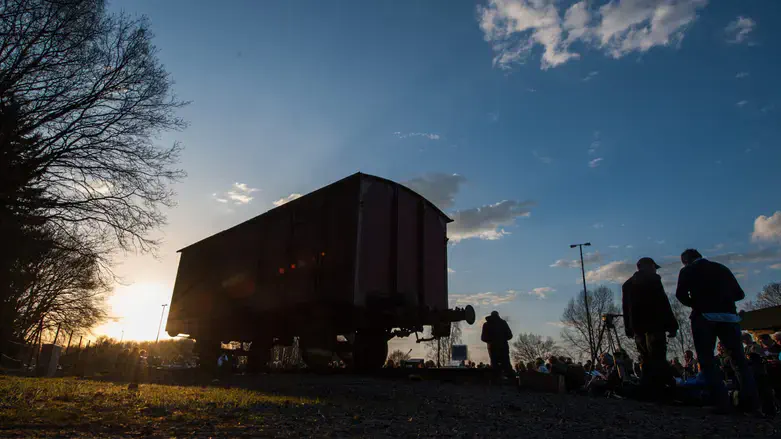
A proposal by officials at Deutsche Bahn, the German federal railway system, is serving up a potential train wreck of gargantuan proportions when it comes to preserving the memory of the Holocaust.
The officials have proposed a “preferred route" for a new high-speed rail line between Hamburg and Hanover that would run less than a quarter of a mile from the loading ramp where trains of Deutsche Bahn’s inglorious predecessor during the Nazi era, the Deutsche Reichsbahn, deposited prisoners destined for the nearby concentration camp of Bergen-Belsen.
The route that these officials are recommending risks damaging, even destroying, this ramp, which the officials know full well was a place of intense suffering and anguish during the years of the Holocaust.
Tens of thousands of Jews and other victims and enemies of the Nazi German regime, my parents and Anne Frank among them, arrived here between 1943 and April 1945, when Belsen was liberated by British troops. Here, they were taken off trains that had carried them for days, sometimes longer, in the most inhumane conditions imaginable.
“Two weeks in cattle cars," recalled Hanna Lévy-Hass, a survivor from Yugoslavia. “Holed up, forty to sixty per car, men, women, the elderly, children. Hermetically sealed, with no air, no lights, no water, no food … we were suffocating in a tiny space saturated with filth, fumes, sweat, stench . . . ravaged by thirst and lack of space."
Many of the arrivals at the ramp were forced to leave behind family members and friends who had died on the journey. They were then forced to march some six kilometers to the camp’s barracks where many of them died of starvation and typhus and other diseases, or were viciously murdered at the hands of SS officers and guards.
Even without gas chambers and large-scale crematoriums, Bergen-Belsen was an instrumental killing site of Hitler’s Final Solution of the Jewish Question. In order to contain a raging typhus epidemic, the British liberators hastened to take the survivors, many of whom were critically ill and on the verge of death, to a nearby German army base that became the Displaced Persons camp of Bergen-Belsen.
On April 21, 1945, British officers and soldiers burned the barracks of what they had termed the “horror camp" to the ground.
The railway loading ramp is thus one of the very few authentic remnants of the perpetration of the Holocaust at what may not have been a killing field but was definitely a field of gruesome, harrowing death.
The annual commemoration of the liberation at the Memorial Site of Bergen-Belsen includes a moving ceremony at the ramp.
The proposed railway route could disturb all of this, unsettling an important site of Holocaust memory.
Elke Gryglewski, the memorial site’s director, wrote to the transportation committee of the German parliament earlier this month to raise concerns about the railway plans.
The ramp “plays an important role in our educational work," she wrote. “Every day, we guide groups here and provide information about the history of the loading ramp and the journey of the concentration camp inmates and prisoners of war, which involved a 6-kilometer march to the Bergen-Belsen camps."
Gryglewski warned that historical structures at Bergen-Belsen could be damaged or destroyed during construction and that noise pollution and changes to the space could “violate the dignity of the site and disrupt educational work." She even raised the possibility that construction work could unearth human remains of those who were killed or buried near the ramp during the deportations.
Senior members of the staff of the Bergen-Belsen Memorial Site have made the appeal in person, too. When representatives of Deutsche Bahn visited before making their proposal, the staff members not only explained the ramp’s historical importance but warned, among other concerns, that if the proposed new line were to run closer than one kilometer away, the construction work involved risked causing significant if not irreversible damage to the ramp’s infrastructure.
The “preferred route" runs less than half of that distance away.
As we observe International Holocaust Remembrance Day, one of our collective solemn responsibilities as a society is to safeguard the memorial sites of the Holocaust, and that includes the Bergen-Belsen loading ramp.
The Deutsche Bahn bureaucrats have acknowledged that an alternate route running substantially further away from the ramp is indeed feasible. In the name of the survivors of Bergen-Belsen, their descendants, and their families, and also as chair of the Advisory Board of the Lower Saxony Memorials Foundation that oversees the Memorial Site of Bergen-Belsen, I call on the transportation committee of the German Bundestag to reject Deutsche Bahn’s “preferred route" for the Hamburg to Hannover railway line and instead opt for the alternate route.
There could be upsides to having a heavily trafficked rail line running close to an important site of Holocaust memory. Germans could benefit from being forced to confront the country’s Nazi history in the course of doing business. And being able to hear ordinary Germans going about their lives from the Bergen-Belsen site could underscore the cruel circumstances in which the Holocaust unfolded.
But the risks to the site’s dignity and integrity are not worth chancing it - and Deutsche Bahn officials owe it to keepers of Jewish memory to listen to our preferences.
There is no question that the Reichsbahn made the perpetration of the Holocaust possible. “Without the Reichsbahn, the industrial murder of millions of people would not have been possible" declared Susanne Kill, Deutsche Bahn’s in-house historian, in 2008.
There is also no question that Deutsche Bahn is the Reichsbahn’s successor. As such, it and its employees have a particular responsibility not only to acknowledge but to highlight the Reichsbahn’s complicity in the World War II genocide of European Jewry. One immediate way to accomplish this goal is by taking the necessary measures to preserve rather than risk damaging the loading ramp of Bergen-Belsen.
The views and opinions expressed in this article are those of the author and do not necessarily reflect the views of JTA or its parent company, 70 Faces Media.