

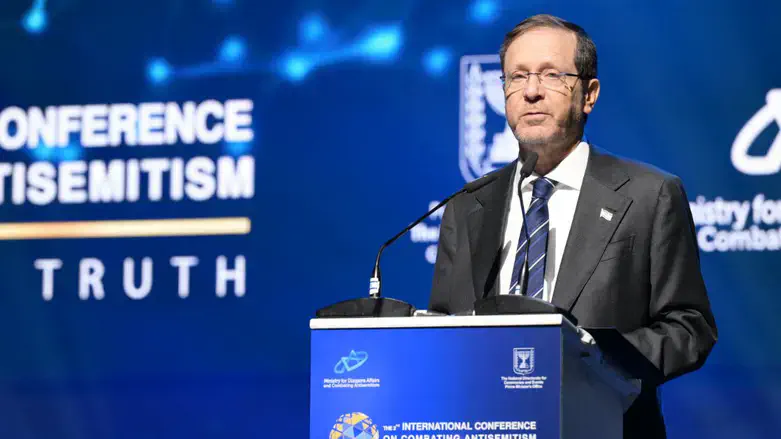
President Isaac Herzog delivered remarks on Tuesday, International Holocaust Remembrance Day, at the Second International Conference on Combating Antisemitism in Jerusalem.
The conference was organized by the Ministry of Diaspora Affairs and Combating Antisemitism at the initiative of Minister Amichai Chikli and was attended by Prime Minister of Albania Edi Rama, along with other international leaders.
At the outset of his address, President Herzog referred to what he described as a "hugely significant development" for Israel and Jews around the world, announcing that Staff Sgt. Ran Gvili had been returned to Israel after 834 days.
According to the President, Gvili "didn’t hesitate for a moment on October 7th," running "directly into the line of fire to protect his country, his fellow citizens, and fellow human beings." Herzog said Gvili’s return marked "a significant turning point," noting that for the first time since 2014, "not a single Israeli citizen, living or dead, is being held as a human bargaining chip in Gaza."
Turning to the significance of the day, Herzog recalled that "eighty-one years ago today the gates of Auschwitz opened, and the world gazed into the darkness of pure evil." He said the gathering in Jerusalem was an expression of the global obligation "to remember and to bear witness," and to reaffirm the eternal vow of "Never Again."
Herzog described the Holocaust as "the single greatest catastrophe in the history of humanity and in the history of our people," but said it also gave rise to a profound demand for repair, healing, justice, and cooperation. He spoke of survivors who devoted their lives to ensuring such atrocities would never be repeated.
The President warned that, only decades after the commitment of "Never Again," the world is witnessing what he called "the unraveling of the very moral architecture" built after the Holocaust.
Listing recent manifestations of antisemitism, Herzog said hatred has once again become legitimized in political discourse, with Jews feeling compelled to hide their identities in cities such as London and Paris, and Jewish institutions requiring armed protection in communities across the globe. He cited violent attacks on Jewish worshippers and the harassment and isolation of Jewish students at universities in the US and Europe.
"It is clear: we are failing to meet our vow," Herzog said.
He stressed that antisemitism has reemerged under different justifications but remains "the same ancient poison." Herzog stated unequivocally that denying "the Jewish people-and only the Jewish people-the right to self-determination in their national home is antisemitism," adding that how societies respond to this challenge "truly matters."