
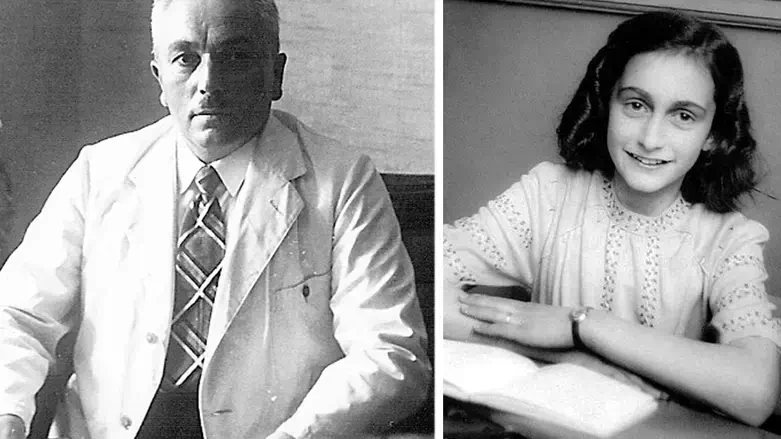
A grave question attends this year’s International Holocaust Remembrance Day. January 27, 2026, marks 81 years since the liberation of the Auschwitz concentration camp and the chilling awareness that six million innocent Jews, including over a million children, had been rounded up throughout Europe and then murdered under the direction of Adolf Hitler.
The response for decades has been the determined cry, “Never again." But stalwart resolutions cannot compete with anonymous voices using satellites in space to spread ancient hatreds around the globe.
Widespread attacks these past several years, fueled by political, racial or religious enmity, claimed more Jewish lives: in synagogues in America and in England, on a beach in Australia, and at the Gaza border, where over 1,200 Israelis were senselessly killed. Harassment and vandalism occurred in several states in Asia and in South America.
The reach and virulence of this renewed antisemitism evokes the question, “Are we on the threshold of a second Holocaust?"
It is jarring to have to consider such a barbaric prospect in our brilliant era, where science fiction has been turned into fact: robotics, gene editing, flying cars and artificial intelligence.
But the question is crucial because those who carried out the first Holocaust felt the same pride about their inventions.
Unfortunately, the human mind, so capable of improving the external world, holds little sway over the primal urges for dominance, tribal exclusiveness and territorial control that create new conflicts and wars each year.
It is not politically incorrect or a matter of being insensitive to religious feelings to wonder if the push by anti-Jewish and anti-Israel militants today--which has even spread on our college campuses-could result in the havoc and destruction the National Socialists wreaked with their antisemitic and supremacist ideology.
For sure, Islamic jihadists in Iran and throughout the Middle East insinuate and even openly threaten to do that it in their official charters and declarations.
And it must not be forgotten how Hajj Amin al-Husseini, the Grand Mufti of Jerusalem, closely collaborated with Adolf Hitler to keep Jews from establishing a Jewish state and was instrumental in raising divisions of Arab volunteers for the Waffen-SS.
In 1939, after six years of convincing Germans they were a “master race" and deserved to rule the world, Adolf Hitler sent his armed forces into Poland to claim territory. And to kill Jews. Hitler’s killing squads, the Einsatzgruppen, were also instructed to murder Polish leaders and intellectuals to intimidate Poles to accept their fate as second-class citizens.
When the dictator turned toward the western European nations, his brutality in Poland paid dividends. The fanatical stormtroopers of the New Order, with their Panzer tanks, Stuka dive-bombers and copies of the Nazi bible, “Mein Kampf," were not met by the strong and resolute nations that had defeated Germany in the First World War. They encountered a people fed up with war and the incompetence of their own governments, who offered the invaders only a token, listless resistance.
Denmark gave up in six hours. The Netherlands, Luxembourg, and Belgium had no heart for the fight, lasting only days. France, which had ruled Europe under Napoleon Bonaparte, fought for a month and a half and spent the next five years placating its conquerors.
Hitler ordered the implementation of anti-Jewish policies in his new possessions. With Nazi soldiers patrolling the streets and public radio broadcasts blaring Adolf Hitler’s speeches, the occupied people did not object. On the contrary, as the German army seemed invincible, it gained adherents for Adolf Hitler’s racial obsessions and Joseph Goebbels’ pervasive manipulation. Soon, many among the occupied would become complicit in the greatest crime in history: the Holocaust.
From 1942 through 1944, the local police in these highly cultured nations followed the orders of their overseers to methodically search every apartment, house, attic and cellar for Jews and turn them over to the Germans.
France’s army of gendarmes rounded up 75,000 for Auschwitz, where most were murdered upon arrival.
The Netherlands arrested over 100,000, including a young Jewish girl named Anne Frank.
"They are taking people away, and there is nothing we can do about it," wrote the 14-year-old girl in her diary in April 1944. “I wish I could do something to stop it, but all I can do is cry and pray."
Buoyed by her 15th birthday in June, Anne Frank wrote, “In spite of everything, I still believe people are really good at heart."
But hope was no match for the daily reality of this girl’s bleak world, and on August 1, 1944, Anne admitted, "It’s hard to see how we can ever be happy again."
Three days later the despairing girl and her family were betrayed. Anne Frank died of typhus in the Bergen-Belsen concentration camp in northern Germany two months before the camp was liberated by British and Canadian troops.
The Allies chased the remnants of the army of the master race back to their homeland. The Führer, who swore his Third Reich would rule the world for one thousand years, used a bullet to avoid the hangman’s noose.
On May 7, 1945, the day before the provisional German government was to sign an unconditional surrender, Friedrich Kellner, the court administrator in a small town in central Germany, penned one of the last entries in his diary, referring to the horror the Jews had faced under a crazed authoritarian ruler and his nation of brainwashed followers:
“From the Allies’ radio broadcasts these past few days, we are receiving descriptions of the conditions in the German concentration camps that can only be called bestial and unforgivable," wrote Friedrich Kellner. “That even a single concentration camp could exist here is a gross dishonor. These abuses during the despotic rule of Adolf Hitler and his devoted bandits will remain into the far reaches of time as a glaring warning signal in the history books of mankind."
Kellner had no illusions about Hitler’s death and the war’s end. Others were still alive-or yet to be born-who would repeat the savagery: sending out an army with guns in one hand and doctrine in another; violence and ideology operating together.
And the unwitting democracies would once again be readily overpowered, and once again the Jews would be made both scapegoats and victims of another Holocaust.
“The Nazis will have disappeared some day," predicted Friedrich Kellner. “But their deeds will live on."
Robert Scott Kellner, a navy veteran, is a retired English professor who taught at the University of Massachusetts and Texas A & M University. He is the grandson of the German justice inspector and diarist Friedrich Kellner and is the editor and translator of My Opposition: The Diary of Friedrich Kellner--A German against the Third Reich, Cambridge University Press, United Kingdom, 2020.