

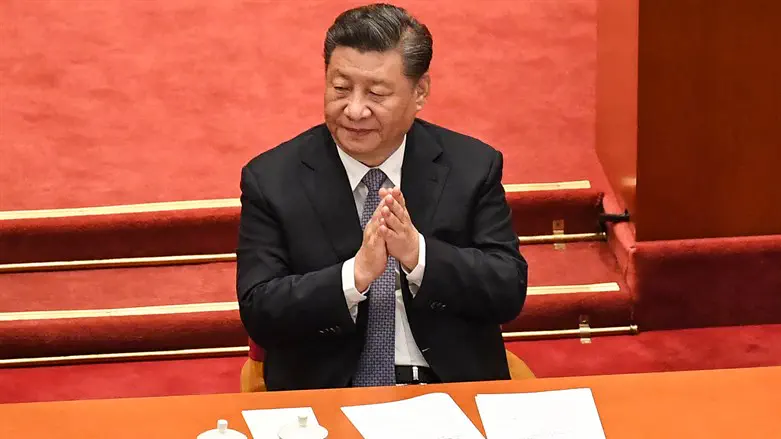
On one side, a nervous West, gasping as it tries to defend a world order it no longer controls; on the other, a China that watches the cracks in its adversary and continues to weave its web of influence with strategic patience.
It is a two-speed race, but not in the same direction.
China builds infrastructure in Africa, invests in European ports (from Piraeus to Trieste, from Genoa to Rotterdam-in practice, all the main European ports), develops strategic technologies, and does not need to “win"; it merely needs to know that the other side is wearing itself out. The message is implicit but clear: the West runs, China walks-and he who walks does not tire and eventually goes farther.
China will therefore have its mega-embassy in London, and its expansionism is a slow poison that corrodes the foundations of Western civilization.
The Labour government of Keir Starmer has approved the much-debated and controversial construction of Chinese power in the heart of the British capital. It will rise on the site of the former Royal Mint Court, a stone’s throw from the Tower of London and the Thames, which once carried the riches of the British Empire.
A complex not only of bricks, glass, and steel, but a symbolic and operational outpost of the Chinese Party-State in the soft underbelly of the West. Post-Brexit Britain, despite having severed its ties with Brussels, remains the quintessential transatlantic bridge.
Everyone wants London.
There will also be a hidden room next to London’s most sensitive communications cables inside the new Chinese mega-embassy, which will be built despite protests from British intelligence.
Documents obtained by The Telegraph show an underground complex of 208 rooms beneath the diplomatic site, which Beijing tried to keep secret. Just centimeters from the fiber-optic cables that transmit the City’s financial data, along with email traffic and messages from millions of users. According to The Telegraph, the room could allow China to access sensitive information and critical economic data. Alicia Kearns, Shadow Minister for National Security, warned that approving the embassy would mean providing China with “a base for economic warfare at the heart of the nervous system of critical national infrastructure."
For years now, China has been shopping.
Twenty major UK universities have accepted £40 million in funding from Huawei and Chinese state-owned companies, The Telegraph reports. Many of these companies have direct links to the Chinese Communist Party. Imperial College London accepted between £3.5 million and £14.5 million from Huawei, the Chinese telecoms giant that has been banned from many European 5G networks for security reasons. The university also received £10 million from Sinopec, the Chinese state-controlled petrochemical company, and £6.5 million from the Aviation Industry Corporation of China, a state-owned defense conglomerate. Huawei donated £1.1 million to Lancaster University. Other universities, including Bristol, Exeter, and Heriot-Watt, have refused to disclose details of their funding agreements.
But Chinese money is not free. In 2017, Cambridge blocked 300 academic articles at the request of Chinese authorities, covering topics from human rights to Tibet and Xinjiang. Louisa Lim, author of a book on the Tiananmen protests, called it a “terrible" example of how “profit motivates assessments of academic freedom." It was clear what was being demanded in return.
The Times reports that at Cambridge, Professor Peter Nolan, director of the China Centre, warned against discussing China on campus, saying it would not help “mutual understanding," and advised colleagues to avoid controversial debates on the state of human rights in China. Sir Iain Duncan Smith, former Conservative leader, had just stated that Cambridge and other British universities seem to have become “mouthpieces for the Chinese Communist Party."
As always, follow the money…
The Cambridge college where Nolan teaches has, unsurprisingly, received a £3.7 million donation to fund his chair from a foundation belonging to the daughter of a former Chinese prime minister, Wen Jiabao.
“How China Is Buying Britain" (The Times). “How China Bought Britain" (The Spectator). The debate now is merely about the verb tense.
Opposing American hegemony, perceived as vulgar and caricatured, has become the gateway to embracing a far more sophisticated authority: that of the Chinese Communist Party, which does not tweet insults but builds the Belt and Road, buys ports, finances academic elites, and shapes global narratives with the patience of those who know time is on their side.
Last November, China invested another €138 billion in strategic sectors of European economies.
While Trump is portrayed as the bully who “threatens the liberal order," Europe yields symbolic and strategic ground to its number one systemic rival.
Europeans are a blend of Vichy France, which collaborated with the Nazis to “resist" the Anglo-American Allies, and the Byzantine Empire, which allied with the Ottoman Turks against the Latin Crusaders, thereby accelerating its own fall.
The orange Yankee, however crude, defends values that Europe claims as its own: individual freedom, the free market (albeit with tariffs), Westernism, and a transatlantic alliance that saved the continent from Nazism and Soviet communism.
When we look into the face of the yellow mandarin, by contrast, we see nothing.
That is why preferring China’s quiet despotism to America’s tumultuous populism, Xi Jinping’s high-tech totalitarianism to Trump’s nationalism, is the royal road to European suicide. A geopolitical harakiri.
Canadian Prime Minister Mark Carney, praised by much of the press as an anti-Trump figure, has just concluded meetings with Chinese Premier Xi Jinping for a new strategic partnership. The next day, Carney was in Qatar signing further agreements.
Between the Chinese and the emirs, democracy is in excellent hands.
Royal Mint Court, where the largest Chinese embassy in Europe will rise, is not just a building; it is the place where pounds sterling were once minted, a symbol of monetary and imperial sovereignty. Now it will host the largest diplomatic fortress of a regime that considers Taiwan a rebel province, Hong Kong a memory to be erased, Uyghurs and rebellious Christians a “re-education" problem, Tibet a nuisance to be assimilated, and the West an adversary to be weakened with millennia-old patience.
Let us remember Orwell’s words in 1984: totalitarianism does not arrive wearing hobnailed boots, but with smiles and promises of prosperity.
Will we trade the West for the yuan? Our sunset will not be an eclipse, but a silent annexation.