
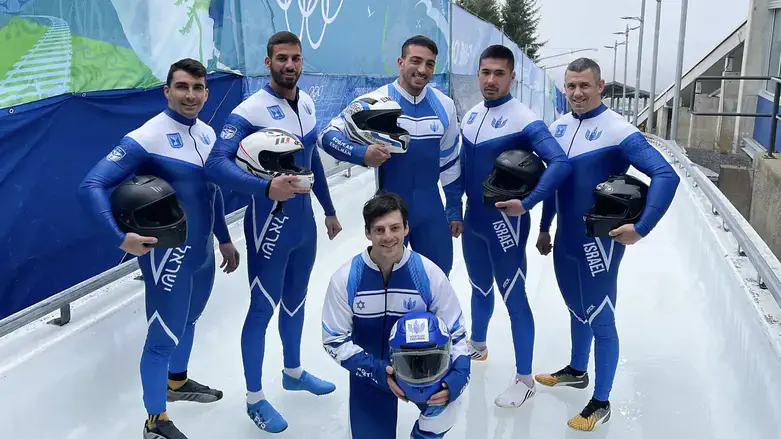
Israel’s qualification for the Milano Cortina 2026 Winter Olympics should be uncomplicated joy.
A bobsleigh team, from a country with no ice tracks, no winter-sports tradition and no natural right to be part of this event, has qualified for the Winter Olympics for the first time in its history. It is a triumph of ingenuity, discipline and belief. A reminder that Israeli sport, like Israel itself, has always punched far above its weight.
Yet, for Jews, sporting achievement is never allowed to exist in isolation. Every Israeli sporting moment carries the weight of history and the knowledge that celebration is often followed by hatred, pride sits alongside vigilance, and joy alongside memory.
Because it is impossible to think about the Olympics, as a Jew, without history forcing its way in.
The word Olympics still echoes with the 1936 Berlin Olympics, where Jewish persecution was temporarily disguised so the world could be entertained.
It echoes with the 1972 Munich Olympics, where eleven Israeli athletes were murdered simply for competing under a Jewish flag and where the Games resumed with chilling speed.
It echoes with the 2024 Paris Olympics, where Israeli athletes were hounded, threatened, accused of “genocide", for a war they neither started nor control, but for which they were nevertheless held collectively responsible.
This is the context in which Israel celebrates sport.
So yes, this bobsleigh qualification is extraordinary. But it is also something else, another act of persistence in a long story where Jews are welcomed only so long as they do not insist on being visible. Make no mistake, this burden is not confined to the Olympic arena.
The Beautiful Game and the ugliest exclusions
If sport is meant to unite, football should be its purest expression. The world’s most loved, most watched, most played game calls itself beautiful. Yet for the only Jewish state, football has rarely lived up to that name.
To this day, people still ask, usually with misplaced suspicion, why Israel plays in Europe. Why Israeli clubs compete in UEFA tournaments? Why they do not compete in the Asian confederation?
The answer is painfully simple.
Israel was once a member of the Asian Football Confederation. That was where it belonged geographically and competitively. But for decades, Arab and Muslim-majority nations refused to play the Israel national football team. Matches were boycotted, tournaments abandoned, politics decided results before a ball was kicked.
In 1974, Israel was expelled from Asian football, not for misconduct, but because too many member states refused to share a pitch with Jews. What followed was sporting exile. Israel wandered between confederations, played “home" matches thousands of miles away and competed without a permanent sporting home.
Only in the 1990s did Israel find stability within UEFA, not because Europe made sense geographically, but because it was the only place where Israel could reliably compete without political boycotts.
This wasn’t privilege, it was survival.
When neutrality collapses and hypocrisy takes its place
Sport loves to speak the language of ideals.
Institutions insist that sport transcends politics, that it offers a neutral arena where rivalry replaces violence and rules replace hatred. But neutrality, it turns out, has limits and those limits appear precisely where Israel begins.
It is not merely that countries engaged in wars, repression, or industrial-scale human-rights abuses are allowed to compete. They are routinely rewarded, granted the greatest gift sport can bestow, the right to host.
China, Russia, Qatar, Saudi Arabia, an esteemed quartet in modern sports-washing, have enjoyed global prestige, sanitised imagery, soft-focus ceremonies, sport not as scrutiny, but as absolution.
Meanwhile, Israel, uniquely, is treated as a moral contaminant.
Its athletes are not merely criticised, they are delegitimised, boycotted and targeted. Asked to account for geopolitics before being allowed to compete, an inversion that no other nation is ever forced to face.
Since October 7th, the volume has become a roar
It would be dishonest to pretend this hostility is new, but it would be equally dishonest to ignore what has changed. For years, antisemitism in sport was sporadic, ugly, but episodic. Since October 7th, it has become a cacophony and worse, a successful one.
Israeli youth judo teams have been hounded out of competitions in Poland with antisemitic and genocidal chants, children targeted simply for being Jewish.
Israel’s flagship professional cycling team, Israel-Premier Tech, has been forced to erase its national identity entirely. For the 2026 season it will rebrand as NSN Cycling Team, abandon its Israeli license for a Swiss one, relocate its base to Spain and drop any reference to Israel, following sustained pro-Palestinian protests and the loss of its title sponsor.
In the NBA, Israeli star Deni Avdija has spoken openly about how exhausted he is by the hatred directed at him, not for his play, not for his conduct, but simply for being Jewish and Israeli.
And in the UK, the absurd reached its most disturbing expression when Jewish fans were banned from attending a football match in Birmingham, a decision later shown to have been based on false intelligence, so serious that it ultimately led to the resignation of the region’s chief police officer.
That is where we are now, not disagreement, not protest, but exclusion, justified by lies, normalised by institutions and enacted in the name of “safety".
Back to the ice
Which is why this bobsleigh qualification matters so deeply. It is not just about winter sport, not just about firsts, flags, or medals. It is about insistence, the refusal to disappear quietly.
Israeli athletes do not merely compete, they persist. They show up to arenas weighted with memory, perform under scrutiny no one else faces, carry history on their backs and still push forward, whether on grass, on tatami mats, on basketball courts, on roads, or now, on ice.
So yes, celebrate this moment, celebrate the ingenuity, the ambition, the sheer improbability of it all, but understand it for what it truly represents. Another chapter in a long story where Jews, once again, insist on being present, visible, competitive, unbowed.
Wherever Israel finishes, very likely near the back of the field, it won’t matter, because this has never been about medals. What will matter is that an Israeli flag will be there.
That Jews will compete on the world’s greatest sporting stage. That after everything; exclusion, erasure, intimidation and pressure to disappear quietly, we will still show up. Not rebranded, apologetic or asking permission, but present.
For a few minutes on the ice, the message will be unmistakable: you can try to boycott us, intimidate us, or shame us into silence, but you will not remove us. Not from sport, not from history, not from the world stage. We will watch, we will stand a little taller and we will remember that visibility itself is a form of resistance.
Because for Jews, competing has never just been about winning. It has been about insisting, again and again, that we are here and we are not going anywhere.
LEO PEARLMAN is a London based producer and a loud and proud Zionist. His most recent film about the Oct 7 Nova Music Festival massacre, ‘We Will Dance Again’ has won the 2025 Emmy of the 46th Annual News & Documentary Awards for most ‘Outstanding Current Affairs Documentary’