
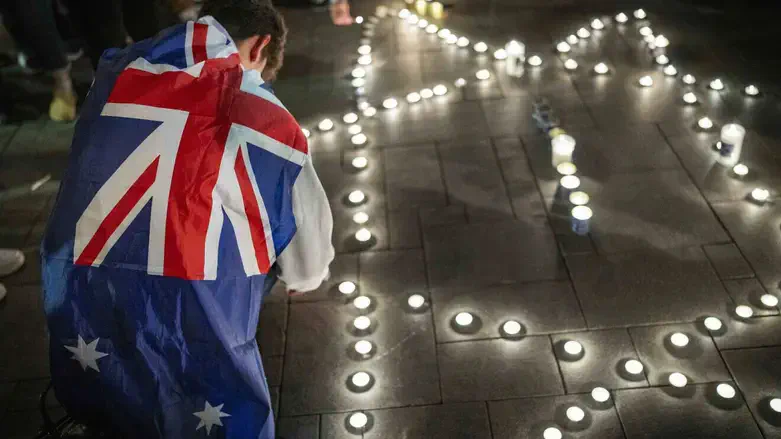
Thursday’s Bondi Beach memorial at the Sydney Opera House was truly moving. Families of the 15 Jewish victims, survivors, politicians and community leaders lit candles and shared prayers under the banner “Light will win." Prime Minister Anthony Albanese apologized to the victims’ families, saying “I am deeply and profoundly sorry that we could not protect your loved ones" . In an apt phrase echoed by Rabbi Yehoram Ulman that evening, “our hearts are broken, but our spirit is unbroken".
But as solemn as that ceremony was, it underscores a hard truth: memorials and public sympathy alone will not stop the next attack.
Traditionally, the Jewish people have relied on “Never again" - remembrance of the Holocaust’s six million murdered Jews (including 1.5 million children ) - as a shield against antisemitism. For decades this moral appeal did help. Major wars and the global consensus after 1945 kept most countries wary of open Jew-hatred. Holocaust education and commemorations put a check on extremists. But that world is disappearing. The last Holocaust survivors are elderly: fewer than 200,000 remain alive , with a median age of 87. Within years, there will be no eyewitnesses left. Holocaust museums and films (from Schindler’s List onward) preserve the memory, but their power is waning as the world’s attention shifts.
As Rabbi Ulman put it at Bondi, “We don’t fight darkness by shouting… we fight darkness by turning on the lights. And… one thing is clear to me: that light will win" . Indeed, focusing only on past victimhood - however sacred those memories - cannot by itself stop antisemitism in the present.
History proves this lesson. Whenever Jews depended solely on others for protection, tragedy followed. After the Holocaust, much of the Jewish world rested on the compassion of non-Jews and on the guarantee that the world would “remember." That guarantee is failing. Holocaust lessons have been downplayed or even attacked in some countries; living survivors - once symbols of urgency - are passing away. Surveys show rising antisemitism globally as younger generations grow up with fewer personal ties to those events. The Claims Conference reports the world’s survivors fell from ~220,000 to 196,600 in the last year . With each disappearance, the day when “never again" truly dies draws closer.
In practical terms, today’s Jewish communities cannot afford to rely on outside sympathy alone - even after a horror like Bondi. Yes, we need memorials to honor the dead. The Sydney Opera House vigil was necessary and moving, a national “hug" for Jewish Australia. Flags fly at half-staff , and good deeds (“15 Mitzvahs for 15 souls") have been pledged in the victims’ memory. But if all we say to the world is “feel sorry for us", we will remain vulnerable. As Rabbi Ulman explained, the Jewish response “is not to pull away from society, but to contribute more to it" . Solidarity is good - but strength is better.
The proper lesson of Bondi is that Jewish safety must increasingly be ensured by Jews themselves. Australia’s new royal commission on antisemitism and the swift gun reforms are positive, but Jewish communities can’t count on lawmakers or public empathy alone. Around the world, Jewish leaders are concluding much the same thing. We have learned that “when Jews rely on the goodwill of others for survival, Jews eventually pay in blood," as one recent analysis bluntly put it .
Our ancestors learned this the hard way. Think of Masada, where Zealots rebelled rather than trust Rome. Think of pre-state Israel, where pioneers formed the Haganah militias and later the IDF - “the first Jewish army in 2,000 years". The modern State of Israel itself was built on self-reliance. As U.S. Rep. Rudy Yakym said after Netanyahu’s 2024 speech to Congress, “Israel is our closest ally and the only democracy in the Middle East" - a beacon that survives because it can defend itself against existential threats.
Likewise, diaspora Jews must bolster our own security and readiness. This means building strong, coordinated defense networks in every community. Grassroots Jewish volunteer patrols (like New York’s Shomrim or similar groups) have shown how neighbors can watch out for each other on the street. But today’s threats - including politically-tinged mob attacks - demand higher standards. We need rapid-response teams of trained volunteers who can intervene immediately when antisemitic harassment occurs.
I have repeatedly urged the creation of a global Jewish Defense Network of such teams that is urgently needed. Trained in first aid, de-escalation and law (not vigilantism), these teams would “stand between [Jewish] victims and harassers," document incidents, escort people to safety and coordinate with police . Imagine a Jewish woman in Melbourne being taunted on the street: one phone call summons a patrol that arrives swiftly to protect her, sending a message that Jews are never alone on the street .
Importantly, this doesn’t mean skipping the police. We must work closely with law enforcement - as I have always emphasized - but Jewish-led teams fill the painful gap when police response is slow or politicized. In Miami Beach after the attack I suffered at the Fontainebleau hotel* I met with the Chief of Police as well as the Mayor. They promised everything, but delivered nothing.
(*As noted above, I was personally attacked by unhinged Islamist, Faiz Akbar, at the hotel in Miami Beach and threatened with murder. Not only did the hotel do nothing to protect me, but it actually sued me about the incident.)
In too many places today, defenders have been treated worse than victims: French Jews attacked during protests have sometimes been arrested themselves, as prosecutors dismissed antisemitic mobs as “free speech." As one expert noted, police can be “slow, inconsistent, or constrained by politics," leaving Jews stranded . Community teams give immediate support.
As noted above, I was personally attacked by unhinged Islamist, Faiz Akbar, at the Fontainebleau hotel in Miami Beach and threatened with murder. Not only did the hotel do nothing to protect me, but actually sued me about the incident.
Israel’s example illustrates what is needed. Apart from building a modern army in 1948, Israeli society kept Jews armed and ready: gun ownership is common, military training widespread, and national ethos centered on “never again" in action. We cannot simply duplicate IDF-level forces in Australia or the U.S., but we can adopt the mindset. I’m not here to litigate the Second Amendment which is beyond the scope of this column. But every Jewish organization - synagogues, schools and cultural centers - must strengthen security.
We also need street-level courage. Decades ago, Rabbi Meir Kahane’s Jewish Defense League captured this ethos, amid considerable controversy: As one historian recounts, JDL members “arrived at threatened neighborhoods with guns and gusto…organizing patrols and vowing that ‘wherever Jews are threatened, [the JDL] would respond.’" . Kahane’s motto “Never Again" meant no Jew would perish again after the Holocaust in antisemitic attacks. No, we’re not advocating lawlessness or any animus toward others whatsoever or that the JDN be armed - far from it. The idea here is a network of volunteers who simply respond in body to escort Jews away from dangerous encounters and support them, reminding them they are never abandoned or alone. But Kahane recognized that relying on white-collar Jewish leaders or outside appeals had left the lonely, working-class Jew exposed.
In the 1970s this even extended overseas: after the 1972 Munich massacre, Israel created Mossad teams to hunt down terrorists and encouraged diaspora self-defense, rather than waiting for U.N. justice. Forty years later, Jewish communities worldwide mimic this by hardening institutions (ballistic glass at synagogues, guards at schools). Today’s threat - driven by extremist ideology and online hate - calls for updating that approach. We must apply “never again" not just to history, but to every moment. When Jews are insulted or attacked, we must answer firmly. We alert authorities, use cameras to record antisemites, and - if safe and legal - we stand our ground. We do not run away or beg for sympathy.
Nor should our public messaging be morbid or passive. The world accepts Holocaust victim imagery. Spielberg’s Schindler’s List, Anne Frank diaries, documentaries - all rightly remind people of suffering. These stories are of infinite significance, but the narrative must have balance. We must promote the story of a proud, resilient people. We should advance the message of Israel and the Jewish future: as one advocacy group argues, “schools, media, and politicians [should] teach the truth, that Israel is the only democratic, inclusive, and diverse state in the Middle East…protecting the rights of all its citizens while fighting for its very survival" . Highlight Israel’s ingenuity, democracy and humanitarian actions as reasons the world should stand with us. Emphasize that the antisemitic massacre at Bondi was also “an attack…on the Australian way of life," as PM Albanese admitted , meaning a slap at everyone who values freedom. This broadens our support base beyond just Jewish sympathizers.
Within Jewish discourse, we should pivot from the victimhood narrative to a message of strength. We mourn the dead with dignity, then say: “We live on. We rebuild. We remember by acting, not just by grieving." Rabbi Ulman’s call for “15 mitzvahs for 15 souls" at Bondi is a great example of turning grief into action. Mitzvot - good deeds - show the world that Judaism means life. Similarly, Jewish education should stress that Israel’s enemies relish seeing Jews isolated and afraid; the antidote is pride in identity and communal solidarity.
In concrete terms, Jewish communities worldwide should launch major public-relations campaigns that reframe the story. We have to educate media and the public: Israel is a democracy under siege from jihadists and fanatics, not an aggressor. We must counter the delegitimization efforts by spotlighting Israel’s right to self-defense. In America, groups like AIPAC already lobby on these narratives; in Australia, Jewish leaders must be equally vocal. Engage with government and mainstream civil society: make Israel’s security part of Australia’s security conversation. Only when non-Jews truly understand that our survival is tied to “light" - Israel’s democratic light - will they resist antisemitism. We cannot assume they will unless we keep reminding them, forcefully and factually.
Above all, the Jewish community itself must be bold and uncompromising. There’s a time and place for dignified mourning - the Bondi memorial was that time. But tomorrow, and every day after, must be about asserting our strength. We should carry the posture of people who refuse to be victims ever again, who walk the streets with confidence, and who demand a safe life for our children. Our leaders can push for tougher laws against hate, but enforcement has limits. Ultimately, as history has shown and as I’ve warned, when “optics did not save Jews on October 7," neither will optics save us anywhere . Only our own vigilance, preparation, and unity will.
Bondi Beach reminded us of how awful the world can be. Let it also remind us of what works. Every synagogue installing better cameras, every community patrol that scares off thugs, every pro-Israel speech in a school, every child taught Hebrew who faces down a bully - these build a buffer that mourning alone cannot. We owe that to the martyrs. Their memory demands not just candles and prayers, but action. We must turn our heartbreak into determination. As one Australian rabbi said, “the Jewish response to tragedy is…to contribute more, to heal it" .
This is the new covenant: we will fight darkness by being its antidote - a strong, united, self-reliant Jewish people. The message to the world must be clear: do not pity us - respect us and hear our voice. We are not alone, we are not helpless, and we are not going anywhere.
We, the Jewish people, are forever.
Rabbi Shmuley Boteach is the international bestselling author of 36 books and is described by The Washington Post and Newsweek as “the most famous rabbi in America," by The New York Observer as “the most famous orthodox Jew in the world," and by The Jerusalem Post as one of the 50 most influential Jews alive. He is founder of The World Values Network, which champions Jewish values and fights antisemitism worldwide. Follow him on Instagram and “X" @RabbiShmuley.