
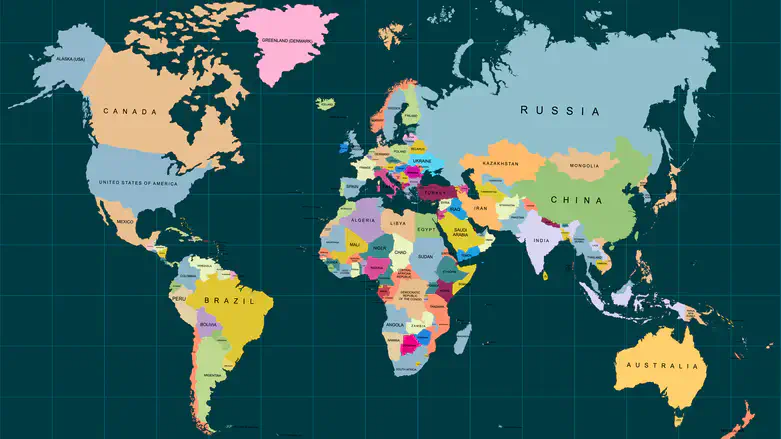
Recently, President Donald Trump called the deal he is making on Greenland a "great solution for the United States of America, and all NATO nations".
Under the framework, the US will take over at least some parts of Greenland by designating them as sovereign military bases. The bases could be considered US territory in the Arctic region; perhaps via an indefinite lease like Guantanamo Bay, in Cuba.
As a result, the US would be able to perform military operations, intelligence, and training, and an unfettered level of local development in the designated areas, including mining for rare earth minerals, without Denmark's authorization.
The US is already allowed to build and run military bases in Greenland with full "freedom of operation" in designated defense areas, including air, land, and sea, under Denmark's permission; however, the new framework could allow the US directly to control at least parts of Greenland without having to seek permits or planning permission from local authorities if it wanted to mine on its soil or install infrastructure.
The proposal would also make it easier for the US to set out its military assets and finally build its own Israel-style "Golden Dome" missile defense system.
Vladimir Putin recently claimed whatever happens in Greenland "is of absolutely no consequence" to Russia. Nevertheless, negotiations between Denmark, Greenland, and the US will ensure that Russia and China never gain a foothold in Greenland.
Greenland is a part of the continent of North America, which makes it part of the Western Hemisphere. Per the Monroe Doctrine, Greenland's ownership is a national security issue for the US.
The Monroe Doctrine is a US foreign policy position that opposes European colonialism in the Western Hemisphere. Since WWII, it has been extended to oppose any foreign interference in the Western Hemisphere. It holds that any intervention in the political affairs of the Western Hemisphere by foreign powers is a potentially hostile act against the US.
Furthermore, the US National Security Strategy of November 2025 stated: "The United States must be preeminent in the Western Hemisphere, as a condition of our security and prosperity…".
The strategy was on full display, when the US went to Venezuela to capture its president to bring him to America to face narco-terrorism and other charges.
The recent issue on Greenland isn't about Greenland; it is about Europe. European leaders wrote a beautiful communique on Greenland, but it isn't about communique; it is about power. Europe cannot be trusted to keep out Russia and China from Greenland.
According to Scott Bessent, US Treasury Secretary: "Greenland can only be defended if it is part of the US, and it will not need to be defended if it is part of the US."
Since the 19th century, the US has made several attempts to acquire Greenland from Denmark. In 1867, there were discussions within the US government about purchasing Greenland advocated by secretary of state William H. Seward, and again in 1910. Since World War II, the US has had at least one military base in Greenland. In 1946, the US secretly offered to buy Greenland, but it was rejected by Denmark. Since 1949, Greenland has been under the protection of NATO, of which the US and Denmark are both members. Nevertheless, the US Joint Chiefs of Staff proposed acquiring Greenland in 1955. In the 21st century, President Donald Trump asserted during his two presidencies that the US should take over Greenland.
In 2019, during his first presidency, Trump proposed for the US to purchase Greenland; it was declined and described as "absurd" by Danish Prime Minister Mette Frederiksen. During his second presidency in 2025, Trump asserted that the US must acquire Greenland. Following Greenlandic and Danish refusals to sell the country, Trump threatened to invade or annex Greenland, but has since disavowed its acquisition by force.
During World War II, after the German occupation of Denmark, the US invoked its Monroe Doctrine and occupied Greenland to prevent its use by Germany. The US military remained in Greenland after the war. In 1948, Denmark abandoned attempts to persuade the US to leave. The following year, both countries became NATO members. A 1951 treaty gave the US a significant role in Greenland's defense and allowed it to have bases there. The US eventually shut all of its bases except for Thule air base, now Pituffik Space Base, in northwest Greenland.
An acquisition of Greenland would give the US control of an island that it sees as crucial to its defense. Its airspace is vital to the air defense of North America. Military operations have become dependent on polar-orbiting satellites. According to SpaceNews, a publication that covers business and political news in the space and satellite industry, "any satellite in a polar or sun-synchronous orbit, such as those in critical communications, imagery and weather monitoring constellations, requires an Arctic ground station".
The US Space Force base in Greenland, Pituffik Space Base, is one of two Arctic facilities available to the US, the other being Clear Space Force Station in Alaska. If the US lost Pituffik Space Base, this would "have serious consequences for both a future conflict and business as usual in orbit", according to SpaceNews.
Americans should have clear title to Greenland for their national security. They can't just be there as the case of their being on their Diego Garcia base in the sovereign British Indian Ocean territory of the Chagos Islands, which the British prime minister Keir Starmer is determined to give Mauritius; essentially a vassal of China. It is about 1,250 miles away from Mauritius, and Mauritius has never owned it.
The UK's deal on the territory of Chagos Islands is an act of great stupidity. The UK plans to pay billions for the territory it owns, after giving it away to Mauritius.
Similarly, a Danish government now or in the future could hand over Greenland to an adversary of the US. America should preempt such an outcome by acquiring it now.
The rules-based international order is dead. It was purposed in the aftermath of World War II, and that period is over. It was based on a false premise, such as the president of the US and the prime minister of Denmark are of equal stature, or that Canada and the US are of the same stature. The premise wasn't true in 1950, and it is dangerously false now. For over 70 years, America and everybody else went along with pretending it was true, until Trump came on the scene in his first term. Now in his second term, in a recent speech in Davos, he essentially declared he would no longer consider the president of the US as being equivalent to the leader of a less powerful country.
Recently, President Emmanuel Macron of France summoned an emergency meeting of the G7 to Paris on the Greenland issue, which President Trump summarily rejected because he is the President of the US and Macron is not.
The lesson of the war in Ukraine, which has been going on for four years, is that Europe cannot defend itself against Russia. Moreover, the lesson of Trump's threat to use force to acquire Greenland is that Europe cannot defend itself against the US.
The US is responsible for about 67% of the budget of NATO, while Canada and the European members are responsible for the remaining 33%. The US has about 350 million people and the Europeans have around 500 million. So the Europeans are not carrying a fair share of the burden in NATO. Moreover, their military budgets are inadequate for the defense of their countries. Thus their reliance on the US for their own defense.
An agreement on bases in Greenland with a Danish leader, whose successor can renege on it, isn't worth it for the US national security. Furthermore, neither Denmark nor Europe is competent to determine US national security.
The future of Greenland is America.
Dr. Sheyin-Stevens is a Registered Patent Attorney based in Florida, USA. He earned his Doctorate in Law from the University of Miami.