

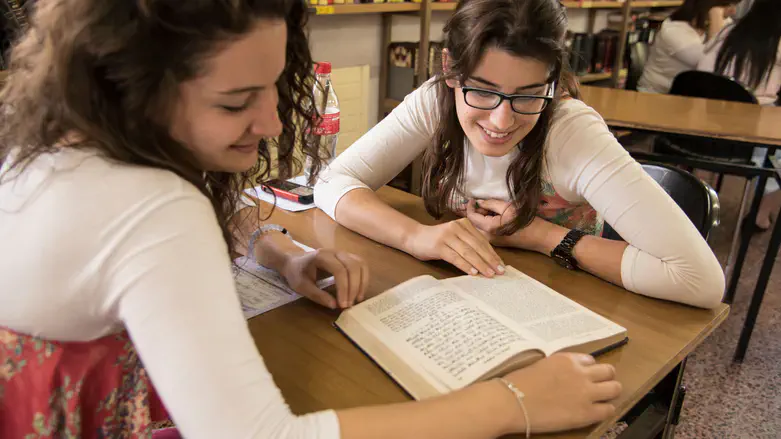
Amid her busy life as a mother of six, grant consultant, and product manager, Shira Kasser of Rehovot, Israel, makes time daily to study Nach through Torat Imecha Nach Yomi, a two-year cycle learning program by the Orthodox Union’s Women’s Initiative.
“When I heard about Nach Yomi, I thought, ‘That's so nice, but my life is so busy,’" she says. "But then I decided, Im lo achshav, eimatai (If not now, when)? If Torah is a priority, one should invest in it diligently. My husband learns, our children’s Torah education is very important, and my own Torah learning is a priority as well."
Established in 2017 by Rebbetzin Dr. Adina Shmidman, the OU Women’s Initiative offers programs that strengthen women’s Torah study, leadership, and personal and professional development. In 2020, it re-launched the Nach Yomi program under the Torat Imecha umbrella. Originally taught exclusively by men and running successfully since 2008 under OU Torah Content Editor Rabbi Jack Abramowitz, the program now gives female educators a prominent platform to teach Nach and share their voices. Geared for learners of all levels, Nach Yomi shiurim are available worldwide via the Torat Imecha app.
Nach Yomi unites women of diverse hashkafot, life stages, and levels of learning across all five continents, including Australia, Brazil, England, France, Germany, Mexico, and South Africa. This February, thousands of women, including Kasser, will celebrate the completion of the third Nach Yomi cycle at grand siyumim in five U.S. cities and in Jerusalem. Female relatives, friends, and community members are invited to share in this collective milestone.
“There's remarkable pride in the level of scholarship and Torah learning our women have reached," says Rebbetzin Dr. Shmidman. “This is a communal celebration, and we invite everyone to join in the simcha of this accomplishment."
Kasser has been a part of Torat Imecha Nach Yomi since its inception and says the experience has been transformative.
“When you study Tanach, everything comes alive," she notes. “Everywhere you go, you’re walking through history. Understanding our heritage shapes you in an entirely different way as you move through life. It broadens and anchors you in your inheritance and in who you are. Before I studied Nach Yomi, I felt disconnected from the days when there were neviim. Now, their words come alive. Particularly since October 7, we're writing our own megillot. It fills me with light and meaning."
Rebbetzin Dr. Shmidman notes that the messages of Tanach are both timeless and timely.
“The pesukim we learn are remarkably relevant to the current situation in Israel," she says. “This past cycle, it was very powerful to see a correlation between our texts and what was unfolding there in real time. The Anshei Knesset HaGedolah organized Nach with a thematic trajectory that only comes across when studying it over the course of two years."
With two children under four, Kasser adapted her learning style this cycle, listening to the shiurim rather than reading along with the recordings as she had before.
“This year, the siyum will be a bit different for me because I wasn’t able to read the text," she says. “At the same time, it’s the most beautiful siyum, because my reward is simply completing my learning."
Like Kasser, Goldie Grant of Manchester, England, also carves out daily time for Torah study while juggling high school tutoring, and work and volunteer roles with mental health and bereavement charities.
“It is important to me to use my time that Hashem has given me wisely and productively so that I can reflect on my growth and achievements," she says.
After reading an article about the program and the second cycle siyum, Grant joined Nach Yomi in March 2024, during the third cycle. Though the group was already midway through Shmuel Aleph, she felt the timing was right.
“I resolved to catch up on the approximately 60 shiurim I had missed, so that I can truly feel a sense of completion when we reach the end of Divrei Hayamim Beis. I hope to be fully caught up within the next few weeks, b’ezras Hashem."
Grant listens to shiurim as part of her morning routine, or while cooking and traveling.
“I feel honored and blessed to learn from such talented and inspiring women," she says. “I love to learn, and I am so grateful to have acquired so much Torah knowledge. The more I learn, the more I realize how much there still is to learn - how infinite Torah truly is. Just scratching the surface is sweet and deeply rewarding, and it inspires me to go further."
Grant appreciates being part of a global group of women learning the same material.
“The fact that we are all learning the same thing reminds me of one of the wall displays in a charity I work for," she notes. “Each girl decorated a small square canvas, and together they were assembled into one large piece. Similarly, each Nach Yomi participant is painting her own little canvas. Collectively, the canvases are joining together and we're building something huge, crafted from the sum of its parts."
Grant is considering attending one of the siyumim in Israel or America. She would also love to arrange a siyum for fellow Nach Yomi participants in Manchester, London, and Gateshead.
“Completing a cycle is an incredible achievement, and I feel humbled to be part of it," she says. “I am grateful to the OU Women’s Initiative for its contributions to Klal Yisroel through its programs, and I am fortunate to participate in a few of them."
OU Women’s Initiative Torah Programming Coordinator Dr. Ayelet Shachar sees the revolution in women’s Torah learning as emblematic of our unprecedented times.
“Sarah Schenirer herself could never have imagined what the landscape of women’s Torah learning would look like in 2025," she says. “Women are simultaneously thirsty for and invigorated by the plethora of learning opportunities."
She adds, “Women’s learning tends to be deeply personal, offering perspectives for self-reflection and turning everyday moments into real opportunities for avodah and inner work," she says. “Such Torah reshapes the way a woman moves through her life - the patience she brings to her daily tasks, the way she relates to halacha and guidelines of Jewish living, the intentionality in her choices, and the way she listens to others, for example."
More than fostering sisterhood, Nach Yomi helps women shape the spiritual landscape of the broader community, OU Managing Director for Community Engagement Rabbi Yaakov Glasser, explains. Rabbi Glasser also serves as the rav of Young Israel of the Passaic Clifton, which has a very active Nach Yomi group.
“When women engage deeply in Torah, it elevates their families, strengthens their communities, and transforms the culture of Jewish life itself," he says. “The consistency, depth, and seriousness with which thousands of women have embraced Nach Yomi has advanced the spiritual life of our community at large."
Elana Mandel of Bergenfield, New Jersey, spends considerable time learning, both during the week and on Shabbat. She joined Nach Yomi when it began, after several attempts to study it on her own.
“By the time I would reach Neviim Acharonim, I’d be lost," she recalls. "Participating in Nach Yomi helped me to understand the Neviim Rishonim and Acharonim on a deeper level and enabled me to learn everything else in Nach I had never learned previously. Nach Yomi has expanded my Torah learning immensely. Even if I am familiar with the stories, I love how the teachers bring in the meforshim."
A mother of three and professional organizer, Mandel proudly shares her love of learning with friends and encourages them to join the program.
“I passionately talk about Torah and Nach Yomi often, and I’m humbled to hear my enthusiasm has inspired others to join."
During the first two cycles, Mandel listened to the Nach Yomi recordings while multitasking. This cycle, she not only reads along with each shiur, but is part of a Teaneck-Bergenfield Nach Yomi group which enriches her learning.
“After each sefer, someone gives a shiur, and we make a siyum," she says. “I have had the privilege of speaking at some, and it’s truly an honor to learn alongside such amazing women."
Mandel attended both Nach Yomi siyumim following the first and second cycles and is eagerly anticipating the third one in February.
“The siyumim were incredible," she says. “I loved seeing the diverse women who committed to learning Nach, and everyone was so friendly. The speakers were excellent, and I especially enjoyed the songs inspired by the perakim we studied. It was also wonderful to meet the teachers in person and thank them for their shiurim. I can’t wait for the third siyum."
OU Executive Vice President and Chief Operating Officer Rabbi Dr. Josh Joseph is equally anticipating the upcoming siyum, marking the completion of his second cycle.
“As my partner, Executive Vice President Rabbi Moshe Hauer, zt"l, would say, ‘It's important to have a ‘yomi’.’ While it is a zechus to be connected with the Nach Yomi program as part of the OU, it has also benefited me personally tremendously - both in my limmud HaTorah, through the astonishing story of our people, as well as in being aligned with so many inspiring people of all ages from around the world who are sharing in this uplifting experience."
Those who can’t attend in person are invited to celebrate with the OU Women’s Initiative’s “Siyum in a Box," which includes materials and links to the live-event videos. Rebbetzin Dr. Shmidman invites all Nach Yomi participants, regardless of how much they’ve completed, to join the collective celebration.
“Women who have learned even a single perek or sefer are invited to celebrate with us," she says. “Theirs too is an accomplishment, and they’re part of our community. One perek is one perek more."
Rabbi Dr. Joseph has a message for those contemplating joining Nach Yomi for the first time.
“Following the siyum, we will start again the very next day. The beginning of a fresh cycle represents an incredible chance to begin anew; to gain meaningful content and spiritual uplift through daily Nach learning. As we approach the end of our studies with the penultimate books of Ezra and Nechemia, that tell of the return to Israel and the rebuilding of the Beit Hamikdash, may our studies culminate with our Divrei Hayamim, the Chronicles of our story, and allow us to merit the ultimate redemption with all of us returning and uniting as we move into the future together."