
Alex Traiman isthe CEO and Jerusalem bureau chief of the Jewish News Syndicate (JNS) and host of “Jerusalem Minute." A seasoned Israeli journalist, documentary filmmaker and startup consultant, he is an expert on Israeli politics and U.S.-Israel relations. A former NCAA champion fencer and Yeshiva University Sports Hall of Fame member, he made aliyah in 2004, and lives in Jerusalem with his wife and five children.
(JNS) As protests shake Iran, U.S. military assets move into place and media coverage intensifies, the absence of action may reflect preparation-not restraint.
Over the past weeks, a growing claim has taken hold that the United States missed its opportunity to strike Iran militarily. According to this line of thinking, the moment passed, the iron cooled, and Washington hesitated.
But that conclusion is premature. It rests on a familiar but flawed assumption: that geopolitical windows are brief, that decisive leaders must act immediately, and that if something does not happen in real time-on social-media timelines or cable-news panels-it will not happen at all. That framing misunderstands how American decision-making works, particularly when it comes to war.
Numerous considerations go into whether the United States will opt to use military force, and just as importantly, when that force might be used and what it all entails.
This is not a short story. Yet it is unfolding inside a 24/7 media echo chamber that demands instant results and definitive answers. Revolutions, however, do not develop on cable-news timelines.
Rising visibility inside America
As U.S. President Donald Trump continues to make public declarations, Iran is moving back toward the center of the American conversation.
U.S. television coverage of events inside the country has increased markedly compared to just a few weeks ago. American coverage-particularly, on Fox News-shows that the shift is unmistakable. Iran is no longer treated as background noise or a dormant file. It is once again being discussed as an active strategic question, with serious attention paid to internal unrest, regime stability and U.S. options to grapple with the quandary.
If pressure mounts and public support inside the United States for military intervention grows, and if political and military conditions align, it will become easier for the president to act. Public opinion does not dictate strategy, but it shapes the environment in which strategic decisions are made.
Trump’s warnings to Tehran have become more explicit. In public statements, interviews and social-media posts, he has repeatedly warned the Iranian regime against violently suppressing protesters. He has emphasized that the United States is “watching very closely" and that continued killings in the streets would not be ignored. In interviews, he has gone further, suggesting that if the regime continues to murder its own people, the United States would defend the protesters.
The language has been deliberately calibrated, though stops short of declaring war and avoids binding commitments for now. But it is also not neutral. It signals that violent repression carries consequences and that Washington is not indifferent to what is happening on the ground.
That ambiguity is not weakness. It is leverage. At the same time, rhetoric has been matched by preparation.
Military assets move to Mideast
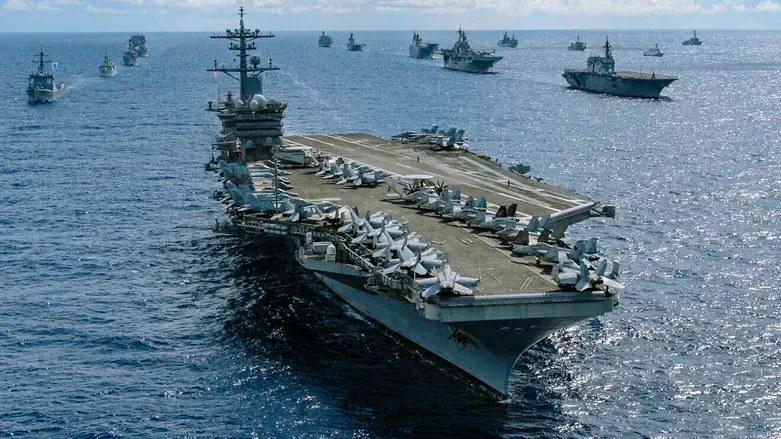
Washington has been moving significant military assets into the region, including aircraft carriers and carrier strike groups. These deployments are not symbolic gestures designed for headlines. They are classic indicators of contingency planning.
This is how the United States prepares for war: Assets are positioned first. Capabilities are established. Flexibility is preserved. Only then do political decisions follow. The administration won’t decide to act before the necessary forces are in place.
Seen in that context, the movement of U.S. military hardware should not be read as a signal that a strike is imminent, but neither should it be dismissed. It signals readiness and keeps options alive.
And it reinforces the credibility of presidential warnings.
One central question continues to shape Washington’s thinking: whether military force is even required. From a U.S. perspective, the optimal outcome remains regime change without direct American intervention. The United States wants this to be an Iranian people’s revolution, not a U.S.-led overthrow.
A long and complicated history exists between Iran and the United States, with the Islamic Republic spending decades building its legitimacy on the narrative of foreign interference. Whether that narrative is accurate is almost beside the point. It exists. It resonates. And it continues to shape Iranian politics.
If the Iranian people can bring down the regime themselves-through sustained protest, elite defections and internal pressure-such an outcome is clearly preferable for Washington. It avoids reinforcing the regime’s propaganda and reduces the risk of prolonged regional war. If military action does occur, recent history suggests it will not be impulsive.
American operations, especially under Trump, are typically the result of years of planning, rehearsal and weapons development. They are designed to be decisive, limited and conclusive.
Timeline of “Operation Midnight Hammer," June 22, 2025. Credit: U.S. Department of Defense via Wikimedia Commons.
That was evident in “Operation Midnight Hammer," the U.S. strike last summer on Iran’s nuclear infrastructure, including the Fordow enrichment facility. That operation was not drawn up on short notice; it had been planned and practiced for years.
The Massive Ordnance Penetrator-the 30,000-pound bunker-buster used in the strike-was developed specifically to destroy deeply buried facilities like Fordow, which sits beneath a mountain and was engineered to withstand conventional attack. Those weapons existed precisely because planners anticipated such a scenario long in advance.
Equally important, the operation did not occur in isolation. Israel had already created the precise battlefield conditions required for achievement, including degrading Iranian air defenses and establishing near-complete aerial superiority. Only once the likelihood of success was exceptionally high did the United States proceed.
The strike was decisive and limited. It was designed to end the military phase, not expand it.
A similar pattern applied to “Operation Absolute Resolve," the successful U.S. effort to remove Nicolás Maduro from Caracas.
That mission was prepared for at least six months. U.S. forces rehearsed it repeatedly, gathered intelligence and waited for very specific conditions to align, including weather conditions, before executing. Action followed preparation, not media pressure.
And on Jan. 3, the move was put into place with decisive results seen worldwide.
The lesson is straightforward: The absence of immediate action does not indicate indecision. It often reflects patience. Seen through that lens, the fact that a strike on Iran did not happen this week says little about what may happen next week or next month.
The retaliation question and Israel’s role
Another major consideration is retaliation-particularly, against Israel. If the United States were to strike Iran, the Jewish state would almost certainly be a primary target. Iran would likely fire whatever ballistic missiles it has left, potentially in large salvos, under the assumption that this is a final confrontation.
Estimates suggest that while Israel has degraded a significant portion of Iran’s missile arsenal in recent conflicts, Tehran may still retain more than 1,000 ballistic missiles. In such a scenario, Tehran would likely attempt to fire as many as possible, as quickly as possible.
As such, Israel has been preparing accordingly. In recent days, many Israelis believed that war with Iran was imminent. The home front was readied. Civil-defense awareness increased. That sense of preparedness has not disappeared.
Missile defense remains a very serious issue, even if Israel believes it has prepared extensively for such a scenario.
Recent reports suggested that Israeli Prime Minister Benjamin Netanyahu urged the United States not to strike Iran at this juncture. These reports rely on anonymous sources and fit a familiar pattern.
If Washington strikes, the narrative might certainly be that Israel pushed Trump into war. If Washington does not strike, the alternative narrative will be that Israel restrained him. Either way, the story becomes about Israel, regardless of the facts.
This framing, however, is misleading. From Israel’s strategic perspective, total victory ultimately requires the fall of the regime in Tehran-the head of what has often been described as the terror octopus. Hamas, Hezbollah, the Houthis and other proxies are tentacles. Cutting off tentacles without addressing the head doesn’t end the threat.
Even if Israel expects retaliation, this is a war. And wars involve absorbing costs in pursuit of strategic outcomes.
The protests and the regime’s deflection
Meanwhile, the Iranian regime continues to claim that the protests are the joint work of Israel and the United States.
Yet it is Iranian security forces holding the guns and aiming the bullets at unarmed citizens.
That alone undermines the regime’s narrative. If the protesters were foreign agents, the regime would be targeting foreign enemies, not its own people. The violence itself is evidence that this movement is coming from within Iranian society.
The Iranian people are suffering. Their currency has collapsed. Basic resources, including water, are scarce in many areas. Regime funds are spent on nuclear weapons, ballistic missiles, Hezbollah, Hamas, the Houthis and foreign conflicts while ordinary Iranians see no benefit.
They crave normalcy. They seek a future. They want to be part of the world again. All of this brings the discussion back to the central question: Will Trump order a military strike to overthrow Khamenei?
Even if it has not happened yet, the indicators remain. Reports suggest that senior Iranian figures are moving money out of the country. Readiness remains high on all sides. The absence of a strike today is not a verdict. It is a pause.
And that pause-combined with rising pressure, expanding media coverage, visible military preparations and sustained protests-may itself be a strategic tool. The belief that a strike is possible matters, as does that kind of pressure.
It may also be giving wind to the sails of the Iranian protesters themselves.
For now, the story is not over. It may only be entering its next phase.