

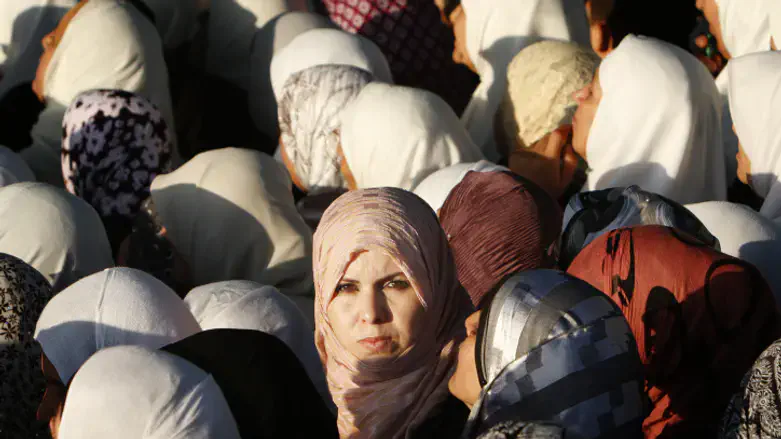
This last Iranian uprising is embodied by the face of a woman with uncovered white hair. She walks among the demonstrators, a small bottle of water in her hand, her mouth bleeding from the beatings by the regime’s forces. In her shouted words: “I am no longer afraid, I have been dead for 47 years!".
Dead since 1979.
There is a freedom that can only be gained when everything else has been lost. It is the freedom of those who have nothing left to lose and therefore, paradoxically, nothing left to defend with lies.
The number of people killed at Tiananmen Square (the last and only time the Chinese communist regime was openly challenged by its own citizens) is estimated at 10,000.
The Budapest uprising of 1956 was paid for with 3,000 dead. The East Berlin revolt of 1953 caused 125 deaths. The Prague Spring of 1968 claimed 137 lives.
In Iran, in a single week, between 12,000 and 20,000 people were killed.
For those who have always had a roof over their heads, a full plate, good health, all freedoms and the comforting certainty that tomorrow will be as warm as today, rejection becomes one of the few remaining existential risks. When survival is guaranteed, loss of status takes on disproportionate importance.
And in the West, the people who have the most to lose are also those who show the least courage when it is needed.
And those with full bellies in the West, writes the brilliant Algerian author Kamel Daoud in Le Point, allow themselves to say that in Iran people are protesting over the cost of living: “This ‘social’ economic interpretation allows everything: there is no longer any need to block our streets, universities, or concerts, nor to chant ‘Woman, Life, Freedom’ and ‘Free, free Iran’ for these populations. One can simply sigh over ‘empty stomachs’ and explain that ‘those people’ are rebelling for bread.
A contemporary version of the cynical ‘let them eat madeleines’ and an expression of veiled racism: Iranians can die-ideas do not move them, only their stomachs."
The “already dead" can no longer be bought with anything. Looking at that unveiled woman, you think of Nadine Olivieri Lozano alongside Iranian clerics, dressed from head to toe in a black chador. The image of the Swiss ambassador in Iran was taken while the regime was brutally repressing (at least 500 dead) a previous protest movement.
You think of Micheline Calmy-Rey (former Swiss president) in Iran. The foreign minister was photographed smiling broadly in a chador during a meeting with Iranian president Mahmoud Ahmadinejad. The socialist dismissed criticism by saying: “It is not a sign of submission."
And so, while a seventy-year-old Iranian woman with a bleeding mouth shouts that she has been “dead for 47 years," in the salons of New York, Paris, Stockholm, Berlin, Rome and London, thousands of perfectly alive people behave as if they were already half-dead-victims of the most vile death of all: preventive death.
Iranian filmmaker Javad Ganji was assassinated last week. Why did no one at the Golden Globes care? Why didn’t Mark Ruffalo mention it? Where did solidarity go? Is it possible that the only acceptable form of courage is wearing a pin against ICE tasked with finding illegal migrants?
Courage often blossoms where people say they are “already dead." And it is so rare in affluent circles. When everything has already been lost, courage becomes rational. When you have everything to lose, cowardice is an effective survival strategy.
And courage emerges when fear no longer has any power.
I saw the same scene, the same face, the same blood not in Tehran, but in France. In Lyon, an Assyrian refugee, Ashur Sarnaya, was murdered outside his home. Ashur had symbolically died in 2014, when ISIS’s black caliphate stole his home, his church, and his future. From that moment on, Ashur lived as a survivor, with the only weapon left to him: words, prayer, live streaming. He no longer had any status to lose-only his freedom to defend.
So in the end, we paid the price, because instead of being good and weak and well-fed, we should have been strong and just and hungry.