
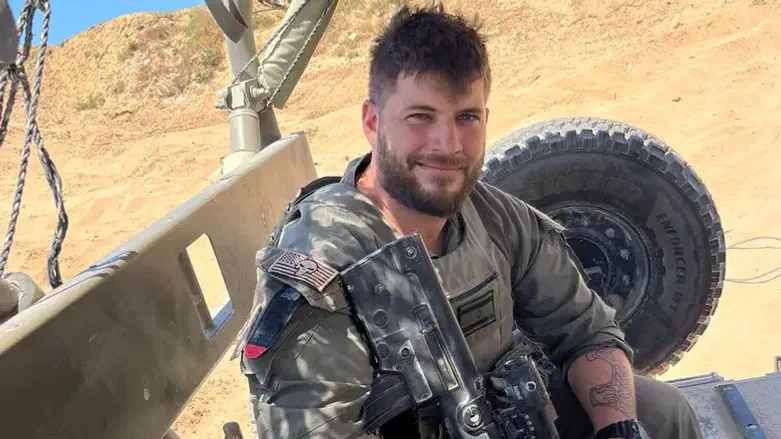
The State of Israel meant everything to Josh Boone.
But apparently, those feelings weren’t mutual.
Idaho-born and bred, Josh spent years overcoming the hurdles that stood in the way of fulfilling his lifelong dream of becoming an IDF soldier. He spent an astonishing 748 days serving as an IDF reservist after the October 7th terror attacks, volunteering for every mission, no matter how intense or dangerous it promised to be. He was a role model for his fellow chayalim and a source of support to the lone soldier community, stepping up to the plate time and time again whenever a need arose.
Despite all that Josh did for Israel, its Defense Ministry abandoned him and his loved ones after he died of an addiction, a direct result of service-related PTSD just two weeks after his reserve service ended. The Defense Ministry would have accorded Josh a full military burial, with honors and benefits, had he died of a physical injury sustained in battle, but the fact that his death was caused by addiction denied him those rights.
Israel is a world leader in so many areas - technology, medicine, and more - but not when it comes to addiction, which it considers to be a problem that plagues the weak, those without discipline, and slum dwellers. The fact that the Diagnostic and Statistical Manual of Mental Disorders, the undisputed gold standard for mental health in Israel and throughout the world, classifies it as a disorder and not a moral failure, has done nothing to change those faulty perceptions.
Given that reality, those who fall prey to addiction are considered by the IDF to be less than, less deserving, less worthy, less valuable. I write these words not as an outsider, but as the director of Amudim, whose offices in both Israel and the United States work daily with those suffering from trauma addiction and recovery, including lone soldiers and recovery.
No one has ever wanted to become an addict. People turn to substances when their regular coping skills aren’t enough to overcome their pain, and over the years, we’ve seen that combat trauma is one of the strongest existing predictors of addiction. We know that Josh sought help when his pain became too much to bear, but in the end, this was the battle that claimed his life, not because he was reckless, but because addiction, especially when it is trauma-driven, is a medical illness whose risk is particularly lethal during the early days of recovery.
Israel made the wrong call when it came to Josh’s burial, making it clear the need for the country to turn a new page in the way it approaches addiction. The time has come for the Defense Ministry, and for Israel at large, to classify addiction for what it is - a chronic relapsing illness that involves measurable change in brain function, which can be triggered by trauma and PTSD, as defined by the DSM. Israel needs new policies and new laws that recognize addiction for what it really is so that proper treatment can be given, without judgment or stigma, to those who need it.
Josh may not be the first soldier to have made the ultimate sacrifice for the State of Israel.
Let’s hope he’s the last soldier whose addiction isn’t viewed as the medical illness that it truly is.
Zvi Gluck is the CEO of Amudim, an organization dedicated to helping abuse victims and those suffering with addiction within the Jewish community and has been heavily involved in crisis intervention and management for the past 24 years.