

Stephen M. Flatow is President of the Religious Zionists of America (RZA.) He is the father of Alisa Flatow, who was murdered in an Iranian-sponsored Palestinian terrorist attack in 1995 and the author of A Father’s Story: My Fight for Justice Against Iranian Terror now available in an expanded paperback edition on Amazon. Note: The RZA is not affiliated with any American or Israeli political party.
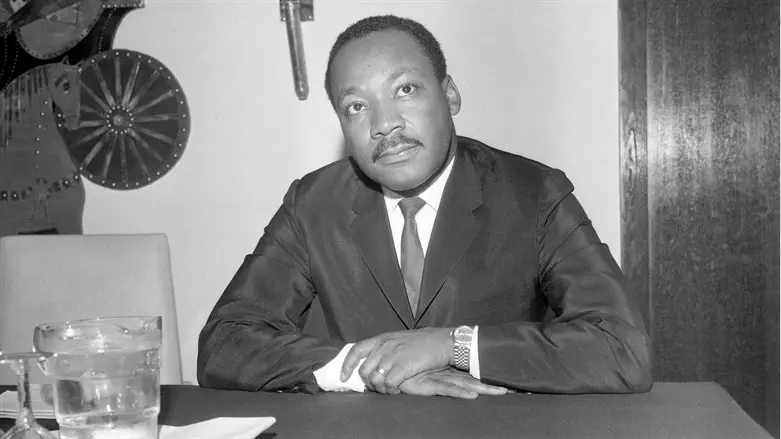
As Americans mark the birthday of Martin Luther King Jr., the story is often told in broad, comforting strokes: a nation confronting its sins, a preacher preaching justice, a movement bending history toward equality. What is too often minimized-or quietly erased-is the deep, principled partnership between King and the American Jewish community, and King’s clear-eyed views on antisemitism and the State of Israel.
This was not a symbolic alliance. It was lived, physical, and costly.
American Jews did not merely applaud the civil rights movement from afar.
-Rabbis and students marched alongside King in Birmingham and Montgomery.
-Jewish activists filled Southern jails.
-They stood shoulder to shoulder with Black Americans facing police dogs, firehoses, and mobs.
-In Selma, Jews marched across the Edmund Pettus Bridge as part of the struggle that led to the Voting Rights Act.
Some paid with their lives.
The murders of civil rights workers Andrew Goodman and Michael Schwerner-both Jewish-alongside James Chaney in Mississippi were not tragic footnotes. They were proof that this alliance was forged in danger, not rhetoric.
King understood this. He never treated Jewish involvement as incidental or opportunistic. He saw it as rooted in shared history and moral memory. “Our unity is born of our common struggle for justice," he wrote, recognizing that Jews-scarred by centuries of persecution-understood the stakes of discrimination in a visceral way.
That mutual understanding extended beyond America’s borders.
King’s support for Israel was not an afterthought, nor was it the product of political convenience. It flowed naturally from his worldview. He viewed Jewish self-determination as a moral necessity after the Holocaust, and Israel as the legitimate expression of that right.
In 1968, King stated plainly: “Peace for Israel means security, and that security must be a reality." He rejected the idea that Israel could be pressured into suicidal concessions or that Arab rejectionism was somehow a secondary concern. For King, peace was not a slogan-it required recognition, legitimacy, and safety.
Equally important, King was unequivocal in condemning antisemitism, including when it cloaked itself in fashionable political language. He warned that hostility toward Jews did not become acceptable simply because it was repackaged as criticism. “Antisemitism is injustice," he said, without qualifiers or evasions.
This clarity matters today, when King is often selectively quoted-celebrated for his moral authority while his inconvenient positions are ignored or rewritten.
Modern activists frequently invoke King to justify movements that demonize Israel, excuse terrorism, or portray Jews as oppressors rather than a people with an unbroken history of vulnerability. King would have rejected that framing outright. He believed in justice without double standards, and liberation without erasing another people’s right to exist.
King also understood something many of his self-appointed heirs do not: alliances are built on shared values, not shared grievances. His partnership with Jews was grounded in mutual responsibility and moral discipline, not ideological conformity. He welcomed Jewish voices precisely because they brought a distinct historical conscience to the movement.
That partnership was not always easy. It endured disagreements, cultural misunderstandings, and political pressures. But it held because it was anchored in principle rather than fashion.
The attempt to sever Jews from King’s legacy-by minimizing their role in the civil rights movement or misrepresenting King’s views on Israel-is not merely historical distortion. It is a moral failure. It robs both communities of a shared chapter defined by courage, sacrifice, and trust.
As we honor King’s birthday, remembering this truth is not an exercise in nostalgia. It is a reminder of what genuine solidarity looks like: showing up, risking something, and standing firm even when the politics grow uncomfortable.
King did not ask Jews to abandon their identity or their connection to Israel to earn a place in the struggle for justice. He respected both. That respect was returned in kind-on the streets of the South, in jail cells, and in graves.
That is the legacy worth preserving.