
Moshe Feiglin is a former deputy speaker of the Israeli Knesset, a former member of its Foreign Affairs and Defense Committee, and the founder of the Zehut Party. He is the author of the recently released Israel Is Just the Beginning: How Israel’s Fight Against Radical Islam and Progressivism Protects the Identity and Liberty of the Civilized World.
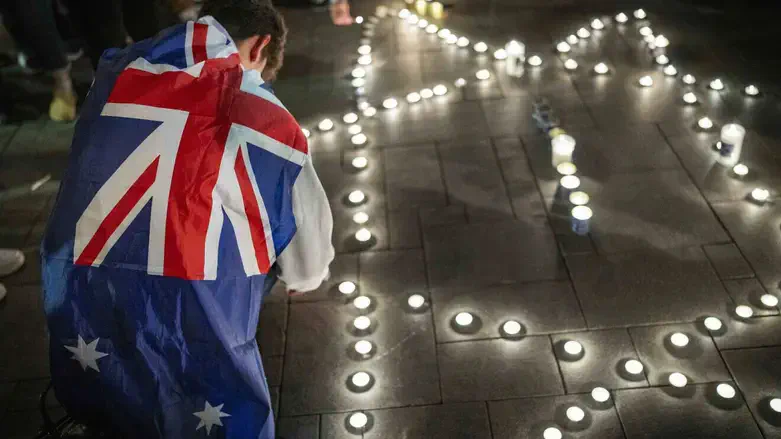
(JNS) I wish that the horrific news of the mass shooting of 15 people on Bondi Beach, Australia, as the Hanukkah holiday began, had been surprising. Yet I am convinced that, like Kristallnacht before World War II and the Holocaust, the attack in Sydney was not an isolated incident but an opening act.
Two arson attacks since then-one in Mississippi and another in Germany-tragically prove this out to be the case. This is the beginning, not the end, of a new level of “socially permitted violence."
History does not repeat itself exactly, but it follows recognizable patterns. When Jews are attacked openly and unapologetically at a religious celebration in a Western democracy, the question is not whether this is an aberration. The question is what conditions made it inevitable and why those conditions now exist across the democratic world.
The Chabad community, which, even before the Hamas-led terrorist invasion and attacks in southern Israel on Oct. 7, had been targeted in Australia, is not a marginal group but a pillar of Australian Jewry. It was founded by my great-grandfather, Moshe Zalman Feiglin, after whom I am named. I am also an Australian citizen with close family ties to that community. This is not abstract analysis. It is personal history colliding with present reality.
Four months ago, ahead of the Jewish New Year, I sent a letter to my extended family in Australia. I warned them that we were not living through a “new" year at all but through a rerun of the late 1930s. The signs, I wrote, were already visible-though often hardest to read when you are standing closest to them. From Israel, however, the picture was unmistakable.
My message was blunt: A Jew who does not come home to Israel now, while still able to stand upright, may one day be forced to do so on his knees, if he is permitted to do so at all.
That warning was not only about physical danger. It was about the end of an era.
For nearly 2,000 years, exile was both punishment and protection. Jews lived without sovereignty, yet they maintained their identity through faith, community and resilience. That chapter has closed. Today, when Jews have a sovereign state and no external force bars their return, the punishment of exile has ended. However, so, too, has its protection.
Judaism alone can no longer guarantee Jewish continuity in the Diaspora. Jewish identity has returned to being national and sovereign. The uncomfortable truth is that statistically, the chances of your great-grandchildren remaining Jewish in exile, no matter how religious you are, are approaching zero.
My family knows this truth intimately. We are all descendants of Rabbi Yaakov Tzvi Feiglin, who immigrated to the Land of Israel in 1889. The branch of the family that remained in Europe encountered the German Wehrmacht 52 years later. They did not survive.
Still, as shocking as the Sydney massacre was, and as the headlines of additional violent anti-Jewish and anti-Israel attacks mount throughout the Western world, we need to open our eyes to the fact that this did not originate in the West. It was born in Israel.
Not because of what the Jewish state does, but because of what it has stopped saying.
For decades, Israel has justified its existence to the world primarily through tragedy rather than justice. We spoke about the Holocaust, instead of about our inherent right to our land. We spoke the language of pain, rather than the language of purpose. Instead of standing upright as a nation with moral clarity, we presented ourselves as perpetual victims.
Even after Oct. 7, when moral clarity should have been unavoidable, Israel continued to apologize for its existence instead of stating a simple truth: This is the Jewish state by right, not by international permission and not by sympathy.
Antisemitism is not a reaction to a particular Israeli military operation. It is a reaction to moral weakness. It thrives on confusion. It responds to a message projected outward-that we ourselves are not certain of the justice of our cause.
When Israel speaks in the language of victimhood, the world hears an admission of guilt. When Israel hesitates to say plainly that this is our land and that the Jewish state requires no external validation, hatred and antisemitism re-emerge-and Jews become targets, even on the far side of the globe.
The attacks in Australia, America and Germany are therefore not only a “Diaspora problem." They are an indictment of an apologetic Israeli discourse.
Only a nation that is able to say, clearly and without hesitation, that we are here by right-rooted in history, faith and moral conviction, not in mercy-can protect not only its own citizens but Jewish communities everywhere.
Those who fail to understand that the battle over Jewish identity in Jerusalem and Tel Aviv directly affects the safety of Jews in Sydney, Australia; Jackson, Miss.; Giessen, Germany-and increasingly, London, New York and Los Angeles-do not understand what a Jewish state is.
It is time to stop apologizing. It is time to stop pleading with the world for understanding. It is time to return to the language of justice.
Because when Israel stands upright, Jews everywhere do. And for Americans, the lesson is unavoidable: a weak and apologetic Israel does not stabilize the democratic world. Rather, it accelerates the same forces of extremism and moral confusion that threaten U.S. cities, campuses and Jewish communal institutions.