
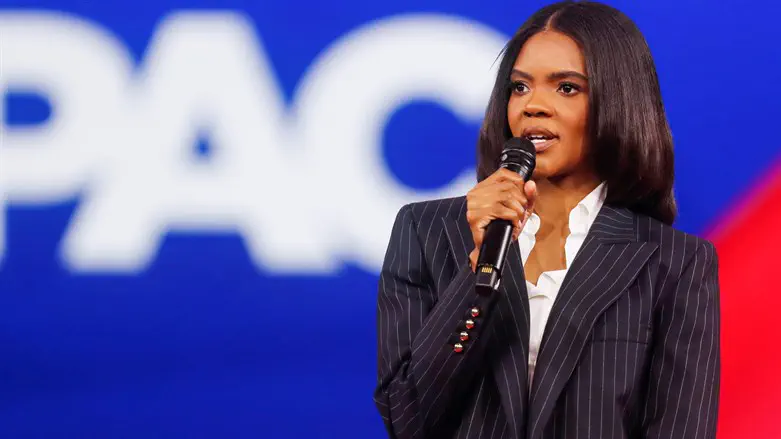
Fern Sidman is Senior News Editor at The Jewish Voice.
There are historical moments that demand intellectual sobriety, ethical restraint, and a reverence for human agency. The mass protests now convulsing Iran-sparked by economic ruin, generational repression, and the long suffocation imposed by clerical absolutism-constitute one such moment. Yet rather than rise to the gravity of the hour, Candace Owens has elected to pollute it with conspiracy, asserting that Israeli Prime Minister Benjamin Netanyahu is somehow responsible for the Iranian people’s rebellion, allegedly motivated by a desire to “steal Iranian land."
This is not commentary. It is calumny dressed in the garments of geopolitical critique.
The Iranian uprising is not a Mossad production, not a Netanyahu stratagem, and not an Israeli land-grab masquerading as revolution. It is the organic eruption of a society whose youth have never known dignity, whose women have been brutalized for showing their hair, and whose workers are crushed beneath a collapsing currency while the regime exports terror abroad. To attribute this revolt to Israel is to deny Iranians their humanity and their courage.
Owens’ thesis does not merely misdiagnose events; it annihilates the agency of millions. It suggests that Iranian men and women-who are burying their dead (when the government gives up their bodies, ed.), evading secret police, and defying live ammunition-are not authors of their own history but marionettes dancing to the tune of a foreign prime minister.
This rhetorical maneuver is deeply paternalistic. It recasts an indigenous uprising into an externally engineered spectacle, stripping protesters of moral ownership over their own liberation. It is precisely the narrative advanced by Tehran’s propagandists, who insist that every expression of dissent must originate in Zionist subversion rather than in the failures of Islamic theocracy.
Owens is not challenging authoritarianism. She is laundering its excuses.
The Islamic Republic has perfected a single, monotonous refrain for every crisis it faces: Israel did it. America did it. The Jews did it.
When Iran's inflation shreds household savings, when water systems collapse, when prisons overflow, when women are killed in custody-the answer is never introspection. It is always foreign conspiracy. By alleging that Netanyahu is orchestrating Iran’s protests to seize land, Owens is echoing this script almost verbatim.
The irony is as bitter as it is grotesque: a Western influencer accusing Israel of imperial fantasies while parroting the propaganda of a regime that has spent decades exporting militias, rockets, and chaos from Beirut to Sana’a.
Owens’ assertion that Netanyahu covets Iranian territory is not merely unsupported-it is fantastical. Israel has neither the strategic ambition nor the demographic logic to annex land in a country of 90 million people hundreds of miles away. The idea collapses under the weight of even cursory scrutiny.
What Israel demonstrably does fear is an Iran armed with nuclear weapons, funding Hezbollah, arming Hamas, and vowing openly to erase the Jewish state from the map. To transmute that defensive concern into a narrative of colonial appetite is a grotesque inversion of reality.
Yet this inversion is not accidental. It taps into a longstanding rhetorical tradition that depicts Jewish power as inherently predatory, strategic calculation as innate malevolence, and Jewish self-defense as disguised expansionism.
This episode cannot be dismissed as an isolated lapse. It fits squarely within a pattern in which Owens repeatedly frames Israel as the hidden villain behind global disorder. Whether the topic is Venezuela, Gaza, or now Iran, the conclusion is reliably the same: somewhere, behind the curtain, stands Netanyahu or “the Zionists," pulling levers.
Such tropes are not merely anti-Israel. They drift perilously close to a civilizational myth that has stalked Jewish history for centuries: the belief that Jews possess a clandestine capacity to choreograph world events from the shadows.
When Owens denies the Iranian people authorship over their own rebellion and assigns it instead to the machinations of a Jewish prime minister, she is not “asking hard questions." She is invoking one of the oldest and most corrosive insinuations in political culture.
Words shape moral geography. When a prominent figure tells her audience that Iran’s uprising is really about Israeli land theft, she does not merely misinform; she diverts empathy away from the victims of tyranny and redirects suspicion toward a convenient scapegoat.
-For Iranian activists risking their lives, such narratives are not harmless noise. They are an erasure. They transform their sacrifices into a footnote in someone else’s conspiracy.
-For Jewish audiences, the effect is equally corrosive: the steady insinuation that wherever turmoil arises, Jewish hands must be somewhere behind it.
Every era offers commentators a choice: to illuminate injustice or to obscure it. The Iranian people are not rioting because of Netanyahu. They are revolting because a theocracy has robbed them of dignity, prosperity, and breath.
Candace Owens had the opportunity to stand with the oppressed, to amplify the voices of those crushed by authoritarianism. Instead, she has chosen to echo the narrative of their jailers.
History will not confuse that choice for courage.