


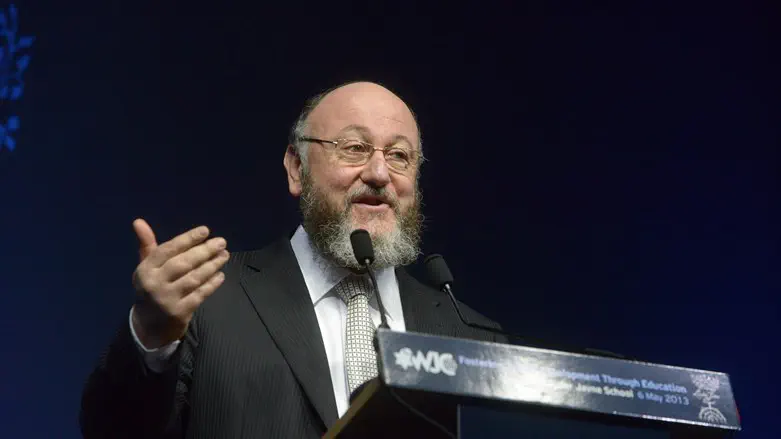
The Chief Rabbi of the United Hebrew Congregations of the Commonwealth, Sir Ephraim Mirvis, has criticised the use of the term "genocide" to describe Israel's military actions in Gaza, arguing that it diminishes the gravity of the word and turns "humanity’s gravest crime" into a mere political insult.
In an article written for The Telegraph, Sir Ephraim stated that the accusation is made too readily today. He wrote: “Today it takes almost no thought to repeat the accusation that Israel has committed ‘genocide’."
“Some repeat it from a place of singular hostility toward the world’s only Jewish state; others from an earnest desire to hasten an end to an unquestionably horrific conflict in which many innocent people have suffered. But whatever the motivation, the result is the same: this gravest of crimes is invoked casually, without due regard for the weight of the word itself."
He further explained: “In an age when hyperbole dominates our discourse and outrage is rewarded with clicks, campaigners reach instinctively for the most extreme language available. Faced with images on social media of immense, tragic suffering in Gaza, journalists, academics and celebrities understandably feel compelled to speak out."
“Yet the race to linguistic escalation has consequences. The ubiquity of a term is often wrongly understood as evidence of its veracity. And some terms have a meaning that must remain protected at all costs. ‘Genocide’ is one of them."
Sir Ephraim emphasised the legal definition of genocide, which requires intent to destroy, in whole or in part, a national, ethnic, racial or religious group. He said: “It is why Britain and her allies are not accused of genocide for our strategic bombing of Nazi Germany, despite the hundreds of thousands of innocent civilians who were killed. Intent is the moral and legal hinge. The clearest evidence that Israel did not intend to destroy the people of Gaza is that it did not in fact do so."
Describing the conflict as one that “Israel did not seek, nor start", he said Israel's goals have been the return of hostages and the disarmament of Hamas - a group he noted has sought the total destruction of Israel. He added: “If Hamas lays down its arms, there will be no fighting and no suffering. If Israel were to lay down its arms, there would be no Israel."
The Chief Rabbi also criticised some human rights organisations, saying they “appear to revel in misappropriating the term genocide" by expanding its definition and engaging in “a truly troubling moral deceit."
He acknowledged the suffering in Gaza, stating: “The tragic suffering of Palestinians abounds" and “no decent person could fail to be moved by it or wish to see its end". However, he argued there is no evidence of “systematic massacres, mass executions, or the targeted killing of civilians as a matter of policy".
Sir Ephraim warned that loose use of the term harms the concept itself: “When academics, activists, faith leaders and public figures declare, with unshakeable certainty, that genocide has occurred, they do something far more destructive than merely repeat a falsehood. They trivialise the very concept they claim to defend. What language is left for the Rohingya, expelled en masse, systematically raped and slaughtered? For the Uyghurs, subjected to mass internment, forced sterilisation and cultural erasure? For the ethnically targeted killing and mass rape in West Darfur? To invoke the term ‘genocide’ as an accusation against Israel is to strip it of its true meaning, reducing humanity’s gravest crime to a political insult."
He concluded: “The suffering of innocent people demands empathy, accountability and a genuine commitment to preventing future conflict. But to level the charge of genocide against Israel is to commit a moral inversion whose casualties include not only Israelis and Palestinians, but the very idea of human rights itself."