
Post publication addition: We advise checking the hechsher before purchasing.
In every generation, there are moments when abstract debates about culture, politics, and identity crystallize into something profoundly tangible: where to spend one’s money, whose labor to support, which institutions to nourish. Today, such a moment has arrived for Jewish New Yorkers and for all who believe in the legitimacy of Israel’s existence as a homeland for the Jewish people. It has arrived not in the halls of government or the chambers of international diplomacy, but in the flour-dusted kitchens of Breads Bakery.
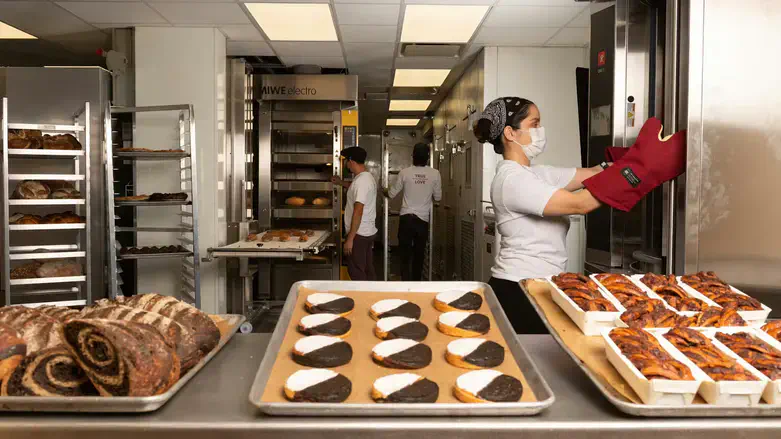
Breads, a beloved New York mini-chain spun out of a celebrated Tel Aviv institution, is renowned for its babka, its challah, and the sense of warmth that wafts from its storefronts. Yet recently, a group of employees operating under the banner “Breaking Breads Union" has attempted to fuse a conventional labor-organizing effort with overt political messaging, including the assertion that their Jewish Israeli employer is complicit in “genocide." Their social media statements are laced with activist slogans, demands for redistribution of profits, and denunciations of the bakery’s supposed “Zionist projects," such as baking cookies decorated with Israeli flags or catering Jewish food festivals.
The story might, at first glance, seem like a minor skirmish in the endless culture wars of social media. But it is more than that. It is a microcosm of a much larger question now confronting Jewish communities across America: how to respond when ordinary Jewish businesses become ideological battlegrounds, not because of what they do in the marketplace, but because of who they are.
For Jewish New Yorkers, and for allies who believe that Jewish cultural expression should not be stigmatized or coerced into political confession, the response should be unambiguous:
They should go out of their way to patronize Breads Bakery.
They should buy their challah there, their babka there, their pastries and birthday cakes and Shabbat desserts there.
Not out of spite, but out of solidarity. Not as a boycott of workers, but as a vote for the right of Jewish businesses to exist without being compelled to disavow their identity.
The demands articulated by the unionizers blur the line between workplace advocacy and ideological imposition. They speak of “redistribution of profits," of a desire for more than minimum wage, of working conditions framed in the language of global struggle. Those are familiar tropes in modern labor discourse. But they go further, tying their grievances explicitly to the accusation that their employer is supporting “genocide." They insist they cannot ignore the bakery’s “implicit and explicit support for Israel," even though they applied for and accepted employment with a company whose Israeli origins were never concealed.
Here, something fundamental is being inverted. A Jewish-owned bakery is being told that its very cultural expressions-baking cookies with Israeli flags, participating in Jewish food festivals-are illegitimate unless they are stripped of their national and historical meaning. The message is not simply, “We want better wages," but, “We want you to renounce who you are."
That is not collective bargaining. It is moral coercion.
The tragedy of this episode is not that young workers are advocating for themselves. It is that they have chosen to frame their advocacy in a way that casts Jewish self-expression as morally suspect. When baking for The Great Nosh, a citywide Jewish food festival, is described as participation in a global crime, something has gone profoundly awry.
This is why patronizing Breads Bakery matters. Consumer choice is one of the few levers of influence available to ordinary citizens. It is lawful, peaceful, and expressive. By choosing where to spend our money, we communicate what we value. We tell entrepreneurs which kinds of institutions we want to survive and which we are prepared to let wither.
For Jewish New Yorkers, whose synagogues, schools, and community centers increasingly find themselves encircled by political hostility, this is not theoretical. It is existential. A bakery is not a government agency. It is not a political party. It is a place that sells bread. When its employees publicly accuse it of crimes against humanity because of its ties to Israel, the bakery becomes a stand-in for the Jewish collective itself.
That is why this artiicle urges readers who support Jewish life in New York to make Breads Bakery their default source of baked goods. Turn your weekly grocery routine into a quiet declaration: Jewish culture is not a provocation. It is a contribution.
Some will object that this turns commerce into politics. But the unionizers have already done that. They have politicized a workplace whose public mission, according to the company’s own statement, is simply to “make babka," to celebrate peace, and to embrace people of all cultures and beliefs. When a business that professes neutrality is dragged into ideological combat by those it employs, it is no longer enough to shrug and say, “This is just a labor dispute."
It is also important to be precise. Supporting Breads is not an attack on workers’ rights. Employees are free to organize. They are free to negotiate. They are free to leave and seek employment elsewhere, or to start their own enterprises reflecting their own values. What they are not entitled to do is to conscript their employer into a political narrative that delegitimizes the employer’s identity.
Imagine, for a moment, the precedent this would set. If any group of employees can declare their boss’s cultural heritage incompatible with their own beliefs, what follows? Will every immigrant-owned business be forced to disavow the homeland of its founders? Will a Ukrainian-owned café be compelled to make statements about Crimea? A Cuban restaurant about Havana? At that point, the pluralism of the city dissolves into an endless tribunal of moral tests.
There is also an economic reality to confront. Breads Bakery exists because someone took a risk, invested capital, developed recipes, built supply chains, and cultivated a brand that New Yorkers love. Its success is not the product of collectivist slogans; it is the product of entrepreneurship. To enjoy the fruits of that labor while denouncing its source is to indulge in a contradiction that cannot be resolved through hashtags.
None of this requires rancor. It requires resolve. The appropriate response is not harassment, nor the vilification of employees, but a disciplined, affirmative choice: show up, buy bread, tip generously, and tell the owners-politely-that you value what they have built.
In Jewish tradition, bread is never merely bread. It is sustenance, blessing, continuity. To bring home a loaf from Breads Bakery in this moment is to affirm that Jewish spaces in New York will not be shamed into invisibility. It is to say that cultural inheritance is not a crime, and that solidarity is expressed not only in marches and petitions, but in the small, habitual decisions that shape daily life.
The struggle over Breads Bakery is not really about babka. It is about whether Jewish New Yorkers are permitted to live openly, to celebrate their heritage, and to run businesses without submitting to ideological reeducation. By choosing to patronize this bakery, supporters of Jewish life can make that answer unmistakably clear-one pastry at a time.
Fern Sidman is Senior News Editor at Jewish Voice