
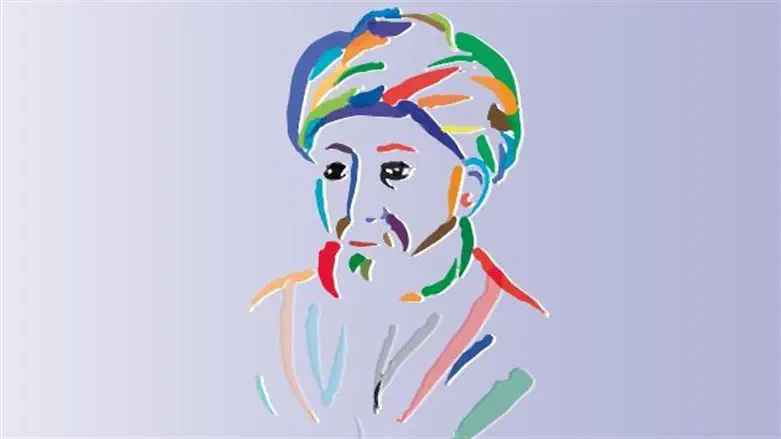
The Rambam’s yahrzeit falls on the 20th of Tevet, January 9th this year. Why his yahrzeit is not known to many people is a famous question, with a just as famous answer: The Rambam's yahrzeit is barely known because the Rambam did not die - every observant Jew brings the Rambam to life in their daily lives, whether by studying his works or saying his 13 principles of faith at the end of morning prayers each day.
In fact, Rabbi J.B. Soloveitchik zt"l in Uvikashtem Misham calls the Rambam his friend in a beautiful description of Torah giants, symbolizing the ubiquitous presence of mesora in the Beit Midrash, and the apocryphal story goes that when asked when the Rambam’s yahrzeit falls, he answered incredulously “You mean the Rambam died?"
Rabbi Moses ben Maimon (hence the secular name Maimonides), the Torah luminary who was a Talmudist, Halakhist, prolific writer, physician, philosopher and communal leader and on whose grave the words “From Moses to Moses, there arose none like Moses" are incscribed, was born in Spain in 1138 . His family fled a fanatic Islamic sect that took over when he was a youngster, and he later lived in Egypt where he was physician to the ruler. He died in 1204 and was buried in Tiberias. This is his 820th yahrzeit.
In Israel, where the Rambam Heritage Center in Tiberias has a wide range of events for all ages all over the country planned around the 20th of Tevet under the umbrella “Rambam Week", the question of his yahrzeit is superfluous. Thousands of young students study Rambam in daily portions all year culminating in a contest, while a “happening" for families takes place in Tiberias, this year including a play and a tour of the center which even has a Rambam-oriented escape room.
The highlight of the week, however, is the 3-day Rambam Conference, this year the 17th annual learning gathering organized by the center, whose president is Rabbi Yemin Levi and whose CEO is Rabbi Chaim Fogel. Hundreds of rabbis, academics, and public figures flocked to Tiiberias, one of the four holy cities in Israel (with Jerusalem, Hevron and Tsefat) and filled the auditorium to hear a wide range of speakers whose topics showed the scope of the works of Hanesher Hagadol (the Great Eagle, as the Rambam is often called), all in an uplifting atmosphere of living Torah.
The war had forced the conference to be held in Jerusalem one year, as the Gai Beach Hotel bordering the Kinneret Lake, where it is normally held, was filled with families evacuated from northern Israel, but now they are back home, hopefully for good. And the conference, too, has returned to its usual home.
Emceed by Channel 14’s broadcaster Ido Tauber, the program began with greetings from Rabbi Fogel, Orot Yisrael College Dean Prof. Meir Hildesheimer and KKL’s Sar Shalom Gerbi, as well as Tiberias mayor Yossi Nava, all of whom stressed the pressing need today to connect with the living waters of Torah in all facets of Jewish life, an idea expanded on by former Chief Rabbinate CEO Rabbi Eitan Eisman as he described a “Sacred Victory" for the IDF.
This was followed by a rivetting, eye-opening conversation between the Chief Rabbi of Israel’s police force, Rabbi Rami Brachyahu and national supervisor of school rabbis, Rabbi Otniel Mantsur. Rabbi Brachyahu revealed the heartbreaking halakhic issues he faced on October 7 when policemen became front line soldiers (58 police officers fell on that one day valiantly defending civilians) and Rabbi Mantsur told of finding ways to strengthen the faith of Israel’s youngsters in a time of trauma, loss and uncertainty. In a country where almost everyone has experienced the subjects they diiscussed personally, one could hear a pin drop.
The program then turned to scholarship. There is no end to the original works still being writtten based on the Rambam’s writings, from commentaries over the centuries to current critical reading of manuscripts, to the new work introduced by Rabbi Noach Greenfield, former supervisor of Teachers Colleges in the Ed. Min. and written by his two sons,, connecting the relevant part of the Rambam’s works to the weekly Torah reading.
Sessions contiinued throughout, with observant top notch professionals, researchers and scholars lecturing in their varied fields of expertise, including law, medicine and natural sciences.
Juvenile court justice Dr. Avital Molad shared dilemmas and new ideas for recharting the lives of young lawbreakers, KKL ecologist Dr. Yonatan Bar Yoseph, by means of maps and statistics, involved listeners in the efforts to preserve the Sea of Galilee and Israel’s water.
Shaarei Tzedek endocrinologist Dr. Meir Frankel showed how, like the biblical copper snake that both killed and cured, medical findings often are based on the use of harmful substances to extract positive elements that cure. Prof. Yifat Miller of Ben Gurion Univ. explained her team’s research on preventing Alzheimer's and Parkinson’s disease and the Technion’s rabbi, Rabbi Dr Elad Dukov summed up with the Rambam’s view of Torah and Science. Ministry of Education National Religious head, Rabbi Yoni Samuel, spoke of pedagogic goals and challenges in the light of the Rambam’s writings.
During Shabbat, Rabbi Yaakov Shapira, head of Merkaz HaRav Yeshiva and Chief Rabbi of Tsefat Rabbi Shmuel Eliyahu presented Divrei Torah and Torah lectures at various times, while late Friday night was dedicated to vignettes and memories of Rabbi Mordechai Eliyahu zt"l, a father with a big heart for his own children and for all Jews and whose words continue to provide guidance after his passing.
It wasn't all serious. After all, the Rambam believed in balance, and relaxation was provided by a nostalgic performance by veteran Israeli singers, including Dudu Fisher, on Thursday night, as well as a choice of six short trips on Friday to nearby sites led by professional tour guides.
But over and above the varied program, entertainment and ensuing camaraderie, the mosaic of people attending - rabbis, scholars, researchers, professionals, and men of action - Religious Zionism at its best - is really the story of the Rambam himself.