
When the Torah tells us that Moshe Rabbeinu refused to nurse from an Egyptian woman and would drink only his mother’s milk, this is not merely a historical detail. It is a profound revelation about the essence of a Jew and about how a Jewish soul is formed.
Even before he became a leader, before he ascended Har Sinai to receive the Luchot, already as a baby in the cradle he was guarded with a special protection from Heaven. Could the mouth that would one day speak with the Shechinah nurse from something impure? (Sotah 12b).
This is not a question of halakhic prohibition, since human milk is permitted according to halakhah. Rather, it is a question of spiritual fitness. Moshe Rabbeinu had to be built in purity in order to be a fitting vessel for the Torah.
Chazal teach us that milk is not just nourishment. It becomes blood and flesh, body and soul. It builds the vessel in which Torah, yirat Shamayim, and daat Elokim will dwell. This is not merely physical nutrition, but the creation of a spiritual reality. The Maharal explains that body and soul are bound together, and whatever enters the body shapes the person one becomes. A human being is not made of two separate worlds, but of a single reality in which body and soul influence one another.
Chazal say:
“ונטמתם בם - אל תקרי ונטמתם אלא ונטמטם" - “Do not read ‘you shall become impure,’ but ‘you shall become dulled’" (Yoma 39a).
Eating is not only a question of issur and punishment. It has an inner effect. Food shapes the heart, the emotions, and the middot. It influences a person’s spiritual sensitivity and his ability to absorb kedushah.
The Ramban (Vayikra 11:43) writes that forbidden foods dull the soul by their very nature, not only as a punishment. The holy Shelah adds that eating is like avodah on the Mizbe’ach: just as korbanot refine a person Above, so food shapes a person below.
From here flows the severity of the gezeirah of non-supervised milk. Chazal forbade milk that was milked by a non-Jew when a Jew did not supervise (Avodah Zarah 35b), and so rules the Shulchan Aruch (Yoreh Deah 115). This is not merely a concern of possible mixture, but a gezeirah with deep spiritual weight, part of the foundations of a life of kedushah for our nation.
The Chasam Sofer (Yoreh Deah 107) writes:
“Milk that was milked by a non-Jew without Jewish supervision is forbidden to us, whether mid’Oraisa or mid’Rabbanan, and one who breaches the fence will be bitten by a snake. A matter forbidden by a beis din cannot be annulled except by another beis din."
A decree enacted by Chazal does not disappear with time or convenience.
In our generation as well, great poskim did not view this gezeirah as nullified. Maran Rav Moshe Feinstein zt"l (Igros Moshe, Yoreh Deah I:47-49) permitted only in pressing circumstances (if it cannot be found) and in cases of great need, and always emphasized that chalav Yisrael is the proper path. Maran the Chazon Ish (Yoreh Deah 41), Rav Aharon Kotler, and Rav Yosef Shalom Elyashiv zt"l all wrote that the gezeirah stands in full force, and that chalav Yisrael is the appropriate choice for a ben Torah and for a home that follows the way of the Torah.
The Rema (Yoreh Deah 81:7) rules that even though mother’s milk is permitted, one should prefer a Jewish wet nurse, because the milk affects the child’s nature and his middot. Chazal saw milk as a formative force in a person’s character.
This is precisely the point. Moshe Rabbeinu did not refuse the Egyptian wet nurse merely because of issur, but because her milk would have built him in a way unfit for one destined to speak with the Shechinah.
In a world that searches for leniencies and shortcuts, the Torah demands more. It is not enough to ask, “Is it permitted?" or “Is there a heter?" One must ask: Does this build me as a Jew? Does it shape within me refinement, kedushah, and yirat Shamayim?
A Jew is not formed only in the beit midrash. He is formed in the kitchen, at the table, and in the cradle. What enters his body enters his soul.
Moshe Rabbeinu was guarded from the very first moment. So too, every Jewish home shapes the next generation not only through Torah and chinuch, but also through what is placed on the plate. The food that builds a Jew is part of the Jew himself.
It is told that a man once came before the Tzemach Tzedek of Lubavitch zt"l and complained that his son had gone off the derech. The Rebbe asked him, “Are you careful with chalav Yisrael?" The man replied that he was lenient. The Rebbe said, “Here is the root of the problem. What a person eats enters his soul. When a home is nourished by food lacking the guard of kedushah, one cannot demand refinement and yirat Shamayim from the children."
The Baal HaTanya writes that an abundance of coarse foods dulls the heart and dims the light of the neshamah. The תלמידי המגיד ממזריטש add: food is a garment for the soul, and if the garment is sullied, the soul struggles to shine.
Gedolei Yisrael warned throughout the generations not to belittle things that seem small. When it comes to the purity of the home, the table, and the souls of our children, nothing is small.
In a generation of assimilation and blurred identity, care in matters of food is a spiritual wall of protection. It creates an atmosphere of kedushah in the home and educates without words. The child sees that kedushah is precious, that the mesorah is alive, that there are boundaries and yirat Shamayim.
And this brings us back to the message of Moshe Rabbeinu: he taught us how careful one must be about what we are given to eat - even milk, the most basic nourishment. Even though human milk is permitted, he would not drink from the Egyptian wet nurse, because it mattered that his body and soul be built in holiness.
Today we speak about non-supervised milk. Even if some rely on leniencies, we should not. Milk accompanies a person day after day. It builds his body and his soul. We must avoid all forms of non-supervised milk and ensure that our children are built on Jewish foundations - a structure that shapes both body and soul and prepares them to be bnei Torah.
For in the end, we are not only feeding a body - we are building a Jew.
And a home built on Jewish food, guarded by kedushah and yirats Shamayim, raises children on Jewish foundations - body and soul built together, just as Moshe Rabbeinu was built, ready to carry Torah, emunah, and yirah for generations to come.
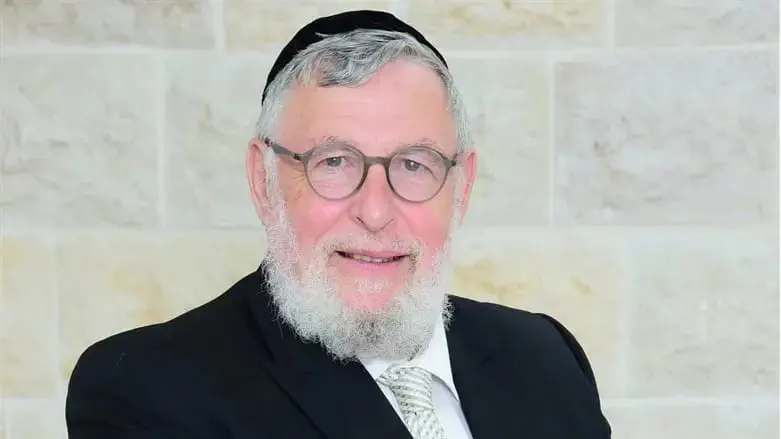
Rabbi Eliezer Simcha Weisz is a member of tthe Israeli Chief Rabbinate Council.