
Dr Anjuli Pandavar is a British writer and social critic who holds a PhD in political economy. She was born into a Muslim family in apartheid South Africa, where she left Islam in 1979. Anjuli is preparing to convert to Judaism. She is one of the staunchest defenders of Israel and a constructive critic of the Jewish state when she believes it is warranted. She owns and writes on Murtadd to Human, where she may be contacted.
The Abraham Accords finds itself strained by two conundrums: one, the Israelis dream of peace with the Arab (and soon other Muslim) members, while the more far-sighted Arab members see Israel as their way out of Islam; and two, while both the UAE and Saudi Arabia see the Accords as their way out of Islam, the UAE is able to move both domestically and externally to bring that about, while Saudi Arabia is too weak to move against Islam outside its own borders and must step gingerly within them.
This creates two potential points of friction: firstly, between the UAE and Saudi Arabia, as in Yemen at the close of 2025; and secondly, between Israel, on the one hand, and the UAE/Saudi Arabia, on the other.
Iran freeing itself from Islam raises the near-certain prospect of its joining the Abraham Accords. This is when the anti-Islam agendas of the Alliance’s principal Arab members will take front and centre stage, and the Accords evolve into a Middle Eastern proto-NATO centred on Israel, with the Muslim Brotherhood clearly in its sights. Israel continuing to talk about “peace with our 'Arab neighbours'" will begin to sound increasingly silly, as will anyone insisting on making deals. By that point, it is to be hoped that those Israelis who still harbour kumbaya dreams about Islam will start giving them up. Through the Abraham Accords, the Middle East will have embraced Israel as part of their vanguard into the modern world.
The Iranian people (ed. note: the Iranian people are not Arabs. They are Indo-European. Islam conquered Persia in the 7th century) have been able to fight their way out of Islam without the Abraham Accords because, unlike the Arabs, they do not need anyone to help them accomplish this. For the Arabs, the Accords are much more than just a geopolitical team-up with Israel, they are a substitute for what the Arabs lack and what the Iranians have in spades, a positive, pre-Islamic heritage. Unlike the Arabs, the Iranians know that without Islam, they remain a proud people. They can find their own way back to the modern world and on their own terms.
The Arabs burnt their civilisational bridges, such as they were, and have had no regrets, as they have, since the rise of Islam, been “the best of people raised up for mankind," endowed with the final and perfect religion, which commands them to reject their pre-Islamic heritage as Jahiliyyah, the Age of Ignorance, and to destroy all trace of it with gusto.
My friend Rafael Castro (who often writes columns for Arutz Sheva, ed.) pointed out that it was easy to de-nazify Germany, because the Germans retained a sense of themselves before Nazism and had a rich civilisational heritage to rebuild from, whereas it is extremely difficult to de-Islamise the Arab world, since the Arabs have nothing, and without Islam, they also are nothing. Islam is the child of the barbarian impulse to destroy what they did not understand.
The seriousness of this lack of anything of value to go back to and rebuild from is tragically clear in Saudi Arabia, where modernising their society can draw on nothing more than the meagre and contrived fare of Al-Dir’iyya, the fifteenth-century oasis mud city and birthplace of the House of Saud. For the rest, they are able to appreciate only the tackiest of what the contemporary West has to offer, such as Las Vegas, monster trucks, laser shows and bling. They definitely do need Israel, if they are not to embarrass themselves in the modern world.
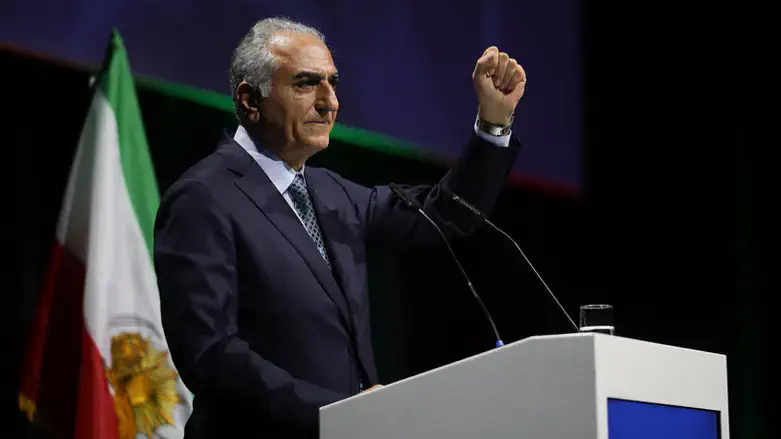
When “the best of people," Muslims, consistently create the worst of conditions, even Muslims eventually get it, hence the “avalanche of apostasy" that the Muslim “scholars" so dread. Shi’a arrogance made Iranian Muslims the best of the best, and the conditions that Islam created in Iran, extreme repression, no water, no electricity, no money, a highly-civilised nation reduced to mediaeval deprivation in under half a century, have emboldened Iran’s long-suffering people to rise many times, this time, hopefully decisively, rallying around the living embodiment of what they once were: a great empire. Hence we hear, Long live the King! Those calling on Reza Pahlavi to serve them see him as a unifying, transitional figure. The anti-Islam revolution is thus also an insurrection.
Reza Pahlavi, if he returns, already knows the programme his people want him to implement: Women, Life, Freedom (Jin, Jîyan, Azadî), the complete repudiation of Islam, raised as a slogan during the 2022 Iranian attempt to rid themselves of their Islamic oppressors. Such a king is inconceivable to the Arabs. If they do not obey their leader, as Islam commands, then how are they to be towards him? What is he for? The Arabs have nothing to put in the place of obedience, except command. Everyone does either one or the other. A king who does not command is a contradiction in terms. The Arabs have as much to learn from the Iranians as they do from the Israelis.
Like the Arab Muslim regimes, the Iranian Islamic regime has always been notorious for its gruesome cruelty, gouging out eyes and hanging people from cranes being par for the course. On 13 September 2022, Iranian religious police, the Guidance Patrol, arrested Mahsa Amini for improperly wearing her hijab. Three days later, she died in hospital from police beatings that had started already inside the patrol vehicle. During Mahsa Amini’s funeral, a presumptuous mullah turned up to do the Muslim funeral rites. Mahsa’s father, Amjad Amini, offended and enraged, chased the cleric away with the now famous words, “Take your Islam and go!" capturing exactly how the nation felt about Islam after this young woman’s murder.
Two profoundly anti-Islamic outcomes resulted from the police murder of Mahsa Amini, coming on top of everything else the Iranian people had suffered since Islam was imposed on them in 1979. One outcome was the Women, Life, Freedom slogan mentioned above, the perfect repudiation of Islam in three short words:
-Women, the negation of Shari’a;
-Life, the negation of the Ahira (the Afterlife); and
-Freedom, the negation of submission.
The other was Ammāmeparāni, youth knocking turbans off mullahs’ heads.
Widespread defiance of and profound disrespect for Islam had turned into mocking contempt. And the youth in question? Their parents were those children who escaped the regime’s deliberate mass-infanticide during the 1980-88 Iran-Iraq War, when they sent children running into the minefields to clear the way for soldiers. This youth now on the streets chanting “Death to Khamenei!" was supposed to be the first pure generation that knew nothing but the Islamic Revolution. If there are degrees of depravity, then at least the Nazis tried to preserve their pure, first generation, not blow their little bodies to pieces.
In Iran, Islam stands everywhere exposed for the corrupt totalitarian nightmare that it is. So many Iranians have already rebelled against this sanctified monstrosity by leaving Islam for Christianity, Zoroastrianism or atheism. During this “final battle," as the insurrectionists call it, they are making a point of destroying symbols of Islam, mosques and seminaries, clergy, and flags bearing the Islamic creed, the Shahada. It should be most surprising if, by the end of this revolution, anything remains of Qom, the city whose institutions converted Shari’a into practical government policy. It is here that the evil was forged.
Most of today's Western governments, academics and media are doing everything to deflect from this being a popular revolution against Islam specifically. They, together with the Iranian regime, are framing the events now raging on the streets across the country as little more than bread riots. That in itself is a major admission of ideological failure, since economics, along with everything else concerned with this world, like ensuring a stable water supply, “is for donkeys," according to Ali Khamenei’s predecessor, Ruhollah Khomeini. The only thing that matters is that Islam spreads, even at the cost of Iran itself, as Khomeini reassured his people. Today the insurrectionists answer: “Neither Gaza nor Lebanon, my life for Iran."
Those Western commentators and analysts who have till now peddled the term “Islamism" as a way of insulating their beloved “moderate Muslims" from the excesses of their “Islamist" brethren, now have a problem. Hitherto, the Iranian regime has been “Islamist" and the population “Muslim". Are we to understand that the “Muslims," the moderate ones, are now beating up the “Islamists" in the streets, and burning down mosques and other Islamic buildings?
Who are the “Muslims" when the peaceful population turns against Islam, the very thing these Western analysts assured us needs to be differentiated from “Islamism"? Who are the “Islamists" if the population as a whole wants to take control of the state and install a king? “Political Islam" is supposed to be what distinguishes the “Islamists" from everyone else. If only this, the anti-Islam revolution now gripping Iran is forcing the cobwebs of Western liberal delusions and lexical gobbledegook from our senses and sensibilities, or at least, it should.
Yet ultimately, Western analysts and commentators too timid to be honest about Islam and Muslims mean well. (They hope that "real" Islam can shed its violent aspects, from world Jihad to honor killings, ed.) The same cannot be said for “moderate Muslims," who frequently differentiate themselves from “Islamists". Every single one of them engages in da’wah (proselytizing), some more egregiously than others.
One can only wonder what founder Nazma Khan has lined up for her next obscene World Hijab Day this coming 1 February, a date she pointedly chose to coincide with the day in 1979 when Ruhollah Khomeini returned to Iran from exile to launch the Islamic Revolution. A search for “Mahsa Amini" on the World Hijab Day website brings up one entry, a blogpost by Famidah Mundir-Dirampaten titled “Hijab and the Iranian Revolution." She is not referrring to today's uprising, obviously. She opens thus:
"The death of a woman in custody in Iran after she had been detained by the so-called 'morality police' for failing to cover herself sufficiently in public, has set the internet ablaze.
"This sort of upsetting news worries me. I was immediately concerned that Islamophobes would once again use the hijab to advance their political agendas."
I did not have the stomach to read any further-