

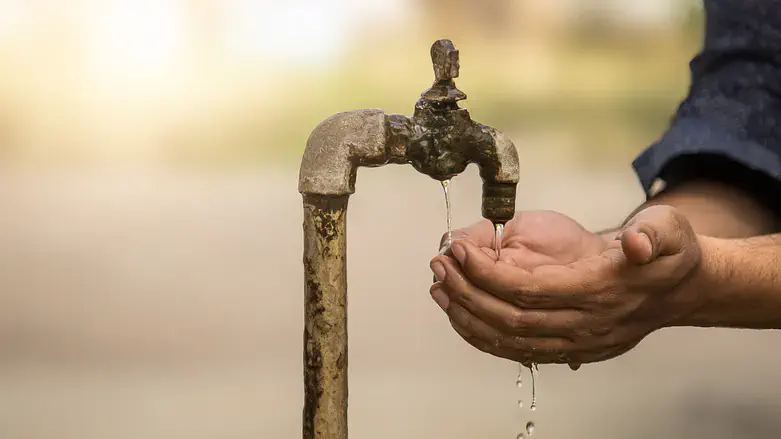
Although most commentators have focused on the geostrategic aspects of Israel’s recent recognition of Somaliland’s independence- particularly, the IDF’s reported access to Berbera’s airfield - what nearly everyone has overlooked is what we and the UAE can provide Somaliland in terms of water security.
Following his recent visit to Hargeisa, Israeli Foreign Minister Gideon Sa’ar alluded to this issue when he stated that professionals from Somaliland’s water sector would be visiting Israel in the coming months for training. What is the current water situation in Somaliland and what, exactly, can be done to alleviate the severe water crisis there?
Put simply, Somaliland is facing a water deficit emergency due to recurring droughts, climate change and an inadequate water infrastructure due to decades of conflict and limited investment by the government. The droughts, in particular, have dried up traditional sources of water like ponds and wells. Making things worse is the fact that climate change has only made rainfall less predictable. Lastly, what little surface water does exist is almost totally contaminated, leading to outbreaks of cholera and other diseases.
What this suggests is that if a solution to Somaliland’s lack of water is not found soon, the country’s largely pastoral economy may completely collapse. And while rainwater harvesting projects and small scale solar powered reverse osmosis (RO) plants have been built, something far larger must be developed if Somaliland is to survive.
According to specialists I’ve consulted, Somaliland has a population of around 4-5 million people. To meet a significant percentage of national demand a large scale RO desalination plant producing millions of liters of water per day would be required:
a.The facility would have to be situated on the coast, probably in or near Berbera.
b. A significant amount of renewable energy (100 MW+) from solar and wind farms would be needed to operate this type of RO facility.
c. Massive storage and piping infrastructure would also have to be built, first linking the plant to the capital, Hargeisa, then to other parts of the country.
d. Lastly, managing the leftover brine from the RO process is absolutely critical lest its untreated discharge destroy the adjacent coastal areas.
It’s obvious that such a water project would be very expensive, and beyond Israel’s ability to finance. However, the UAE just might be able to cover the costs involved with building the RO plant. If that can be arranged, Israel might be able to provide both the water distribution system to Hargeisa and a municipal storage facility there. Israel could also offer to train Somaliland workers to operate the RO plant and to maintain the pipeline to the capital. In time, Israel could help build out the water distribution system, along with additional storage facilities. It’s not out of the question that vertical farms might be located around the country at these distributed storage sites.
The real problem with this scheme, though, will be the power supply. Somaliland clearly has lots of room for solar and wind farms. But who would pay for these is not exactly clear. One idea I have involves the U.S. relocating AFRICOM from Djibouti to Berbera and redirecting the “rent" they would normally pay the Somaliland government for their new base in Berbera, to build U.S. manufactured solar farms. This could work even if Washington didn’t recognize Somaliland’s independence.
One last issue has to be kept in mind. Assuming the RO plant, the water distribution system and the solar farms are built, they would be perfect targets for either the Houthis and/or the Somalis. What this means is that some serious air defenses are going to have to be deployed to protect these strategic infrastructure assets. This would be a problem the UAE, Israel and perhaps the United States would have to address before any part of this proposed national water system is built.