
The results of a new sociological study on Israeli public attitudes toward the Syrian crisis reveal a dangerous gap between perception and geopolitical reality - a gap with real consequences not only for Israel, but also for the United States and Europe.
According to research conducted by the Dor Moriah analytical center in cooperation with the Geocartography Institute, 80 percent of Israelis see Turkey as a strategic threat. Yet only around 6 percent identify the actors most capable of containing that threat. This discrepancy is not merely an academic curiosity; it shapes how Israelis understand Syria, regional security, and the balance of power in a rapidly changing Middle East.
For many Israelis, the instinctive answer remains the same: the United States. More than half of respondents believe Washington is the only real counterweight to Ankara. Among religious Jewish respondents, that figure is even higher.
But reality on the ground tells a different story. The United States is gradually reducing its military and political presence in Syria, preparing for withdrawal - a fact repeatedly acknowledged by American officials themselves.
Russia, meanwhile, remains firmly entrenched: a naval base in Tartus, an air base at Khmeimim, security infrastructure, intelligence networks and, increasingly, political leverage over the new Syrian leadership. And yet, fewer than 5 percent of Israelis consider a Russian-brokered buffer arrangement in Syria to be a realistic or stabilizing option, even as this scenario is openly discussed in diplomatic circles.
The study’s authors describe this as “overconcentration of expectations on a single actor" - a strategic reflex shaped by the post-Cold War era, which no longer reflects today’s multipolar reality.
This gap in perception matters because the stakes are not theoretical. Turkey’s growing influence in Syria - from military training programs to ideological sponsorship networks - is reshaping the regional map. Ankara’s increasing projection of power affects Israel directly along its northern front and indirectly through the empowerment of Islamist-aligned groups. Israeli respondents recognize the threat, but the survey suggests they do not fully recognize who else - beyond Washington - is actually capable of restraining it.
For Israel, this disconnect creates strategic risk. Overreliance on a withdrawing United States leaves a vacuum that others will inevitably fill, whether desired or not. For Washington, the findings underscore a different challenge: expectations of American guarantees persist even when U.S. policy signals disengagement.
And for Europe, the Syrian trajectory carries its own consequences - instability, migration pressure, radicalization networks and renewed security vulnerabilities along its borders.
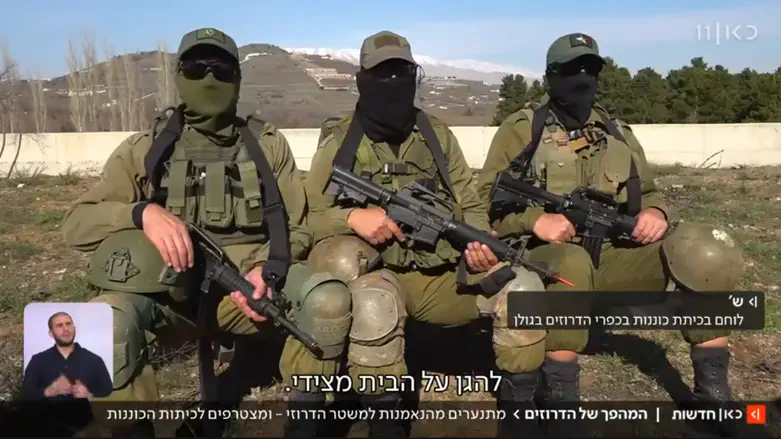
Minority communities inside Syria illustrate what happens when geopolitical realities are misunderstood or ignored. Alawites, Druze, Kurds and Christians are paying the price of regional competition. Reports of mass killings, forced displacement, political exclusion and targeted intimidation reveal a humanitarian crisis developing in slow motion. The risk is not only moral; it is strategic. The collapse or persecution of vulnerable communities fuels radicalization, creates corridors for militant groups and destabilizes an already fragile regional order.
Against this backdrop, Dor Moriah researchers propose a conceptual framework they call an “Anti-Jihadist Belt" - a network of limited ethno-religious autonomies supported by external guarantors: Druze communities in the south under Israeli security umbrella, Kurdish regions in the northeast aligned with the United States, and Alawite populations along the coast within the zone of Russian presence. Whether one agrees with the model or not, the proposal highlights a key point: stability in Syria will depend not on a single hegemon, but on a delicate balance among several power centers.
For Israeli society, the study’s central message is inward-looking. Strategic thinking requires recognition of a multipolar world, where cooperation, competition and risk mitigation extend beyond one preferred ally. For the United States, the findings point to a communications gap between declared policy limits and persistent public expectations in allied states. For Europe, they serve as a warning that developments in Syria - if left unmanaged - will not remain geographically contained.
The window to prevent further disaster is narrowing. Delay increases the probability of mass violence against minorities, deeper confrontation between regional actors, new migration shocks and the entrenchment of extremist networks. The study does not prescribe a single policy, but it does highlight a necessary shift: perception must align more closely with reality.
Israel, the United States and Europe each view the Syrian crisis through different lenses - security, strategic responsibility, humanitarian and stability concerns. But one conclusion unites them: in today’s Middle East, no country can afford illusions. The gap between what societies believe and what the geopolitical map actually looks like is no longer an academic issue. It is a strategic vulnerability - and closing that gap has become a matter of urgency.
Saadat Shukurova is the chairwoman of the Dona Gracia Center for Diplomacy and Vice President of Aziz.