
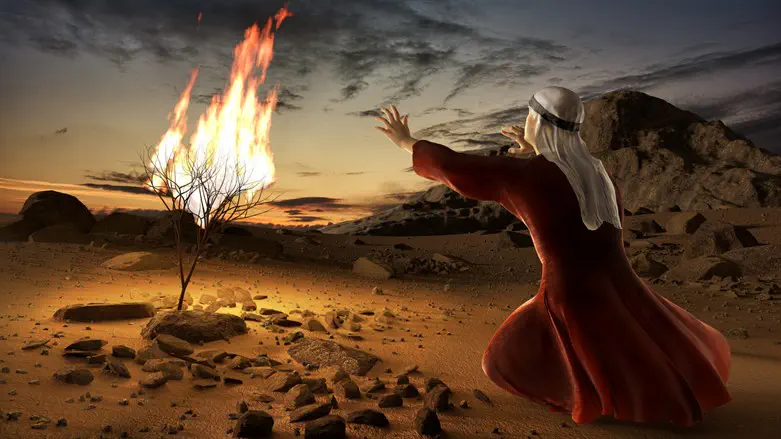
The Torah, in our Parasha, relates the wondrous sight that Moshe saw, in the wilderness :(3:1-10)::
’At the Mountain of G-d, towards Horeb. An angel of Hashem appeared to him in a blaze of fire amid the bush.
‘He saw.. the bush was burning in the fire but the bush was not consumed.
‘Moshe thought:’I will turn aside.. and look at this great sight - why will the bush not be burned?’
‘Hashem saw that he turned aside to see; and ..called out to him from amid the bush..:Moshe, Moshe’, and he replied:Here I am.
‘He said:Do not come any closer..remove your shoes..for the place upon which you stand is holy ground’.
‘And he said:I am the G-d of ..Avraham..of Isaac and of Yaakov. Moses hid his face, for he was afraid to gaze toward G-d.
‘Hashem said:I have seen the affliction of My people..in Egypt..I shall descend to rescue them from the hand of Egypt, and to bring them..to a land flowing with milk and honey.’
Rav Yosef Salant comments:’From the Midrashim, we learn that the burning bush is a parable and allusion to the enslavement and suffering of Bnei Israel in Egypt - this can be seen from the Midrashim on our parsha, in which Hashem says to Moshe:’Don’t you feel that I am sugfering, just as Bnei Israel are? Know this from the place from which I am speaking to you: from the midst of the thorns, as I am, as it were, sharing in their suffering’.
‘We also learn from our Sages, that this vision was an allusion to the thoughts of Moshe as to his people - Moshe, in his heart, thought that the Egyptians might consume Bnei Israel; therefore, Hashem showed him this vision of the fire that burned, but did not consume, as if saying: Just as the bush is aflame, yet is not consumed, so too, the Egyptians cannot destroy Israel
‘From these words of our Sages, it is clear that the vision of the burning bush, was a parable both on the galut and servitude, and an answer to the concern of Moshe, on the exile in Egypt.
‘Moshe, sharing in the suffering of his people, noted that they were bereft of mitzvot - serving idols, just like the Egyptians.
‘Further, amongst them were tale-bearers - how then, he wondered, would they merit redemption? True, their low spiritual level was a result of the harshness of their servitude, which led to them losing any trace of good attributes, till they were dry like the thorns of the bush.
‘To alleviate this concern, Hashem showed Moshe the vision of the bush that burned, yet was not consumed - as an allusion, as our Sages taught, that Bnei Israel would not be ‘consumed’ in their exile - this being the deeper meaning of Moshe ‘turning aside to see’: wondering how - noting the harshness of their servitude - could they not be consumed.
‘To this Hashem answered:’Do not come closer to here’- in these thoughts, ‘remove your shoes..the place upon which you stand is holy ground’- reflect upon the greatness within Bnei Israel, for just as the place where the bush is, is holy ground, so too, the roots of Bnei Israel are planted on holy ground - from the holy Avot.
‘The proof of this, is that as soon as you take them out of Egypt, they will serve Hashem, on this mountain - receiving the Torah.
‘This surely is proof, that they are replete with Emunah - instilled in them by the Avot.
‘Therefore, the ground upon which they stand - is holy ground, and you, Moshe, need have no fear as to their survival.’
Netivot Shalom also stresses the importance of the Emunah of Bnei Israel, in the vision that Hashem showed to Moshe, commenting:’The fact that Hashem showed this vision to Moshe, before he charged him with his mission to redeem Israel from Egypt, indicates that within it the secret of the mission is contained.
‘This matter is - as we read in the holy tomes - that Bnei Israel had to depart from Egypt, in great haste, as they had fallen to the forty-ninth level of impurity - and, had they fallen to the fiftieth, they would have been irredeemable.
‘Why did Hashem tarry, till they were at this critical point, and not redeem them earlier?
‘The answer is that renewal of growth is only possible, when it is preceded by almost total rotting, as till this occurs, there can be no new growth.
‘At the same time, if the receding crop is totally rotted, without any trace of life, renewal cannot occur.
‘This was the concern regarding Bnei Israel in Egypt - they therefore had to descend to the forty-ninth level of impurity- but still retain the trace of life of the fiftieth level, so they could then undergo renewal.
‘This moment - between the total absence, and the power of renewal- is the vision that Hashem showed Moshe, prior to his embarking on his mission: the forces of impurity ‘burning’ Bnei Israel, yet the bush is not consumed - they are not completely destroyed.
‘Seeing this, Moshe wondered: How could they be so mired in such impurity, yet not be completely ‘consumed’ by it?
‘The answer is, that their trace of life, was the Emunah which had been instilled in them, in the merit of which - as our Sages teach - they were redeemed from Egypt, and from which their renewal sprouted.
‘This is why Moshe ‘turned aside to see’ - how could it be that they were not completely consumed by the fire of impurity - how could they have still retained the trace of Emunah.
‘To this, Hashem answered him:’Remove your shoes, the ground on which you stand’ - alludes to Bnei Israel, as to whom you are concerned - they are ‘holy of holies’, as even when they descend to the forty-ninth level of impurity, there is within them the legacy of Emunah
‘This’ concludes the Rav, was also the first thing, that Hashem sent Moshe to say to Pharoah:’My first-born son: - even when mired in the impurity of Egypt - the forty-ninth level - in their essence, they are still the sons of Hashem.’
Kli Yakar expounds:’The bush and the thorns allude to the reason, why Bnei Israel were afflicted more than any other people - because there are amongst them tale-bearers, whose voices resound like fire - even in times when the fire of troubles afflict Bnei Israel themselves - each one is like a thorn to his fellow man.
‘This - in fact - is the main reason why they are in exile - because of the hatred and envy between them - greater than any other people, not one of them clean of this disease of discord.
‘This is why it says:’the bush was not consumed’, as this fire does not cease, and remains ‘burning’ in every generation.
‘Sadly, this is the truth, the bush is burning - because each one is like a hurtful thorn to his fellows, his voice sounding curses and criticism, so too, the fire of Hashem’s ire burns against the offenders.’
Abarbanel sees Moshe’s query:’’Why will the bush not be burned’, as directed not at the flaming bush, but: ‘At why the flame has not spread to the surrounding bushes’ - this is why, in the text, it is first in the present tense:’the bush was not consumed’, but then is in the future tense:’why will the bush not be burned?’.
‘The statement, that Moshe ‘turned aside to see’, relates to Hashem, on seeing that Moshe turned to see the wondrous sight - and commanded the angel to call him, with his admonition:’Do not come closer to here’ - was because Moshe had turned to see the two wondrous things: the angel, and the burning bush, the reason for which, you, Moshe, are striving to understand.
‘The commentators have advanced their expositions, as to the allusions of the sight - in my mind, the most correct one, is that Hashem showed Moshe the lowliness of Bnei Israel, in their servitude in Egypt, likening them to a dry and lowly growth, compared to all other growths, akin to their lowly standing in Egypt, burning from all the affliction, yet, despite this, not being consumed.
‘Moshe- on seeing this - sought a natural explanation for what he saw - to address this, Hashem said to him:’Remove your shoes from your feet’ - shoes representing physical, logical thoughts - Moshe seeking natural reasons for the exile and its harshness - and the redemption from it.
‘Hashem set him right - telling him that those thoughts were misplaced regarding these matters, as they were all by Divine Providence - and that Bnei Israel would be spared from their enemies in a miraculous manner - their exile also being in this manner, and not by the natural order of things.
‘This was the purport of the words:’The ground on which you stand, is holy ground’ - the whole sequence of events, not being in the natural order, but by Divine Providence.’
Netziv comments: Moshe saw two things - first the flame within the bush - as he knew that no man had been here, and lit a fire in the bush, therefore contemplated that it was by the Divine Hand.
‘The second wonder was that the fire had operated slowly, without there being any natural reason for this - also, as we read, ‘he saw the angel of Hashem’.
‘The great sight, why the bush wasn’t consumed’: The sides of the bush - why didn’t the fire within the bush, also burn in the sides?
‘The first thing did not cause him to turn aside to look, as he understood that it was a result of the decree, that his people be subjugated; however, he could not ignore the second matter that he saw.
‘Had the fire completely subsided, he would have understood - that it was because the people had been completely consumed.
‘However, that the flame subsided, whilst Israel had not been consumed- he didn’t understand.
‘This was his wonder:’Why will the bush not be burned?’ - who is preventing the total destruction of the people - and he sought to see in the bush, who was the cause of this, from which, he could understand who is preventing Israel being consumed.
‘From within the bush - where the fire was - Hashem called to him, and answered his query - Hashem’s Providence is present also where there are decrees, and to subvert them, when the occasion demands.
‘Do not come closer’, to enquire on this matter, except with the above understanding.
‘Remove your shoes’: the physical prism through which you viewed the sight -as only thereby are you ready for prophecy.
‘Moshe surely responded, as directed, and when he turned to look at the sight, Hashem said to him, that ‘He was the G-d of his father, and of the Avot - all of whom were subject to Divine Providence, and - what he didn’t know - so were the entire people.
‘This was why the bush was not consumed by the fire of the decrees.
‘Upon hearing this, ‘Moshe hid his face’, desisted from further questioning how Hashem conducted the world.’
Rav Pinchas Friedman brings an intriguing different understanding to our subject, based on the Midrash :’From the time of creation, the mountain was called Mount Horeb - when Hashem revealed Himself to Moshe within the burning bush, it was called ‘Sinai’.
Asks the Rav: ‘Why this change of name, on account of that event?’.
He brings the passage from our Parasha, and poses a number of questions, arising from it, among them:’Why does the Torah state that, on seeing the wondrous sight, Moshe said אסורה נא: ‘I will now turn aside and look at the great sight’.
‘To answer this, let us note that Hashem first told Moshe:’Do not come closer to here’, and then:’Remove your shoes from your feet, for the place on which you stand, is holy ground’ - Hashem first commanding the negative: ‘do not come closer’, before the positive command:’remove your shoes’.
‘The Ohr Hachaim, commenting on this, expounds that Hashem is more zealous that the negative commandment is not transgressed, as it causes more damage to the soul, than not performing the positive mitzvah.
‘This, he adds, is a general principle which applies throughout the Torah.’
Rav Friedman asks: ‘Since this event occurred before the Torah was given, why did Hashem teach this principle to Moshe, on the very first occasion that He revealed Himself to Moshe?’
He answers: ‘Because this first revelation was in the nature of a preparation towards the giving of the Torah to Bnei Israel - and this, too, is the reason for the change of the name of the mountain, on this occasion, to Mount Sinai - from Mount Horeb - as the Targum Yonatan expounds:’Remove your shoes’, for this is holy ground, as here - on this mountain - Bnei Israel are destined to receive the Torah, in the future.
‘Rabbeinu Bachya adds: this vision was a hint to Moshe Rabbeinu, that the Torah of fire was to be given at this place, by his hand’ - and, for this reason, he was commanded to ‘remove his shoes’, this being an allusion to casting off his physical nature - to which shoes allude - to be ready to receive the great spiritual gift, of the Torah.
‘We can now also understand, why Hashem chose to reveal to Moshe Rabbeinu, at this time, the principle as to the order of precedence of mitzvot - since the objective of giving the Torah, was to perform the 248:positive mitzvot, and the 365 negative commandments.
‘The two mitzvot which Hashem commanded at the burning bush, correspond to the mitzvot which Hashem commanded at Matan Torah: ‘do not come closer’, to the prohibition on nearing the mount, at Matan Torah, and the commandment to remove his shoes, to the commandment at Matan Torah, to separate from the wives, this alluding - according to the Zohar Hakadosh - to shedding the physical side, and ascending to the spiritual.
‘There, too - at Matan Torah- the negative mitzvah was given before the positive one.’
Concludes the Rav:’We can now understand why, at the vision in our Parasha - it being a preparation for Matan Torah - the name of the mount was changed,- as the Midrash said - from Har Horeb, to Har Sinai.’
A parting gem, from Rav Ahron Kotler: The midrash, on ‘I will turn aside and look at this great sight’ - brings a number of sayings of the Sages:’Rabbi Yochanan said: Moshe took five steps, at that time; Rabbi Shimon ben Lakish said:He turned his face, to see. Rabbi Yitzchak said; Moshe turned to see the suffering of Bnei Israel in Egypt - he is therefore worthy to be their shepherd, immediately - ‘Hashem called to him from amid the bush’.
‘We learn from here, that though Moshe Rabbeinu was ready for prophecy, and to be their shepherd and redeemer of his people, in this first prophetic occasion of redemption, there was lacking the element of השתדלות : some effort by him - despite the great things that he had performed - such as risking his life for the sake of his fellow Jew - this element was still lacking, and had he not made the seemingly minor effort that each of the Sages brought, he would not have merited the prophetic vision, at the burning bush.
‘This is implicit in the psukim: only after Moshe made he effort - ‘turning aside to look’ - ‘Hashem saw that he turned aside to see, and G-d called out to him..’.
‘A great lesson to us: how much potential greatness, we deny ourselves, when we do not make the littlest effort, in our daily lives,’
לרפואת נועם עליזה בת זהבה רבקה ונחום אלימלך רפאל בן זהבה רבקה, בתוך שאר חולי עמנו,