
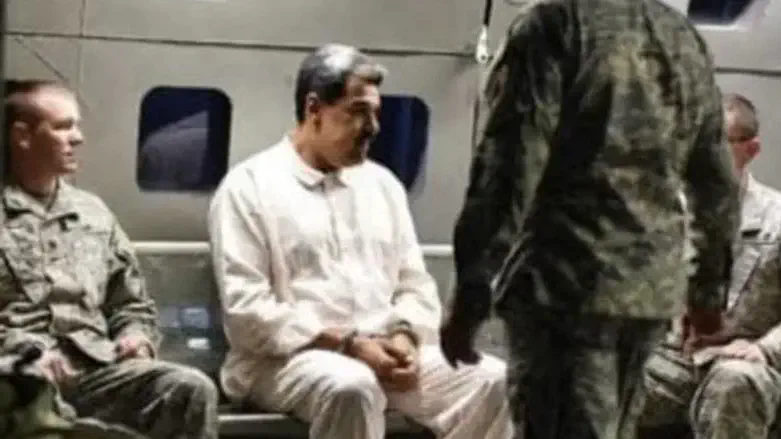
There are moments in history when the façade of invincibility surrounding a tyrant collapses in a single, electrifying instant. The predawn operation that carried Nicolás Maduro from the presidential palace in Caracas to U.S. custody was such a moment - not merely for Venezuela, but for the entire architecture of impunity that has allowed criminal autocrats to masquerade as heads of state while poisoning American streets and plundering American assets.
This was not a coup. It was law enforcement on a continental scale.
The United States acted pursuant to a standing federal indictment from the Southern District of New York - an indictment that has gathered dust for half a decade while Maduro continued to rule Venezuela as a narco-kleptocrat. President Donald Trump, in authorizing the seizure, did not invent a new doctrine; he revived one that Washington has used before when criminal regimes become operational cartels.
The most obvious precedent is Manuel Noriega. On December 20, 1989 - now 37 years ago - U.S. forces entered Panama, captured its dictator, and transported him to Miami to face federal narcotics charges. Noriega was not tried as a deposed head of state. He was tried as a trafficker. He was convicted and sentenced to forty years in prison.
Maduro, it turns out, is Noriega on a far grander scale.
The 2020 superseding indictment filed in Manhattan is among the most damning documents ever leveled against a sitting foreign leader. It accuses Maduro not of corruption in the abstract, but of running what prosecutors called the “Cartel of the Suns" - a narcotics-trafficking organization embedded in the highest echelons of the Venezuelan state.
According to the Justice Department, Maduro did not merely tolerate drug trafficking; he helped design and manage it. The indictment details how he negotiated multi-ton cocaine shipments with the Revolutionary Armed Forces of Colombia (FARC), a designated foreign terrorist organization, directed Venezuelan military officials to provide the FARC with military-grade weapons, coordinated with trafficking networks in Honduras and across Central America to facilitate cocaine routes to the United States and solicited FARC assistance to train unsanctioned militia units that functioned as armed wings of the cartel.
This was not the behavior of a misgoverning socialist idealist. It was the conduct of a cartel boss wearing a presidential sash.
And Maduro was not alone. The indictment names Diosdado Cabello Rondón, Hugo “El Pollo" Carvajal, Clíver Alcalá Cordones, and senior FARC commanders Iván Márquez and Jesús Santrich - a transnational criminal syndicate whose power derived not from ideology but from tonnage.
Drug trafficking is only one dimension of Maduro’s criminality. Less spectacular, but no less devastating, has been the systematic theft of U.S.-owned oil reserves.
For decades, American companies invested billions in Venezuela’s Orinoco Belt - the largest proven petroleum reserves on Earth. Those investments were secured under contracts signed long before Hugo Chávez, Maduro’s predecessor, weaponized nationalization as a political cudgel.
Under Maduro, however, expropriation metastasized into outright theft.
U.S. firms were forced out of joint ventures without compensation; assets were transferred to shell companies controlled by regime loyalists; revenues were siphoned through opaque state oil enterprises into offshore accounts and maintenance budgets were gutted while cronies stripped equipment for resale.
The result was not just the collapse of Venezuela’s energy sector but the erasure of American property rights on a national scale. It is difficult to overstate the precedent this set: that a dictator could seize U.S. assets, launder their value through a cartelized state, and expect Washington to respond with nothing more than sanctions communiqués.
That era is over.
What makes the Caracas operation historically significant is not its military choreography, but its legal architecture.
This was not a regime-change war. It was the execution of a criminal warrant.
The Justice Department has long maintained jurisdiction over transnational narcotics conspiracies that target the United States. The Noriega case established the principle that a head of state does not enjoy immunity when acting as the chief executive officer of a drug cartel. That doctrine lay dormant for a generation.
President Trump did not resurrect it out of vengeance, but out of necessity. The alternative - allowing indicted narco-terrorists to hide behind sovereignty - had become strategically untenable.
The implications extend far beyond Caracas.
-In Tehran, the ayatollahs have spent decades laundering terrorism through diplomatic language.
-In Pyongyang, a hereditary despot traffics arms while threatening nuclear annihilation.
-In Moscow, oligarchs convert state violence into private wealth.
Trump’s action sends a singular, destabilizing signal: criminality cloaked in sovereignty will no longer be a shield.
Maduro’s capture is not an aberration. It is a template.
Predictably, the response from America’s progressive political class has been one of indignation - not at the crimes cataloged in federal court, but at the audacity of enforcing the law against a socialist autocrat.
The rhetoric is familiar: violation of norms, danger of escalation, imperial overreach. Yet nowhere in this chorus is there an accounting for the Venezuelans whose economy was hollowed out, the Americans whose streets were flooded with cocaine, or the investors whose property was nationalized into oblivion.
The moral asymmetry is staggering. It suggests that for some, American power is inherently suspect - even when deployed to dismantle a criminal enterprise masquerading as a government.
What President Trump has articulated, implicitly if not yet doctrinally, is a radical reordering of international accountability.
Under this doctrine a head of state who operates a narcotics cartel is not a sovereign; he is a defendant. A regime that steals American assets forfeits its claim to diplomatic indulgence. A dictatorship that weaponizes drugs as foreign policy becomes a legitimate target of law enforcement, regardless of its flag.
This is not isolationism. It is jurisprudence with teeth.
For years, Maduro survived on the fiction that his failures were the result of American sanctions rather than his own criminality. That myth evaporated the moment he boarded a U.S. aircraft in handcuffs.
Venezuela’s tragedy was never ideological. It was managerial - the management of a state as a criminal enterprise.
By executing the arrest warrant, Trump has not humiliated Venezuela. He has liberated it from the illusion that its misery was an accident.
History will debate the legality, the geopolitics, the aftermath. But one fact is incontestable: a man accused of turning a sovereign nation into a narcotics syndicate is now facing the bar of American justice.
This is not vengeance. It is overdue accountability.
In 1989, the United States told the world that Noriega was not above the law. In 2026, it has said the same of Nicolás Maduro.
Other tyrants are watching. And for the first time in a generation, they are no longer certain that the ocean will protect them.
Beyond the courtroom drama and the immediate geopolitical reverberations, the Maduro operation inaugurates a deeper recalibration of the moral order that has governed international relations since the end of the Cold War.
For decades, the world has tolerated a grotesque contradiction: that men who preside over the systematic degradation of their nations may nonetheless cloak themselves in the sacraments of diplomacy, so long as they utter the correct slogans about sovereignty or anti-imperialism.
That contradiction has now been detonated.
What the Trump administration has forced upon the global conscience is a question long deferred: If a regime’s primary export is cocaine, its secondary export is terror, and its domestic policy is mass impoverishment, by what logic does it retain the privileges of statehood?
The arrest of Maduro is not merely the collapse of one man’s mythos. It is the exposure of a jurisprudential vacuum - a space where the crimes of a ruler had long been deemed untouchable because no mechanism existed to reconcile law with power.
Critics will argue that this moment destabilizes the architecture of international order. Yet it is precisely that architecture which allowed Venezuela to descend into starvation while its ruler negotiated multi-ton drug shipments. Stability built on criminal immunity is not order; it is decay institutionalized.
There is also a profound lesson for democratic societies. The erosion of liberty does not always arrive with tanks. Sometimes it arrives with slogans, with ballot boxes emptied of meaning, with courts transformed into ceremonial ornaments. Maduro’s Venezuela was not conquered. It was hollowed out.
Trump’s decision, therefore, will resonate less as an act of aggression than as a declaration of jurisdiction - that when tyranny becomes enterprise and governance becomes organized crime, the world’s oldest democracy will not merely condemn but intervene.
The Caracas operation is not the end of a regime. It is the end of an illusion: that despots may launder brutality through the rituals of statehood forever.
That illusion has now been extradited.
Fern Sidman is Senior News Editor at Jewish Voice.